OKX
OKX is one of the 3 largest crypto exchanges in the world. Its most active traders go elsewhere to decide what to trade.
I was brought in as a day trader turned designer to lead design strategy for OKX's advanced trading initiatives — across 6 projects, fo4r squads, and 3 pillars: expanding the market, revamping the core engine, and building leverage through AI.
MY ROLE
TIMELINE
2025 Q3 - Current
$208M/yr opportunity unlocked through the Simple Perps business case
4 markets shipped on one architectural pattern — no regional forks
6 intelligence pillars defined as OKX's reference AI model
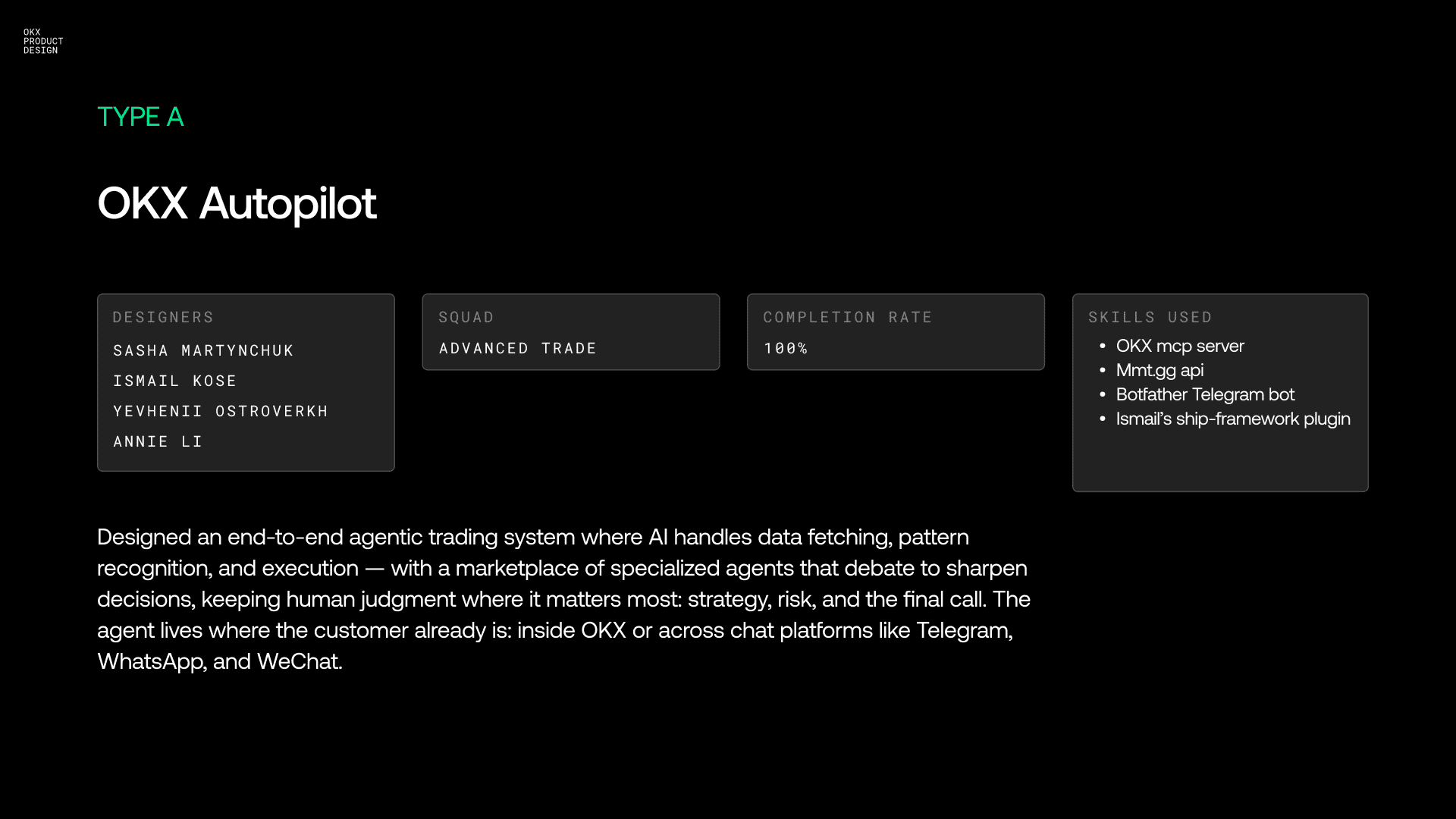
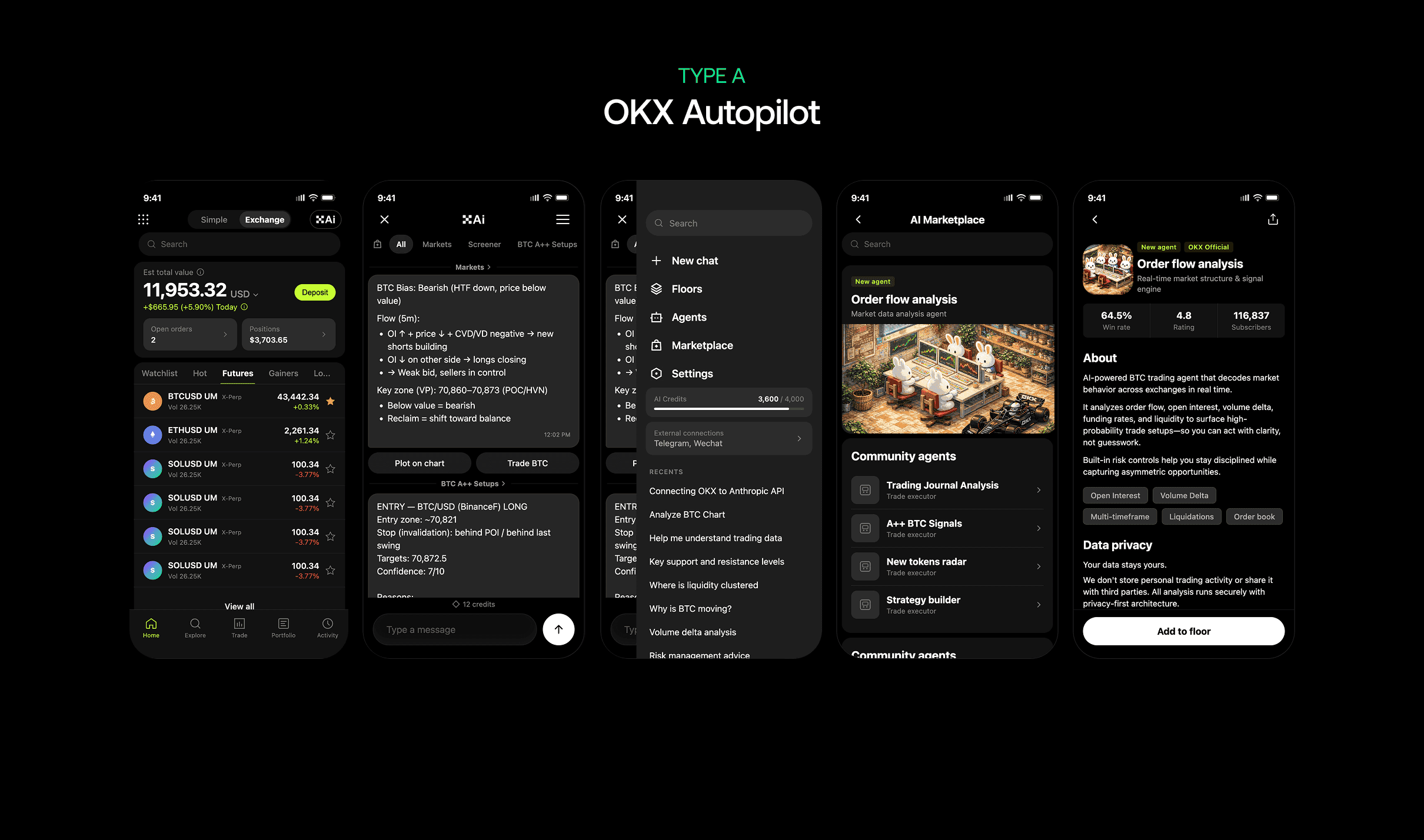
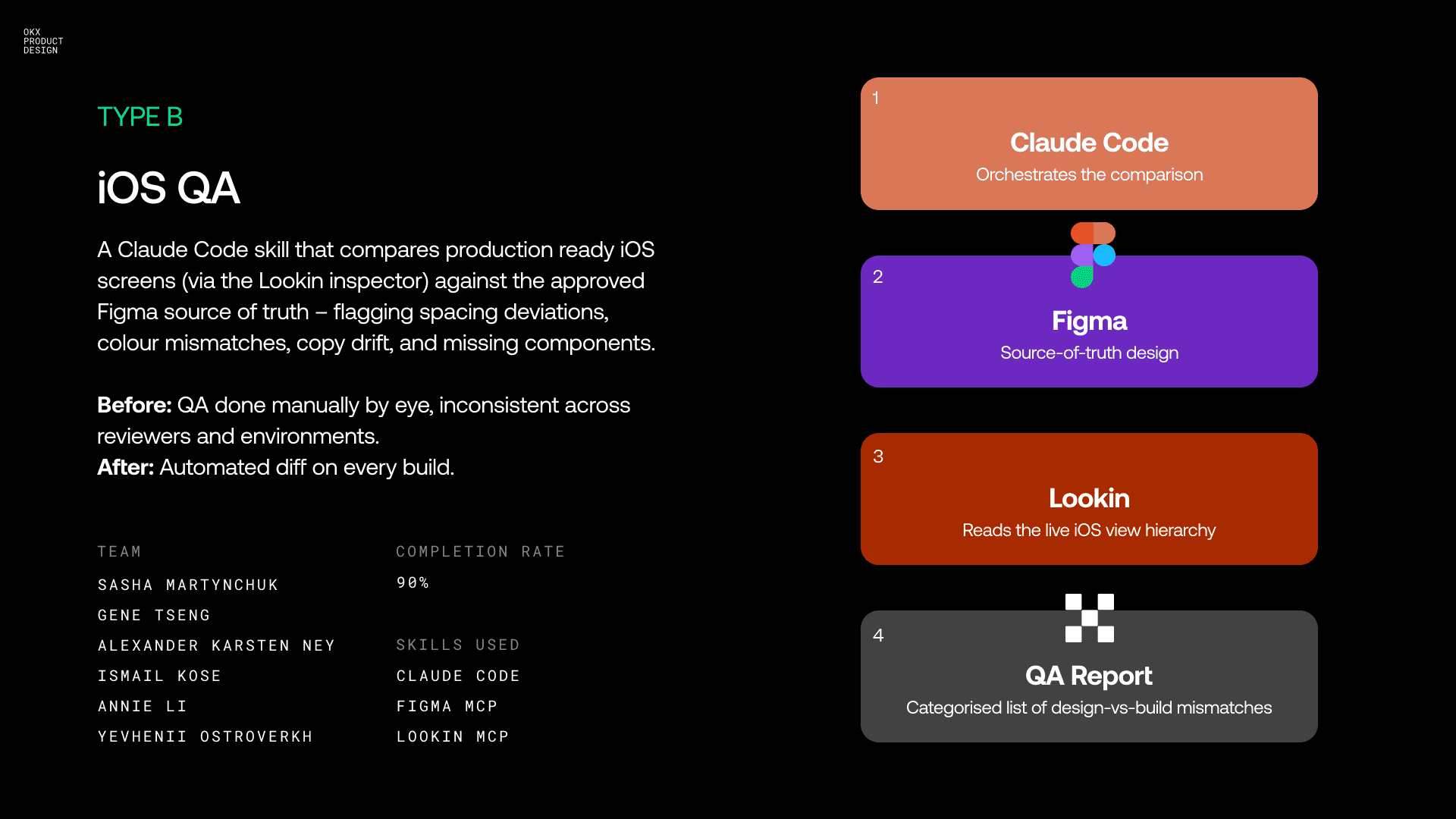
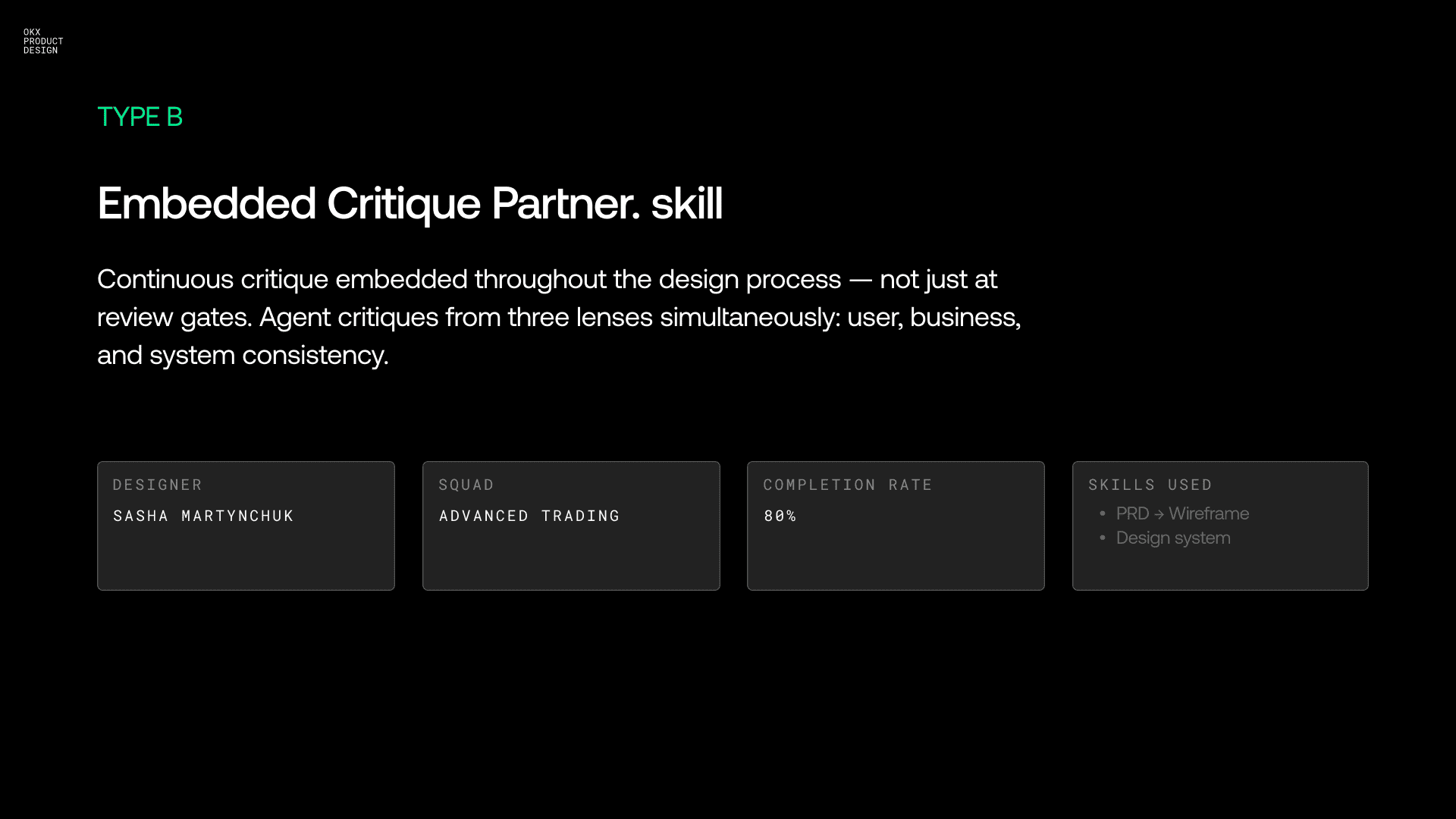
4 Claude Skills shipped across customer surfaces and internal design ops
3,100 tickets, 22 pain points addressed in one coordinated mobile release
PROJECT 1
Trade page revamp
Problem
Crypto trading has evolved. Trading platforms largely have not. Over the past few years, tradershave become faster, more data-driven, and more sophisticated. Their workflows now rely onreal-time market structure, order flow, derivatives data, and context far beyond basic charts and
order books. Yet most exchanges - including OKX today - still offer experiences designed for an earlier generation of traders.
As a result, active traders operate in a fragmented setup. They analyze markets in one place, monitor structure and sentiment in another, and execute trades somewhere else - even when much of the underlying data already exists inside OK.
As a result, active traders operate in a fragmented setup. They analyze markets in one place, monitor structure and sentiment in another, and execute trades somewhere else - even when much of the underlying data already exists inside OKX.
In practice, this means:
Charting & technical analysis: TradingView
Order flow: TradingLite, Exocharts, Quantower, MarketMonkey, TapeSurf
Liquidity & heatmaps: TradingLite, KingFisher, Hyblock, Kiyotaka
Derivatives data: Coinglass, Coinalyze, CryptoQuant
Options flow: Unusual Whales, Greeks.live, SpotGamma
Work
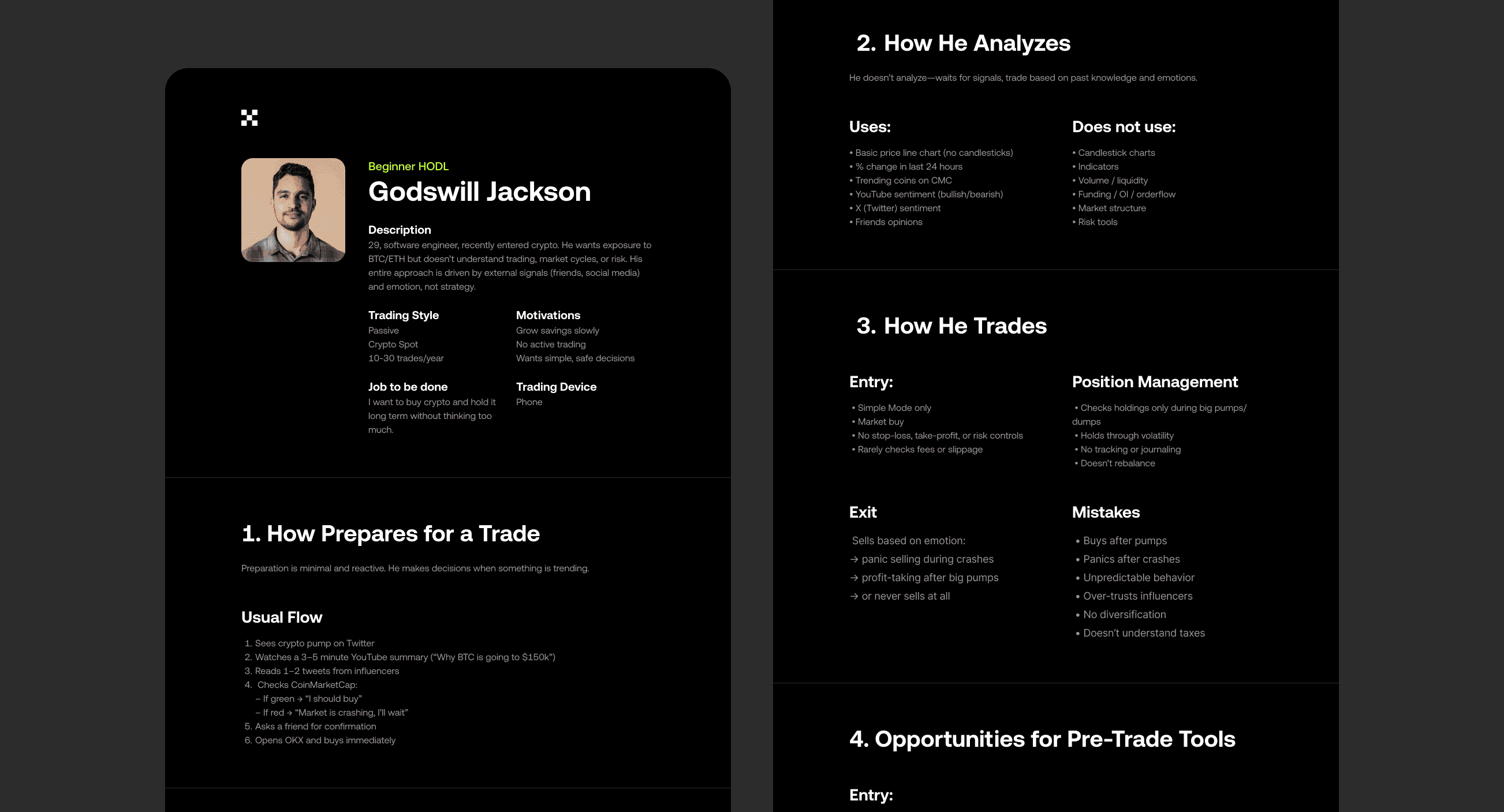
After 15 user interviews with VIP and high-frequency traders and a competitive teardown vs Binance, Bybit, Bitget, TradingLite, Coinglass, Bookmap – I shipped a prioritized friction list and a scoped vision document.
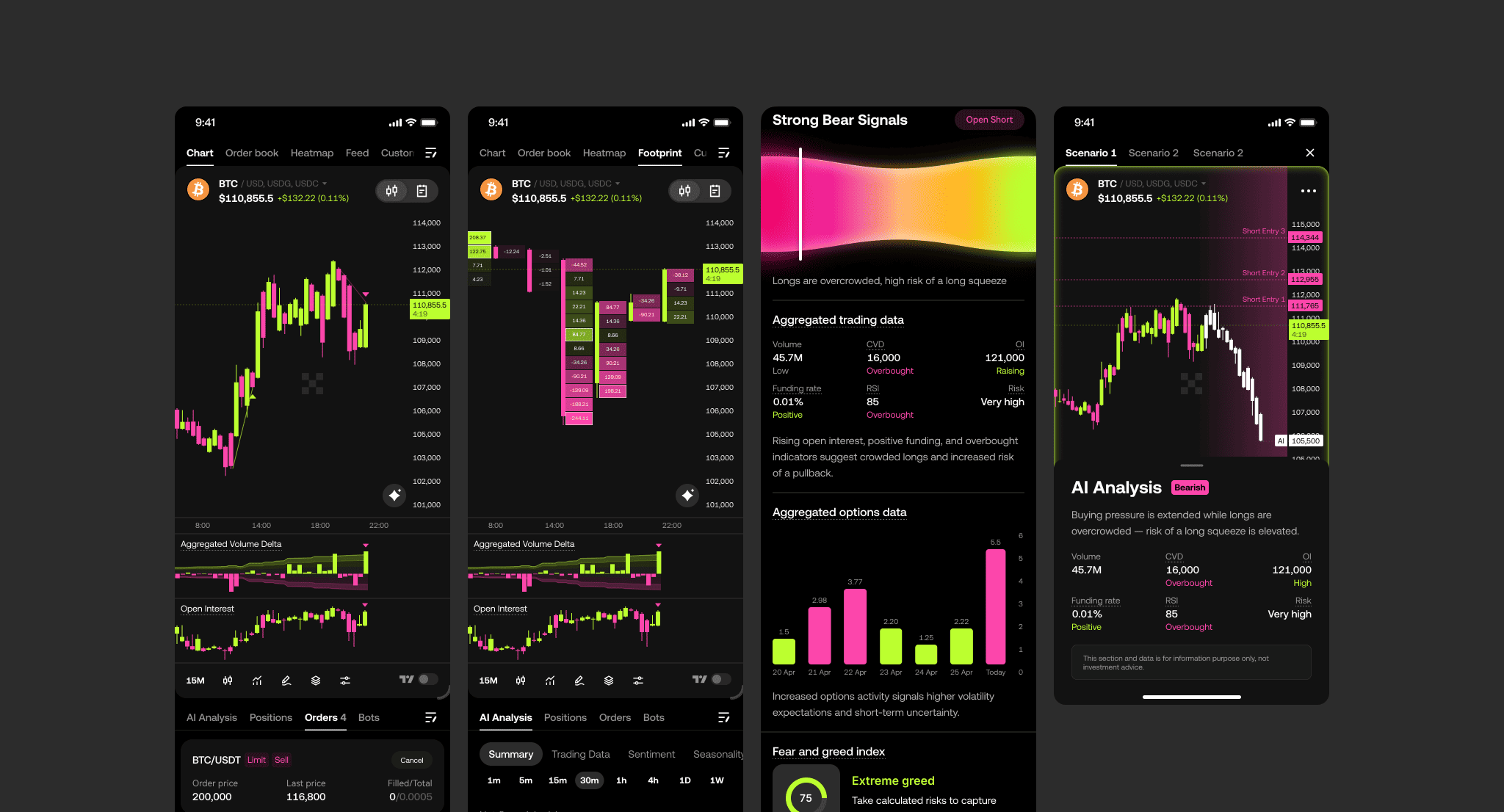
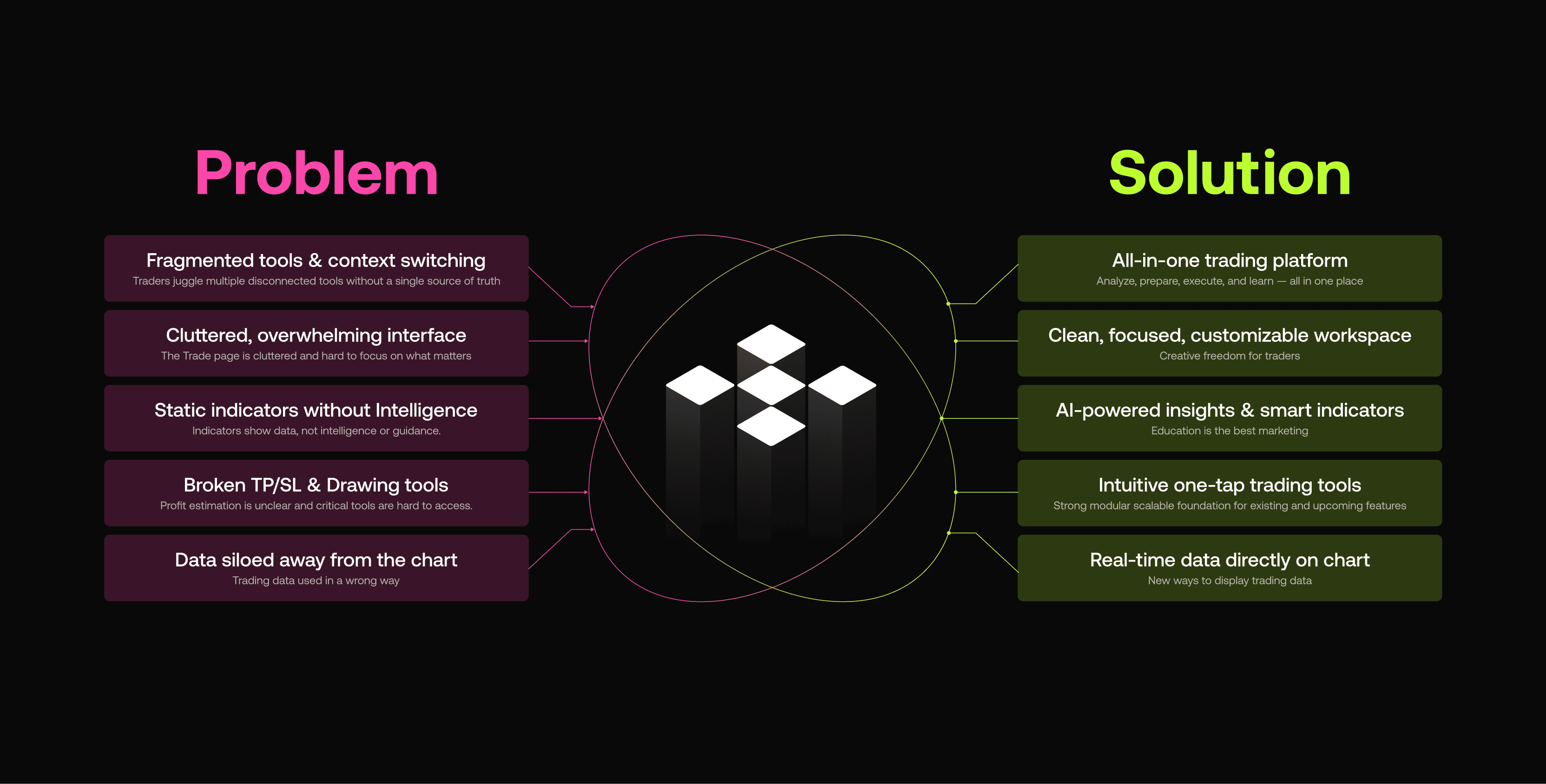
Top 6 fixes: broken TP/SL UX, drawing-tool workflow, siloed derivatives data, static unconfigurable indicators, shallow Feed tab, inflexible chart canvas.
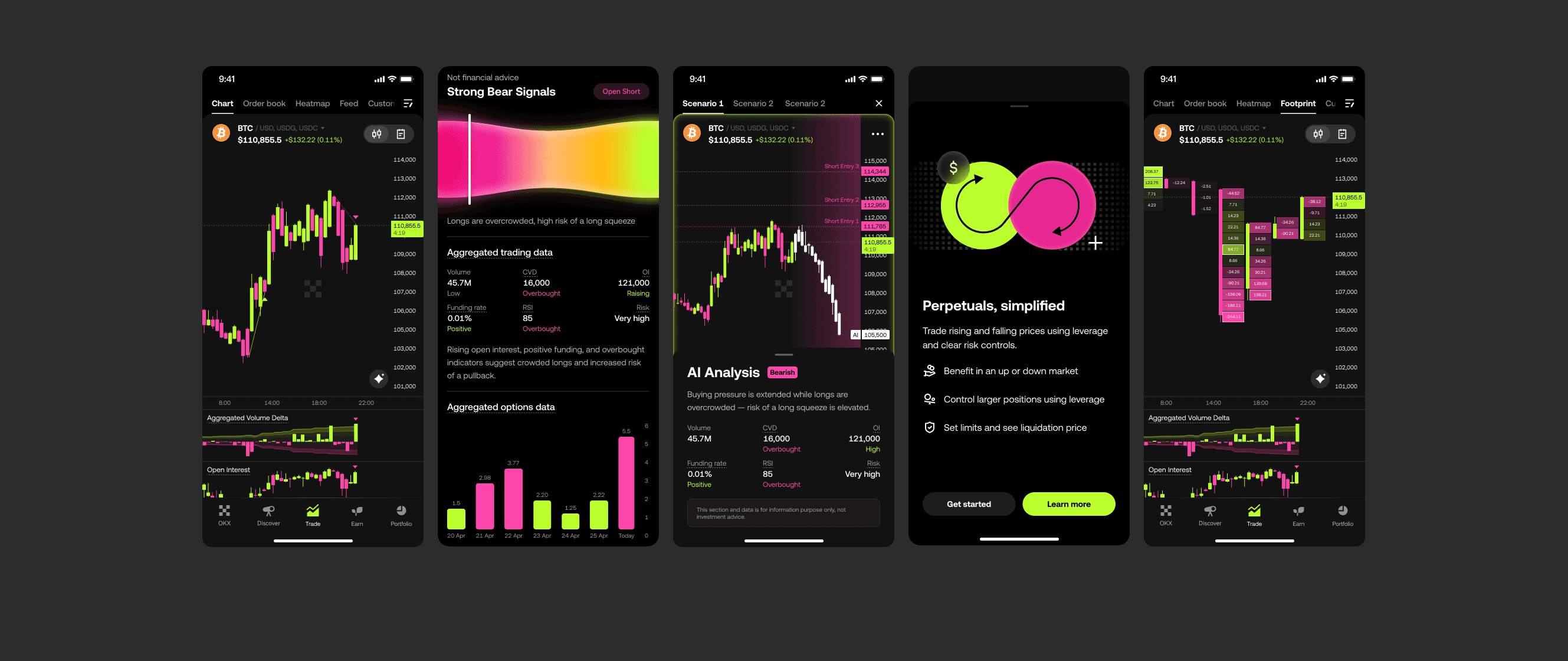
6 strategic solutions: AI Market Summary, native footprint charts, orderbook heatmaps, on-chart derivatives data, customisable Workspace tab, opportunity Screener.
The Solution & Outcome
Vision adopted as OKX's official 2026 product narrative for Trading.
Cross-team commitment from Data, Mobile, Web, AI Platform on one roadmap.
Footprint, heatmap, on-chart derivatives in prototyping May 2026.
Targets agreed: +15% 30-day retention, +25% session duration, +5% volume/user, +12 NPS.
PROJECT 2
Problem
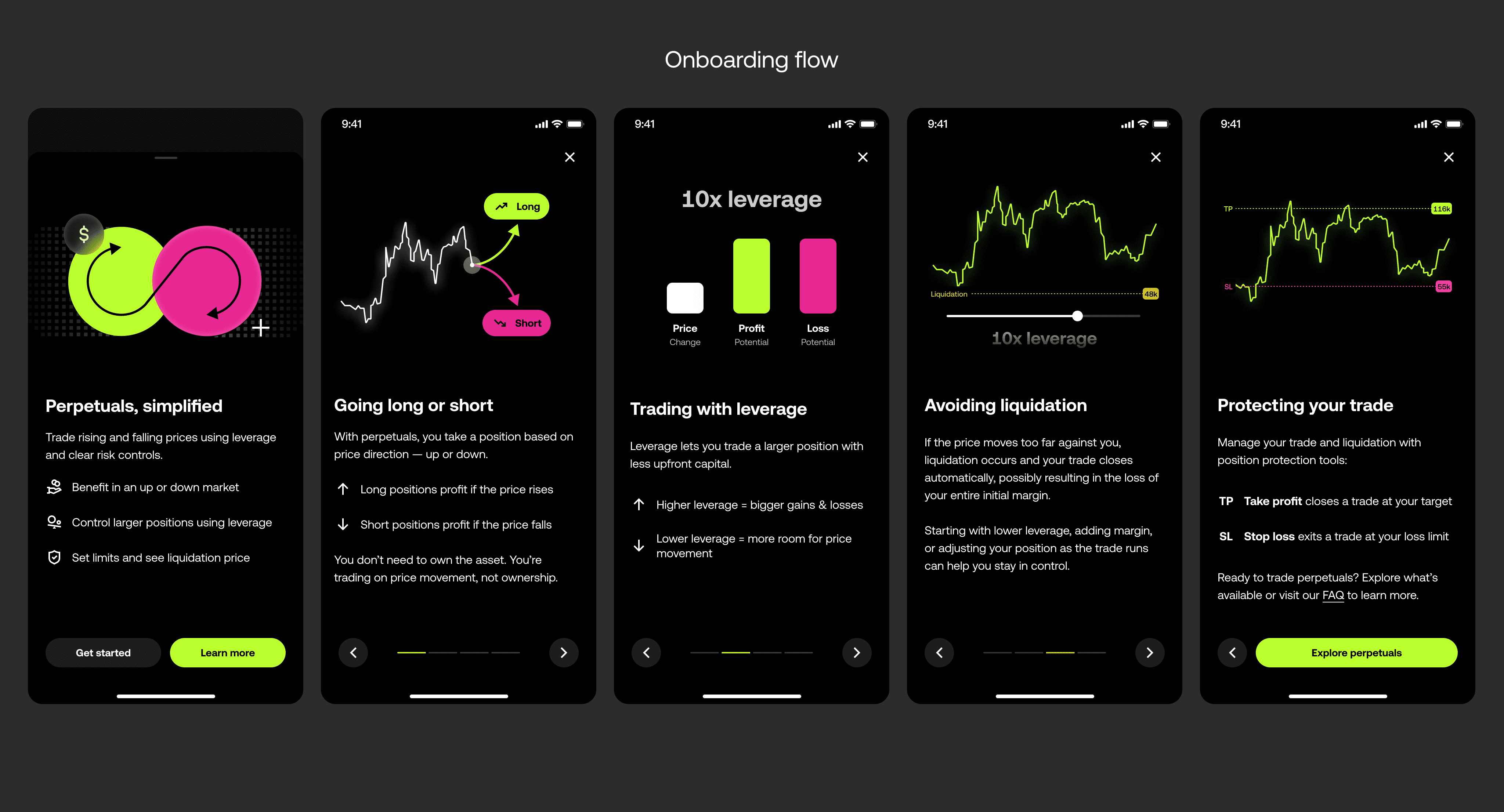
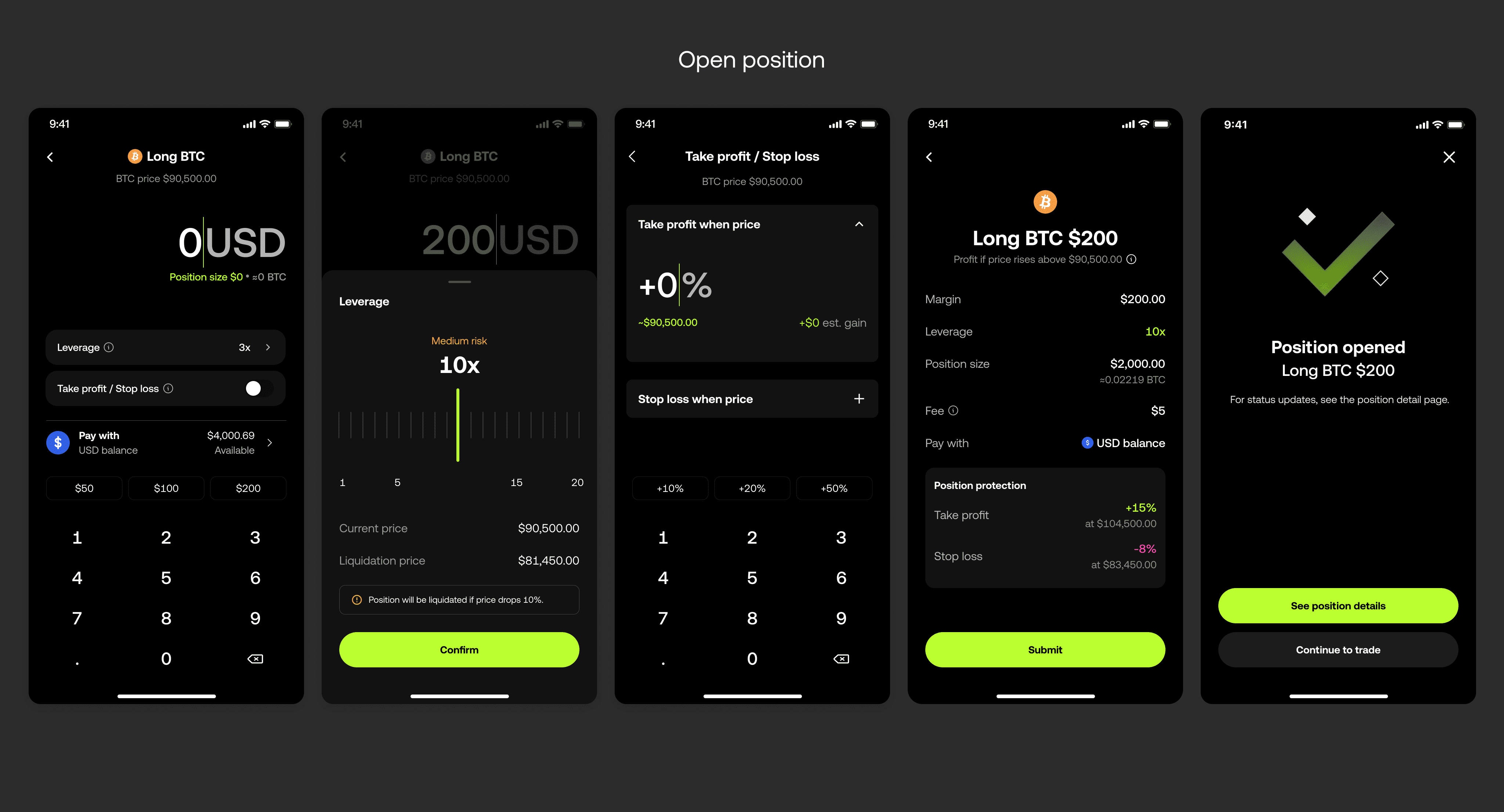
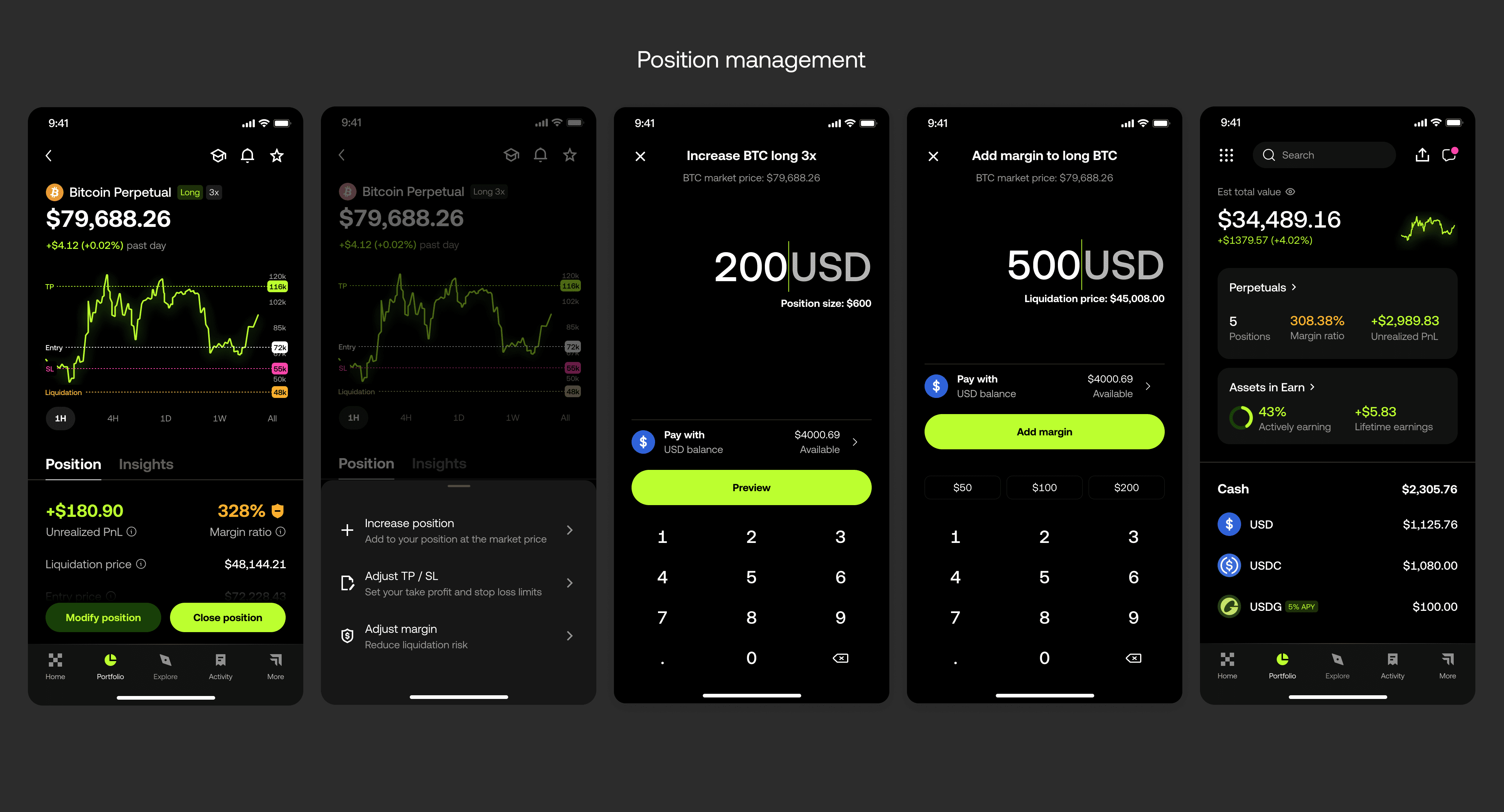
76.3% of OKX's trading volume comes from perpetual contracts. But perps only exist inside Advanced mode — a pro-grade interface (order book, isolated vs. cross margin, manual funding-account transfers, position-mode toggles) that locks out the retail user base spot-side.
Internal research painted a single recurring picture: users who deposit stablecoins, hold spot, and have a directional view have no clean way to act on that view inside our app. They convert opinions into Twitter posts, not positions. Meanwhile, Kraken and Coinbase International were building simple-mode perps products designed exactly for this user.
Business Case
Anchored on OKX's own data. Used the internal EEA Simple/Advanced trading-volume ratio as a proxy for retail-style perp adoption. In Feb–Apr 2026 this ratio stabilised at 15.4%–16.7% — meaning roughly one in six dollars of EEA derivatives volume already flows through the simpler surface, even before we ship a dedicated Simple Perps product.
Applied the ratio to competitor benchmarks. Pulled Kraken Total Perp TV from Kraken's public Futures API (PF_ contracts) and Coinbase International Total Perp TV from the perps dashboard. Applied OKX's EEA Simple/Adv ratio to estimate the Simple-equivalent slice of each platform's volume.
Multiplied by published taker fees to get a defensible monthly revenue estimate per platform.
Personas
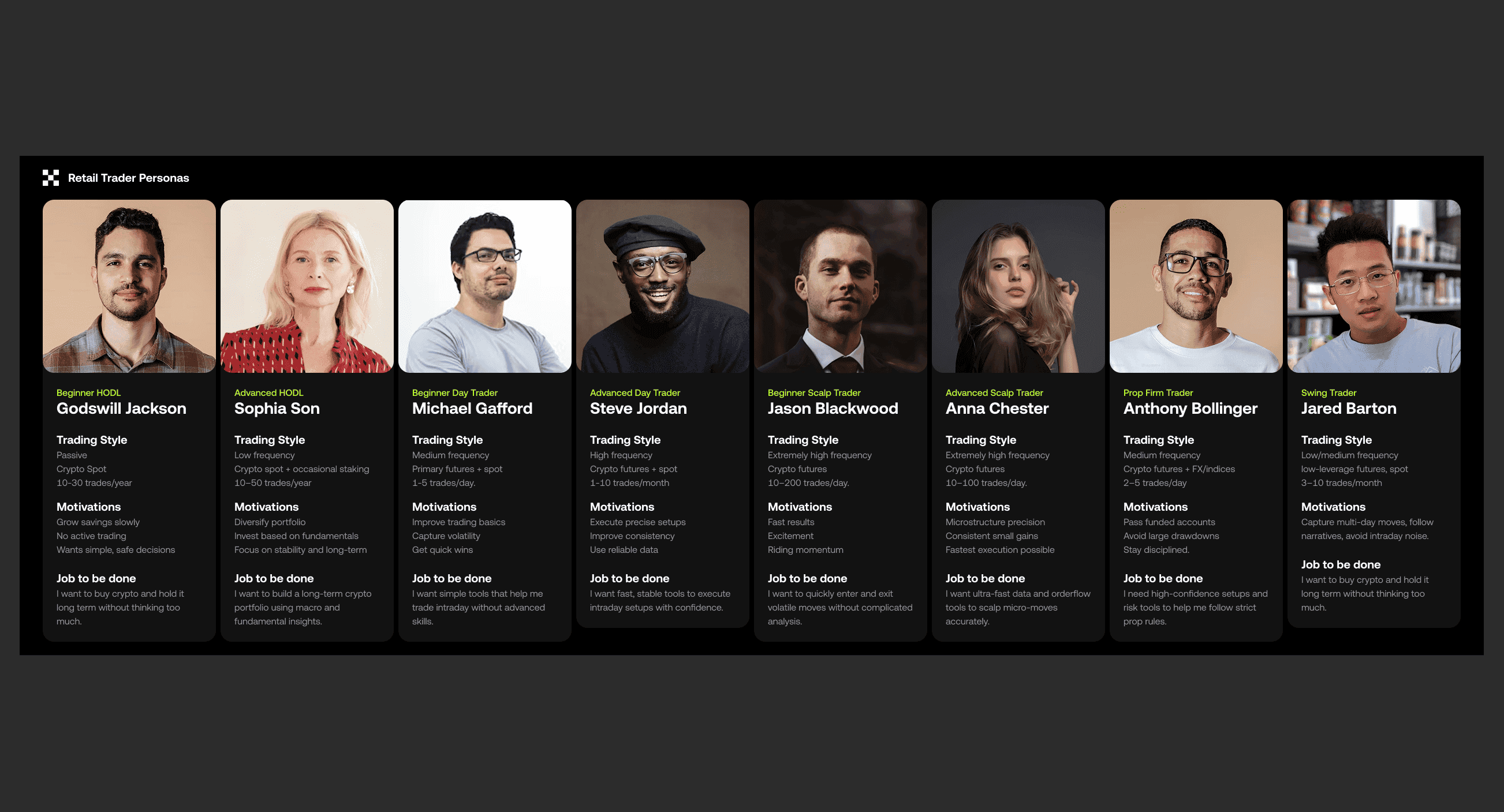
Directional Daniel. 25-40, UAE/SG/AU/EEA. Holds BTC/ETH/SOL spot. Opened Exchange mode once, got intimidated, closed it. "I want to express a directional view without losing money to UX confusion."
Sideline Sofia. 27-42. Sits in $2K–$50K USDT. Won't move funds into a separate futures account. Fears "a trade turning red while I'm not watching."
Outcome
$208M/year opportunity unlocked in roadmap reviews.
4-market MVP scope aligned in one quarter – historically 6.
Mandatory SL, 3x default, auto-transfer codified as OKX's house pattern for all regulated retail derivatives.
Ships Q3 2026.
PROJECT 3
Problem
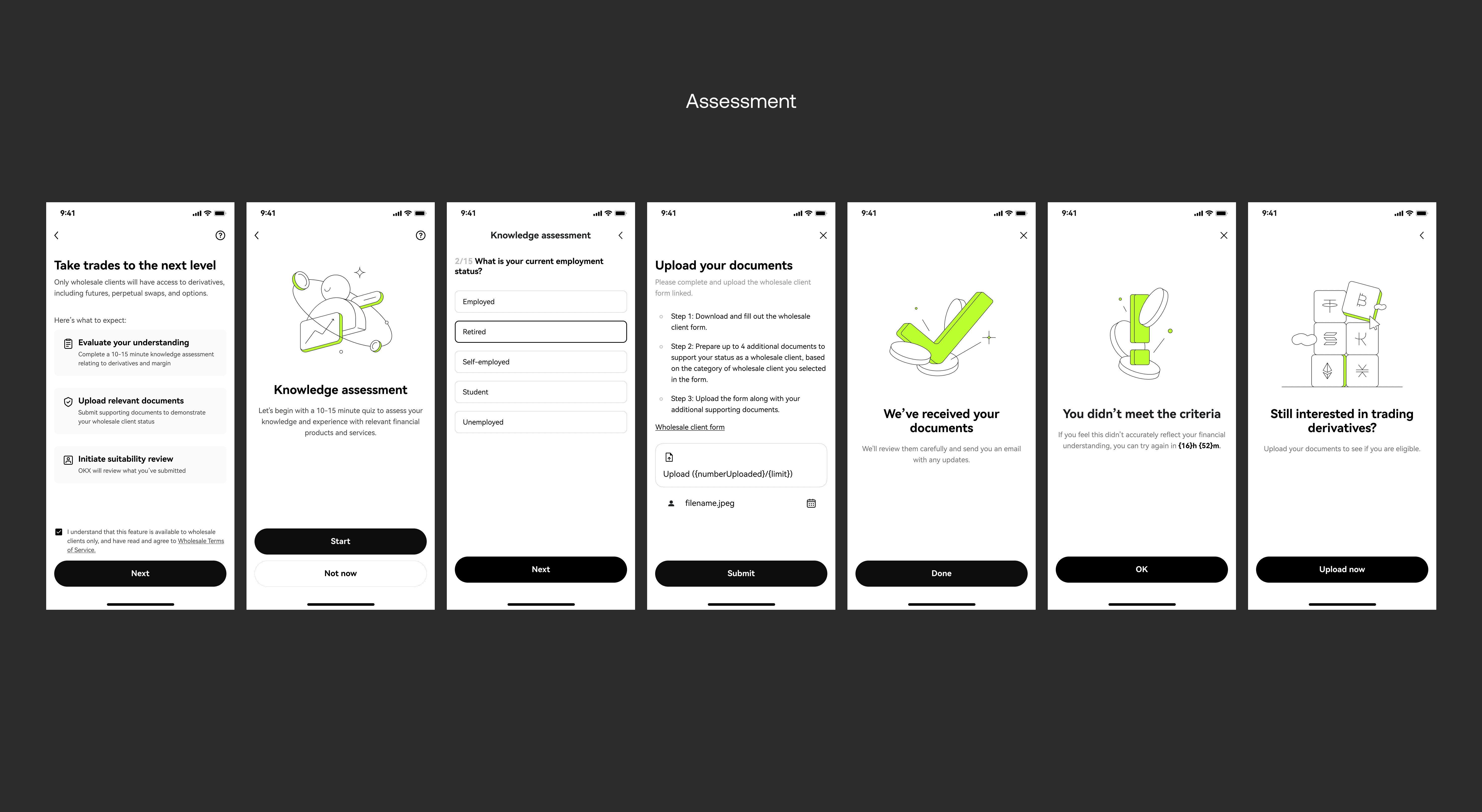
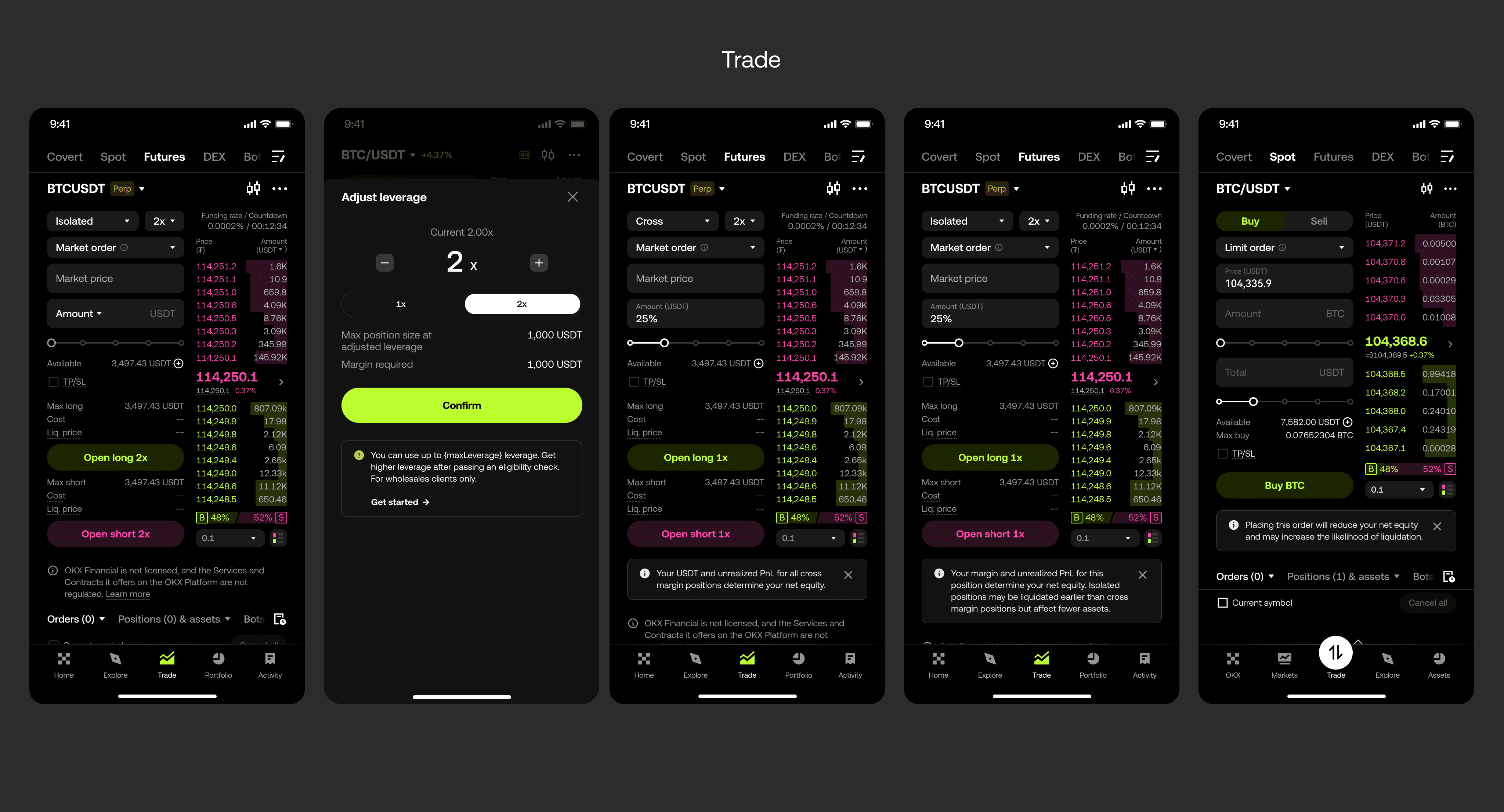
Australia is a high-value, highly regulated crypto market. The goal: become the first ASIC-licensed exchange to offer regulated retail derivatives, without fracturing our global UI architecture.
Business Case
ASIC guidelines mandated a strict 2x leverage cap and eligibility checks. Internal modeling showed Perpetual Contracts would drive 95% of retail volume, dictating a phased rollout strategy.
The Solution
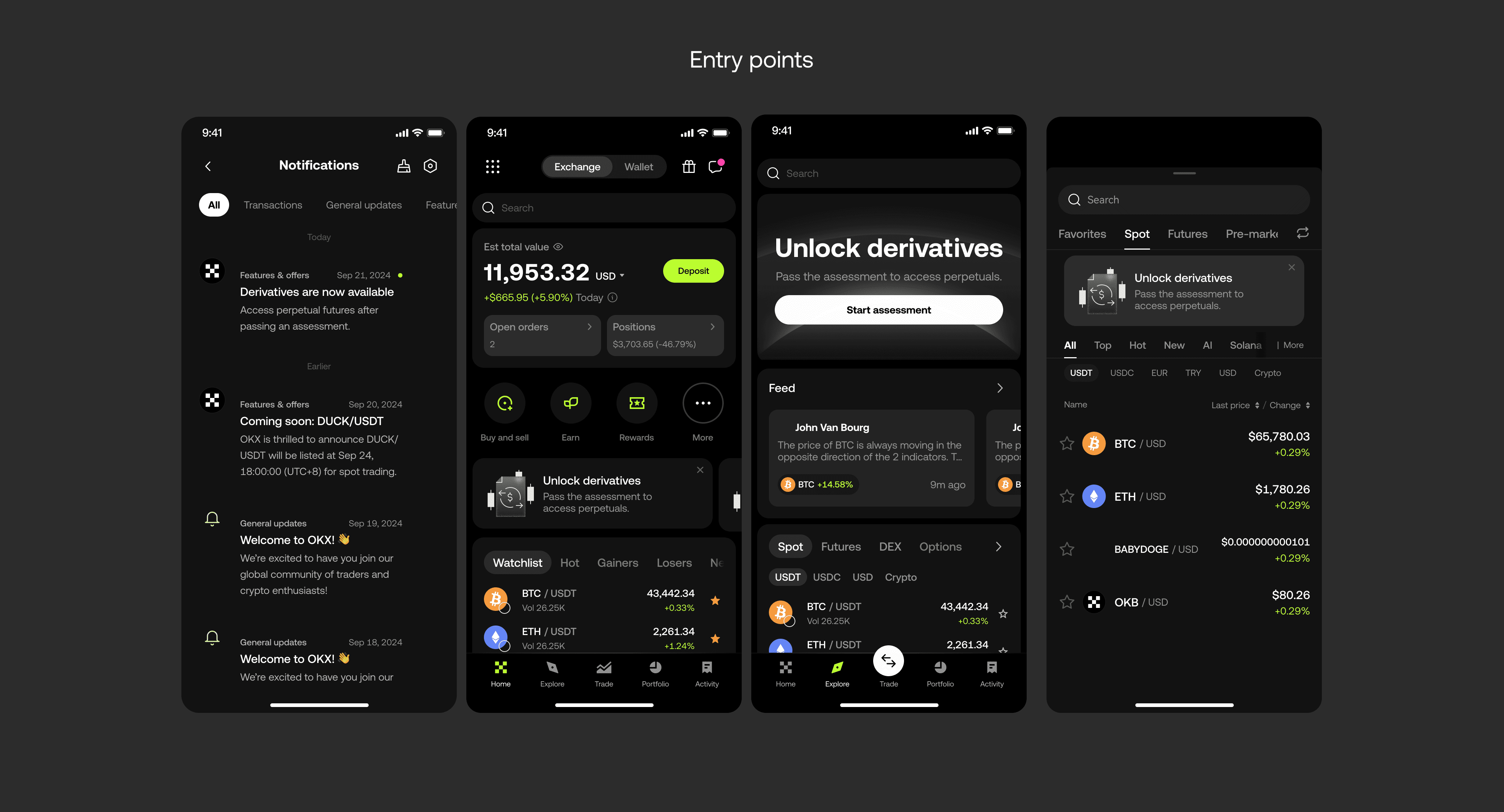
I led the end-to-end design of a two-phase rollout. Instead of treating compliance as a legal roadblock, I designed a seamless eligibility onboarding flow that felt like a premium feature unlock.
Australia isn't where we win on volume. It's where we prove the architecture that lets us win on volume everywhere else.
Outcome
First-mover in regulated retail crypto derivatives in AU. Kraken can't ship it (no ASIC retail licence). Coinbase can't ship it globally. Binance can't ship it at all in the market.
Architecture validated inside a regulator's constraints. First 30 days post-launch saw Open Interest grow from zero to $23K+ and position holders 1 → 8 — every one a fully KYC-cleared, ASIC-supervised retail trader. Numbers are small by design. The signal is that the surface works under regulation, which is the proof EEA / UAE / SG rollouts needed.
Single-codebase Simple Perps surface ships in 4 regions off the AU foundation.
PROJECT 4
Problem
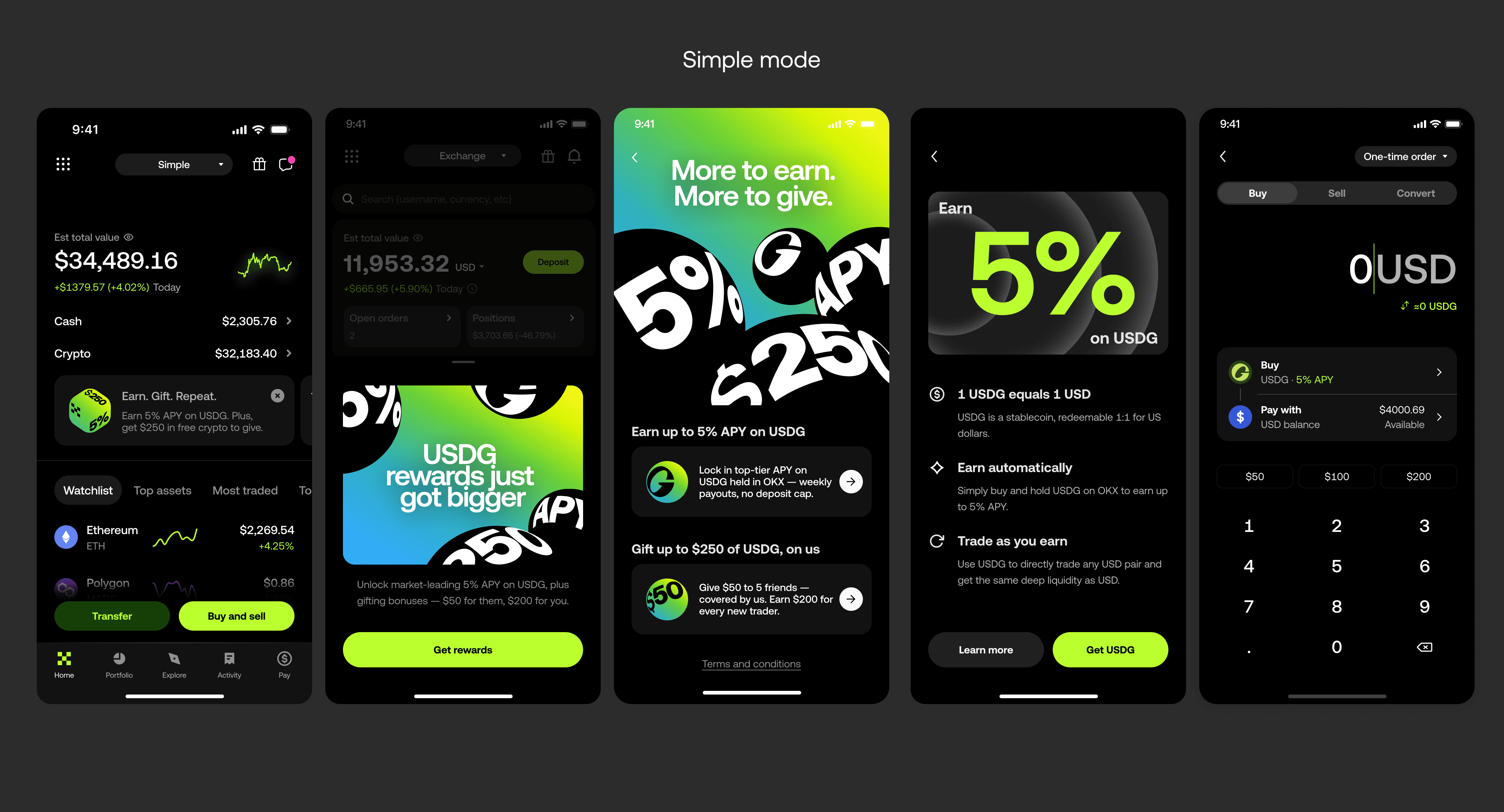
Despite offering a 4.1% APY (boosted to 5%), USDG adoption was stalling. The root cause: users didn't know the yield existed until they actively sought out the Earn product. Yield was invisible at the point of deposit.
Business Case
The objective: increase USDG stablecoin holdings (target: 10x AUM) and increase OKX's revenue share from the underlying Earn product (target: +15% CTR).
The Solution & Outcome
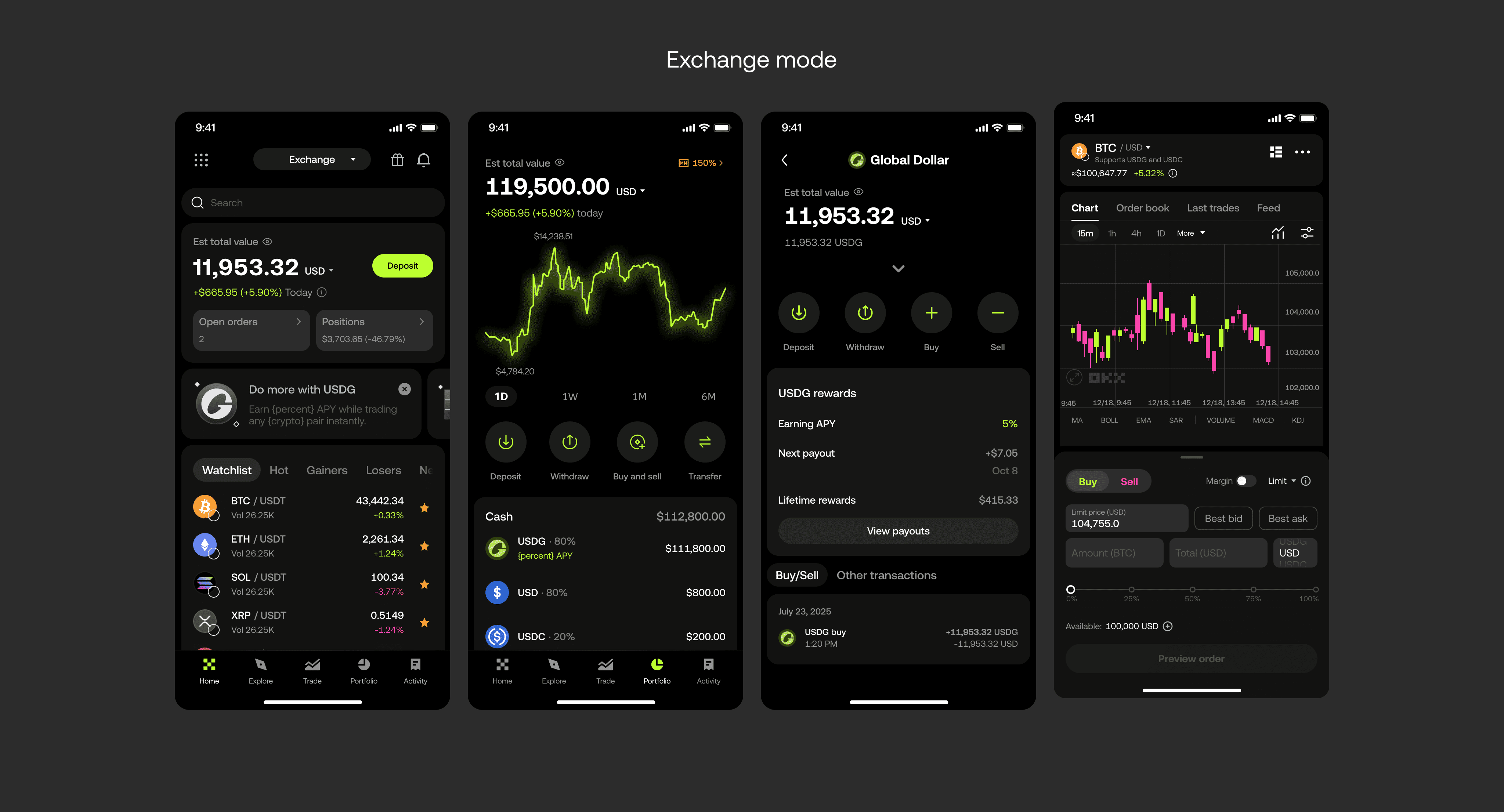
I brought the Earn value proposition into the core deposit flow. I led the UX/UI for a cross-platform integration.
Outcome
The deposit-flow integration drove a 15x increase in USDG AUM and increased the baseline CTR on USDG placements by 32%, directly increasing OKX's Earn revenue.
PROJECT 5
Problem
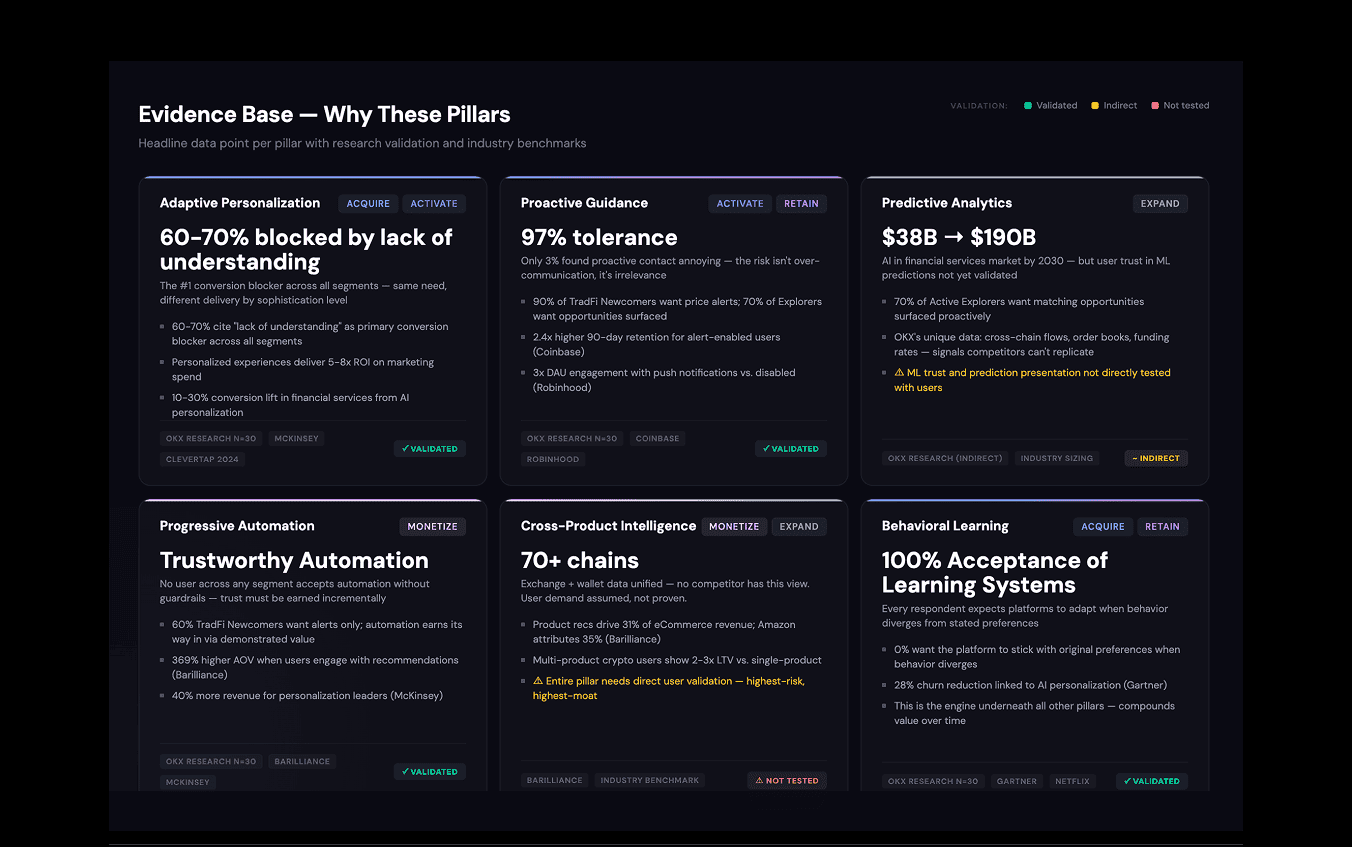
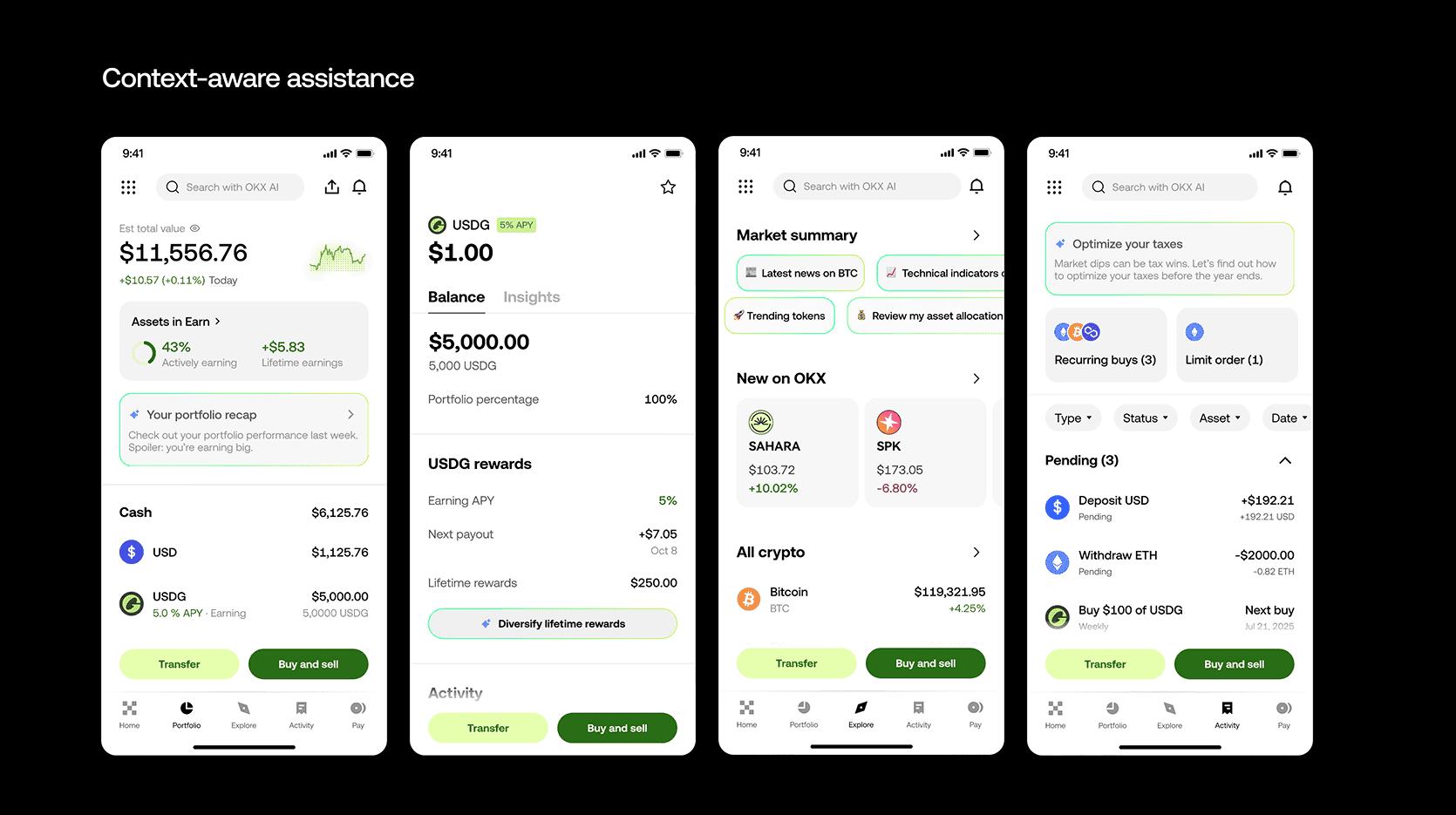
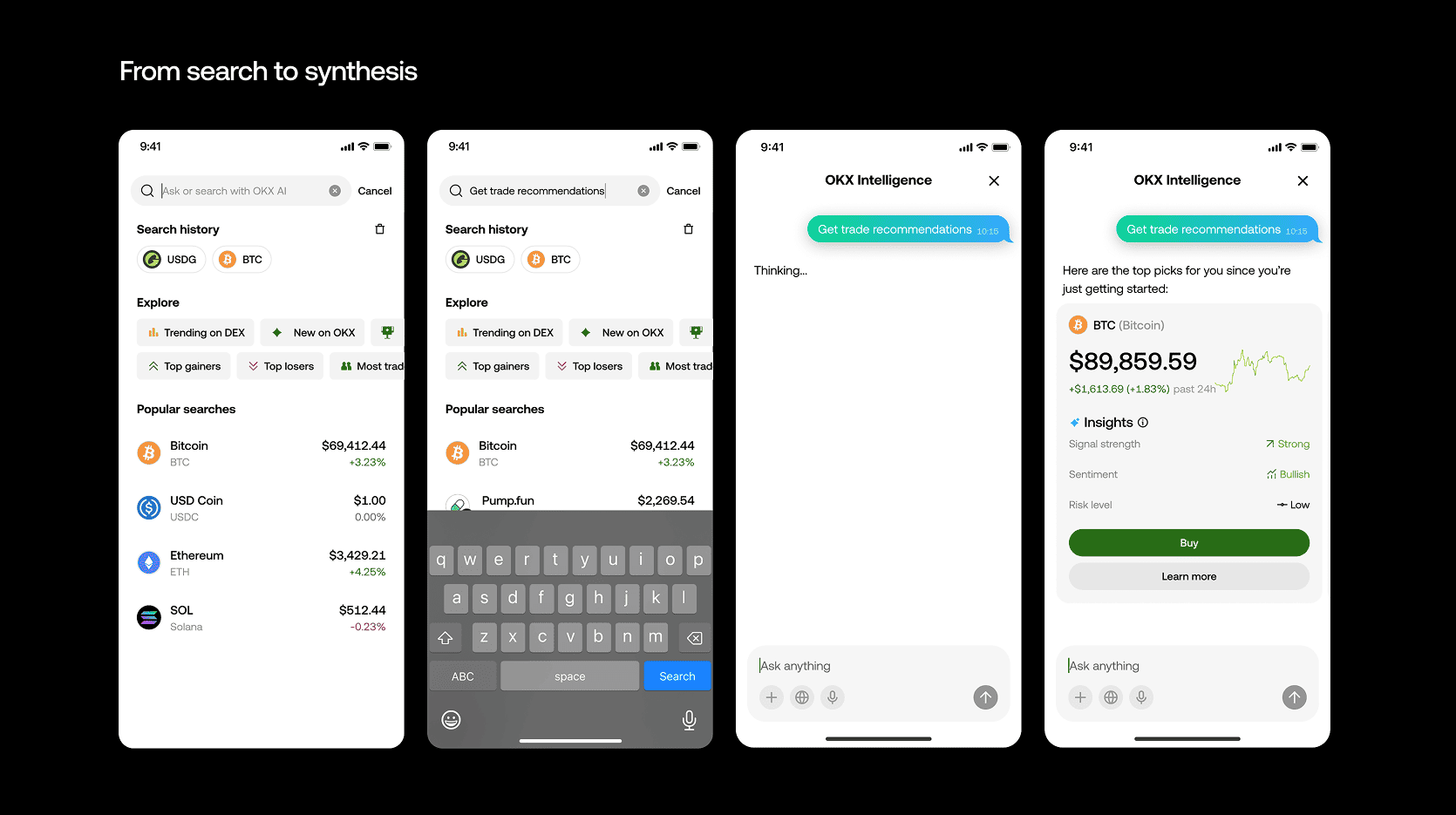
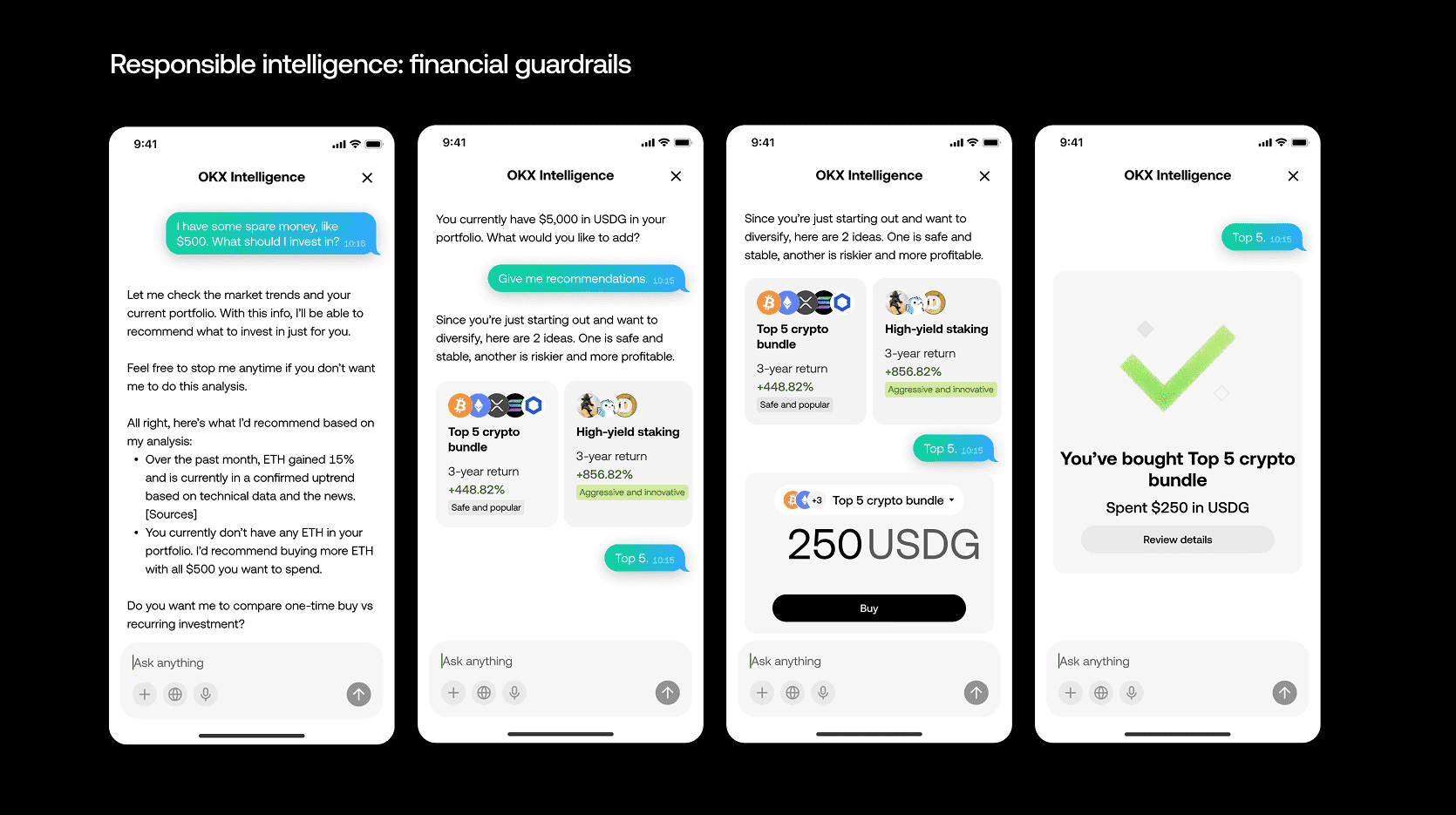
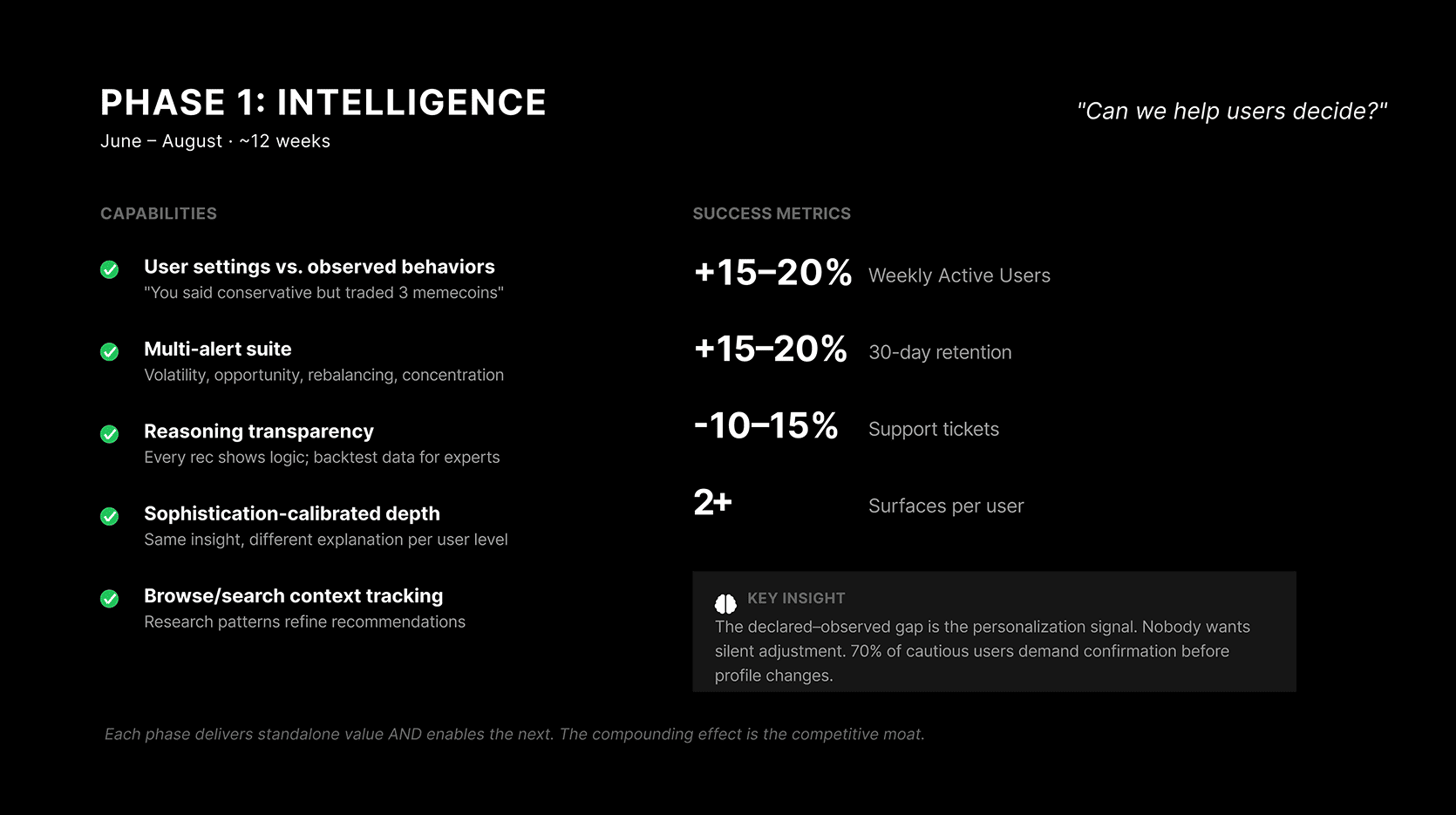
Research revealed a critical bottleneck: 60-70% of retail users cited "lack of understanding" as their #1 blocker. While competitors added standalone chatbots, nobody was building a unified intelligence layer. The opportunity: a 200M+ digital finance user base.
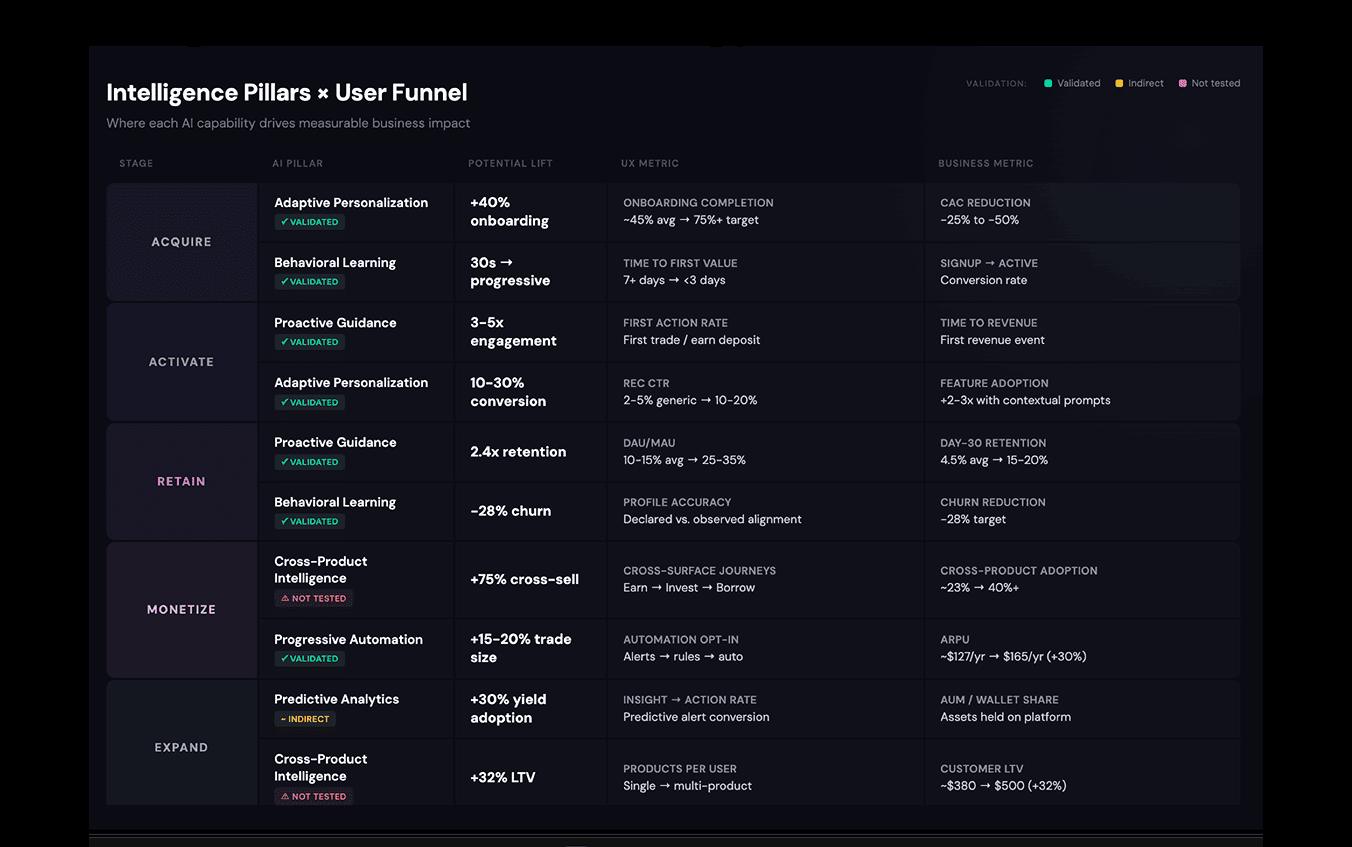
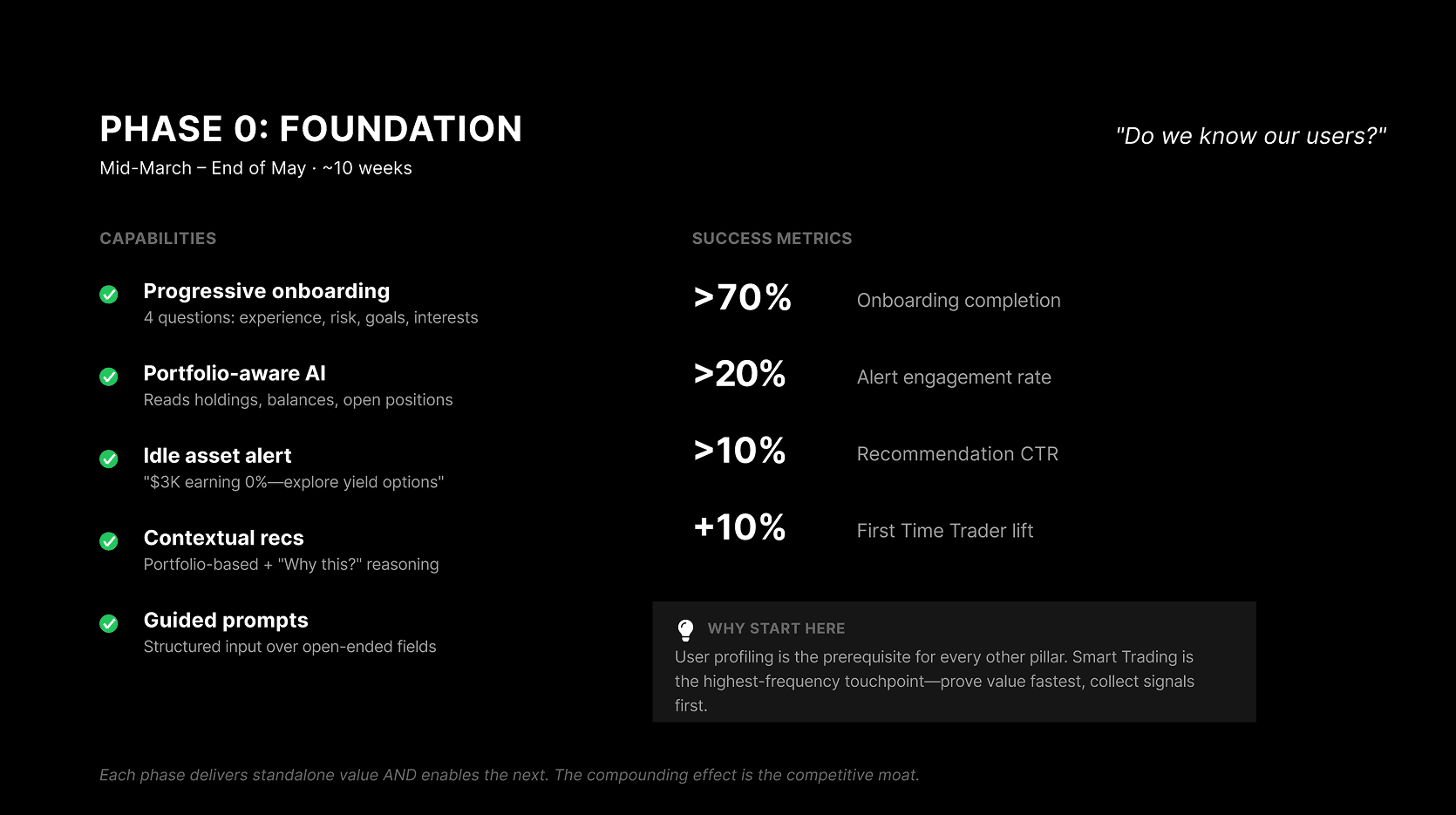
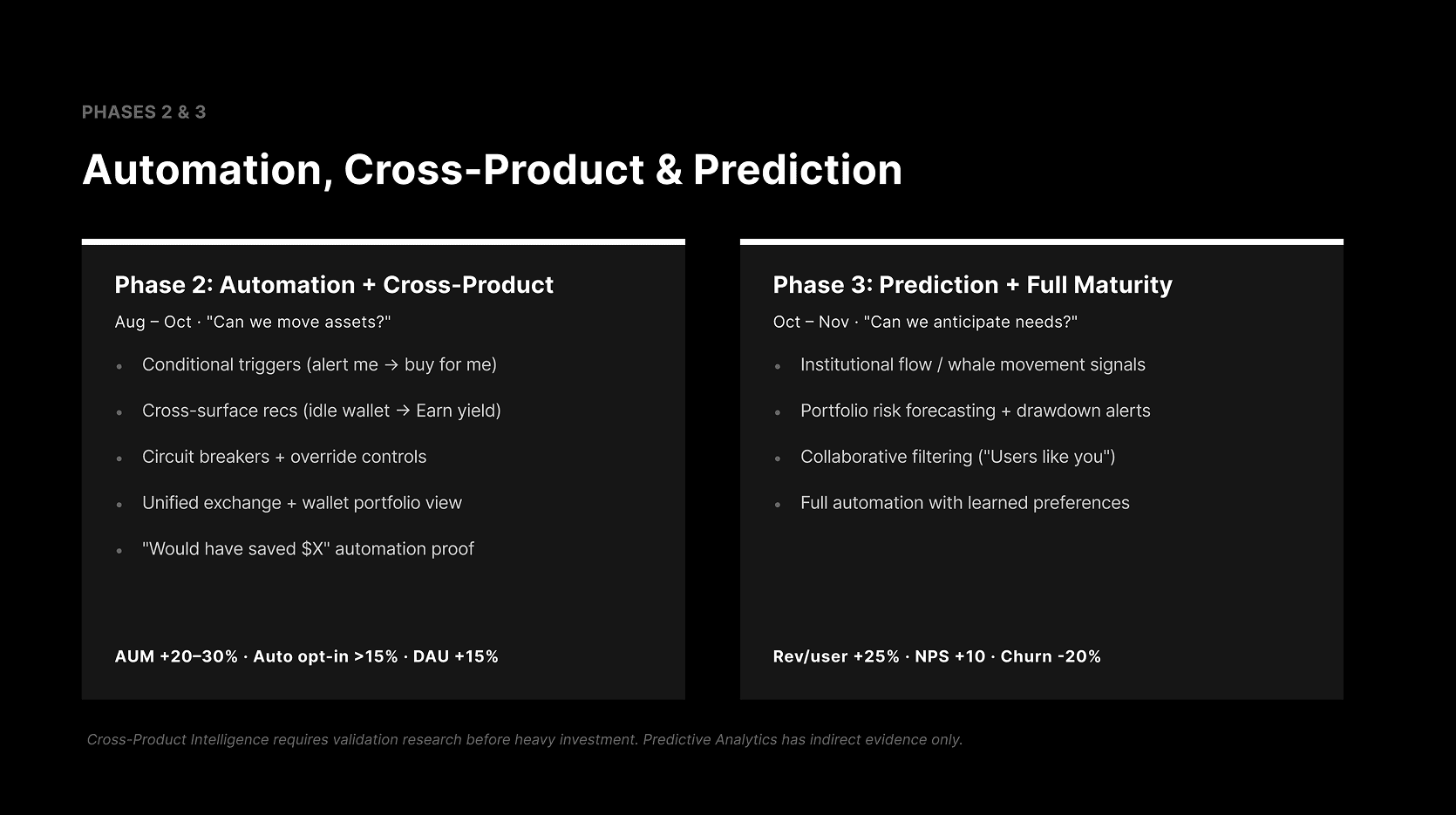
6 intelligence pillars
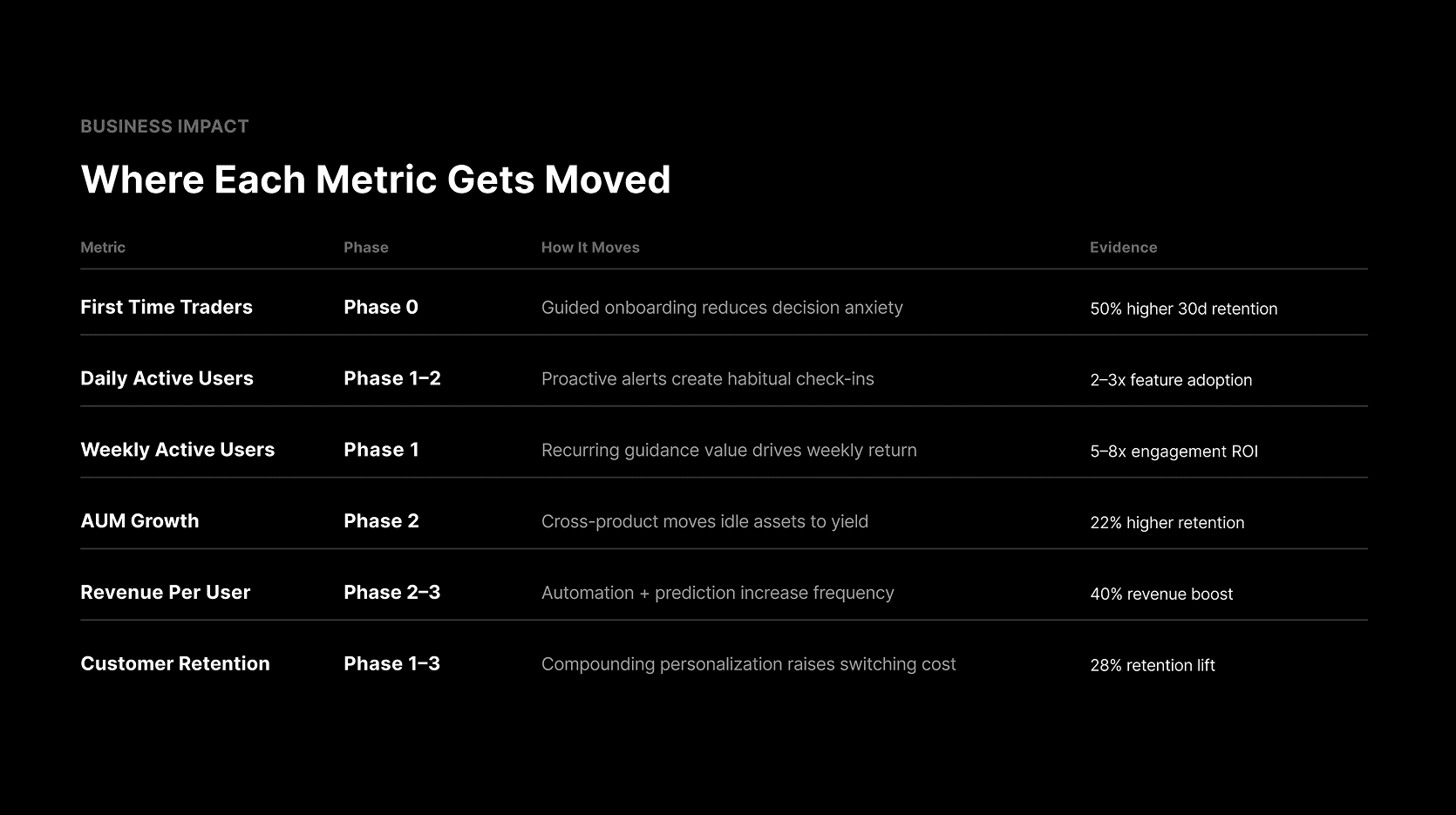
Every AI feature has to map to one otherwise we build the same plumbing twice. "Adaptive Personalization · Proactive Guidance · Predictive Analytics · Progressive Automation · Portfolio Intelligence · Behavioral Learning."
Solution
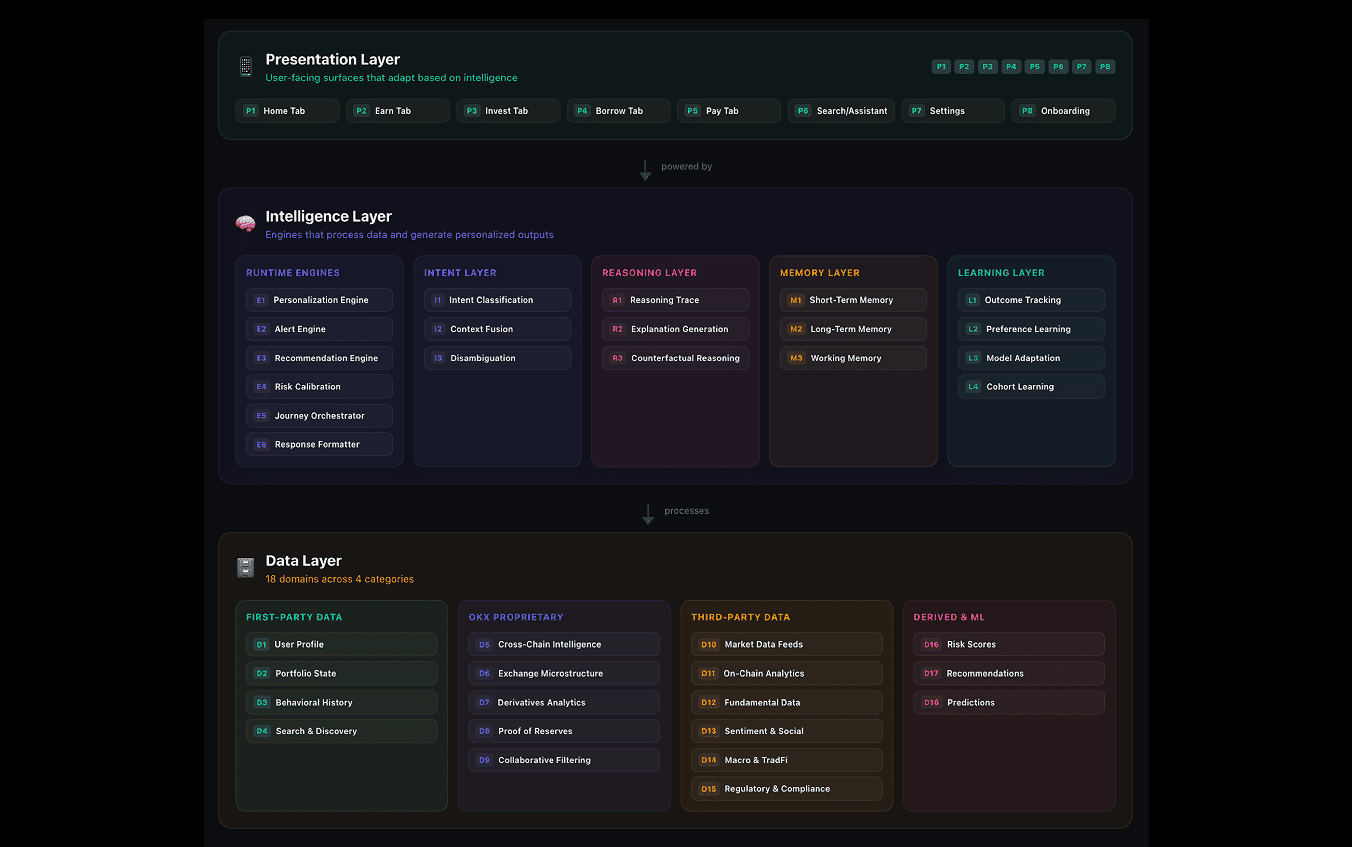
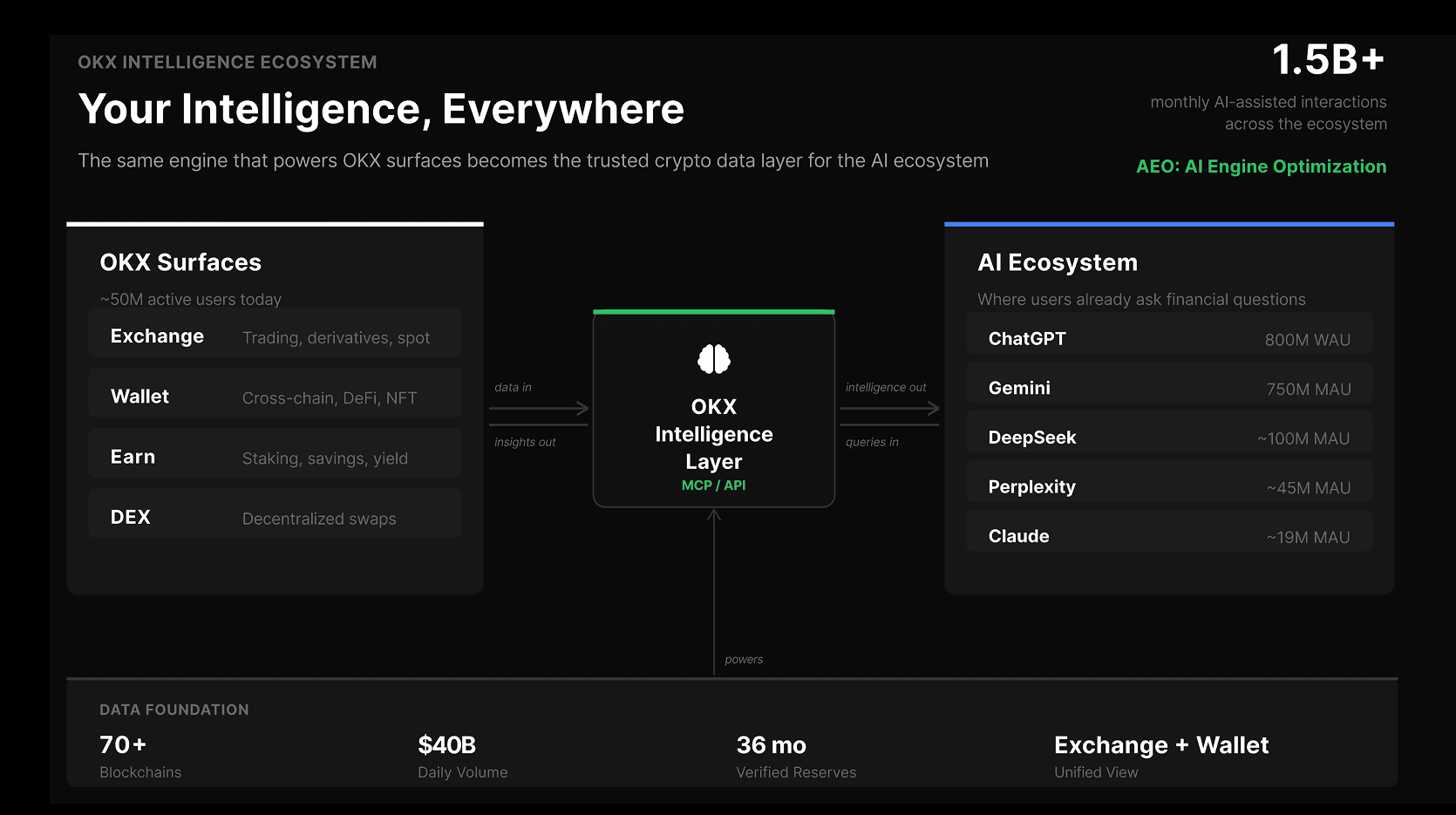
A 3-layer reference model — now OKX's house pattern for every AI feature:
Data layer — exchange data + cross-chain wallet data across 70+ blockchains + third-party feeds. One schema.
Intelligence layer — six runtime engines on an intent / reasoning / memory / learning architecture.
Presentation layer — eight adaptive surfaces (Home, Earn, Invest, Borrow, Pay, Search, Settings, Onboarding).
Outcome
3-layer architecture adopted as OKX's reference model for every AI feature — AI investment compounds across squads instead of duplicating.
Repositioned OKX internally: from reactive trading platform to proactive financial intelligence engine.
The data substrate (exchange + 70+ chains of wallet data) is something competitors cannot replicate by writing better prompts.
PROJECT 6
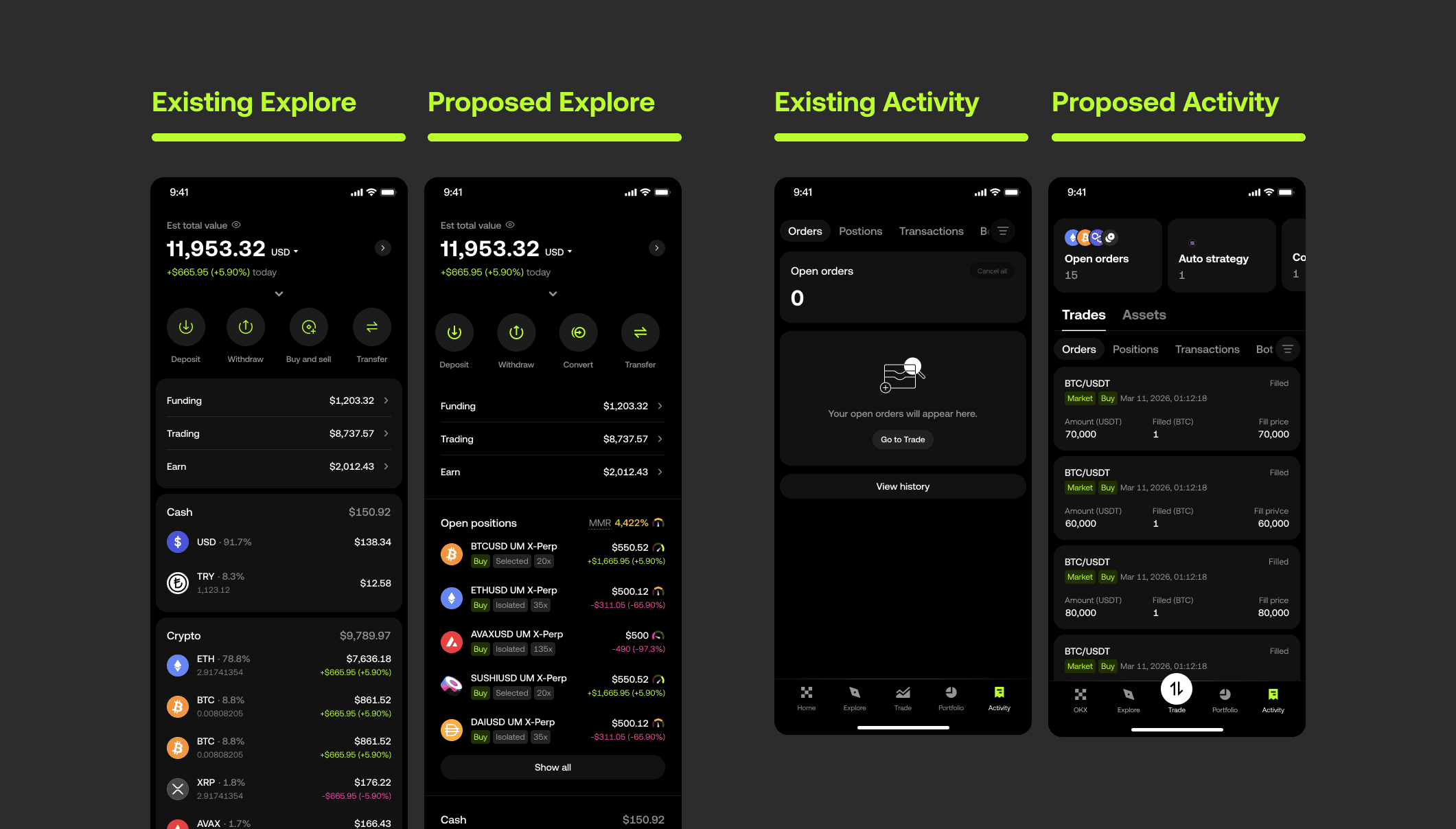
Exchange mode revamp
Problem
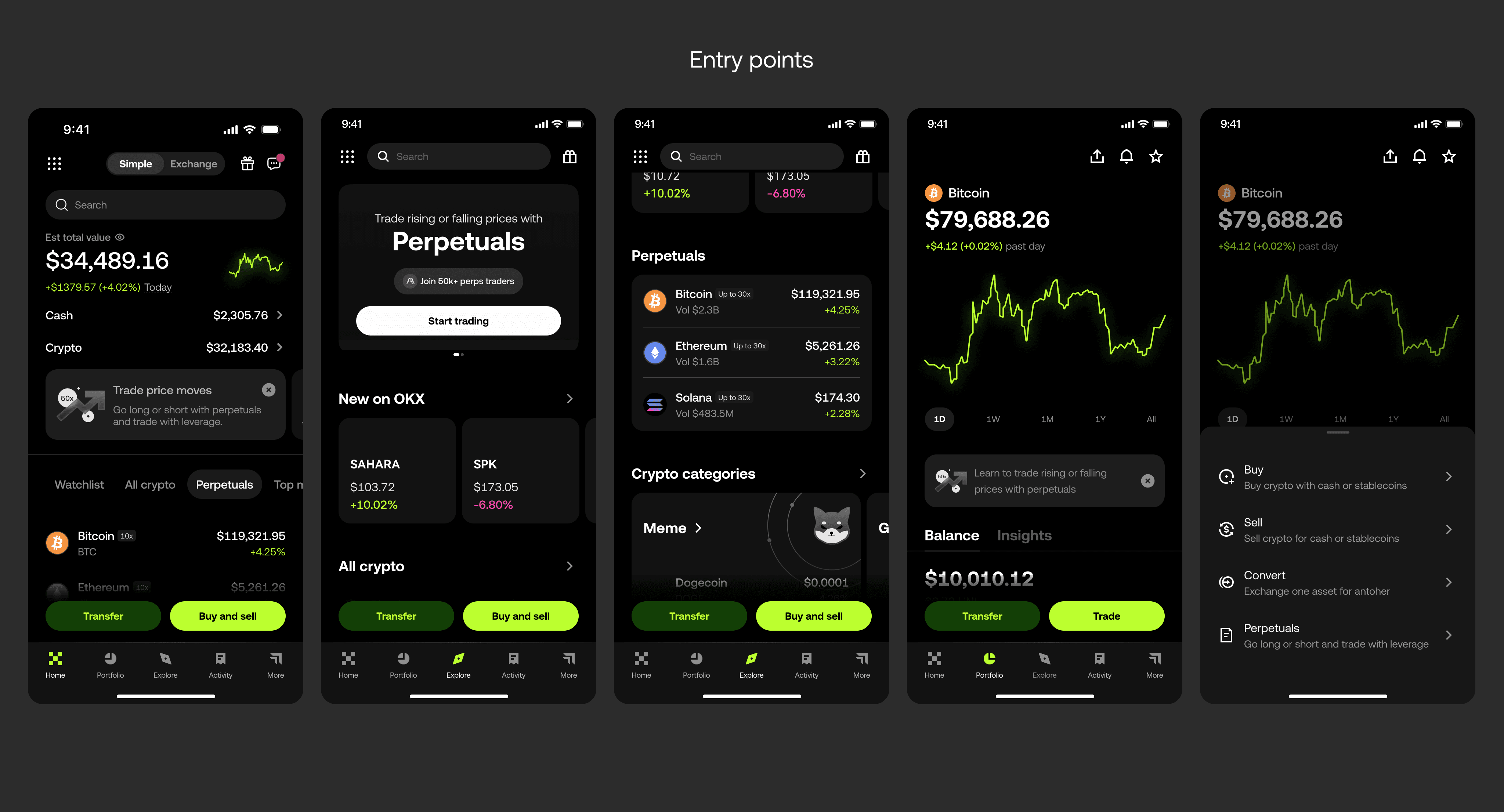
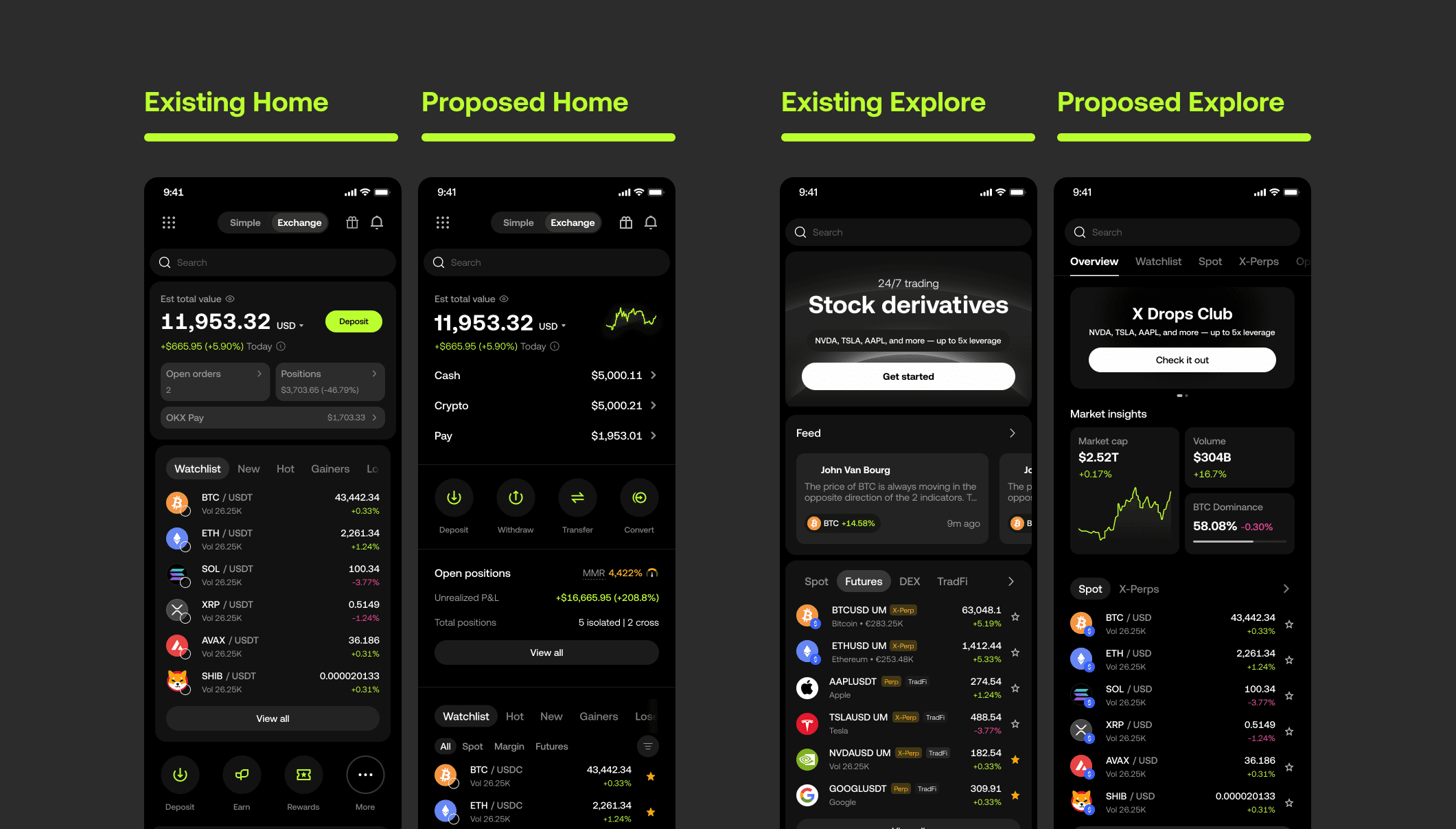
Exchange Mode is the surface 70%+ of mobile users open daily. The five tabs drifted — Home became a campaign dump, Explore lost its job, Trade and Portfolio fell out of sync, Activity flattened into a log.
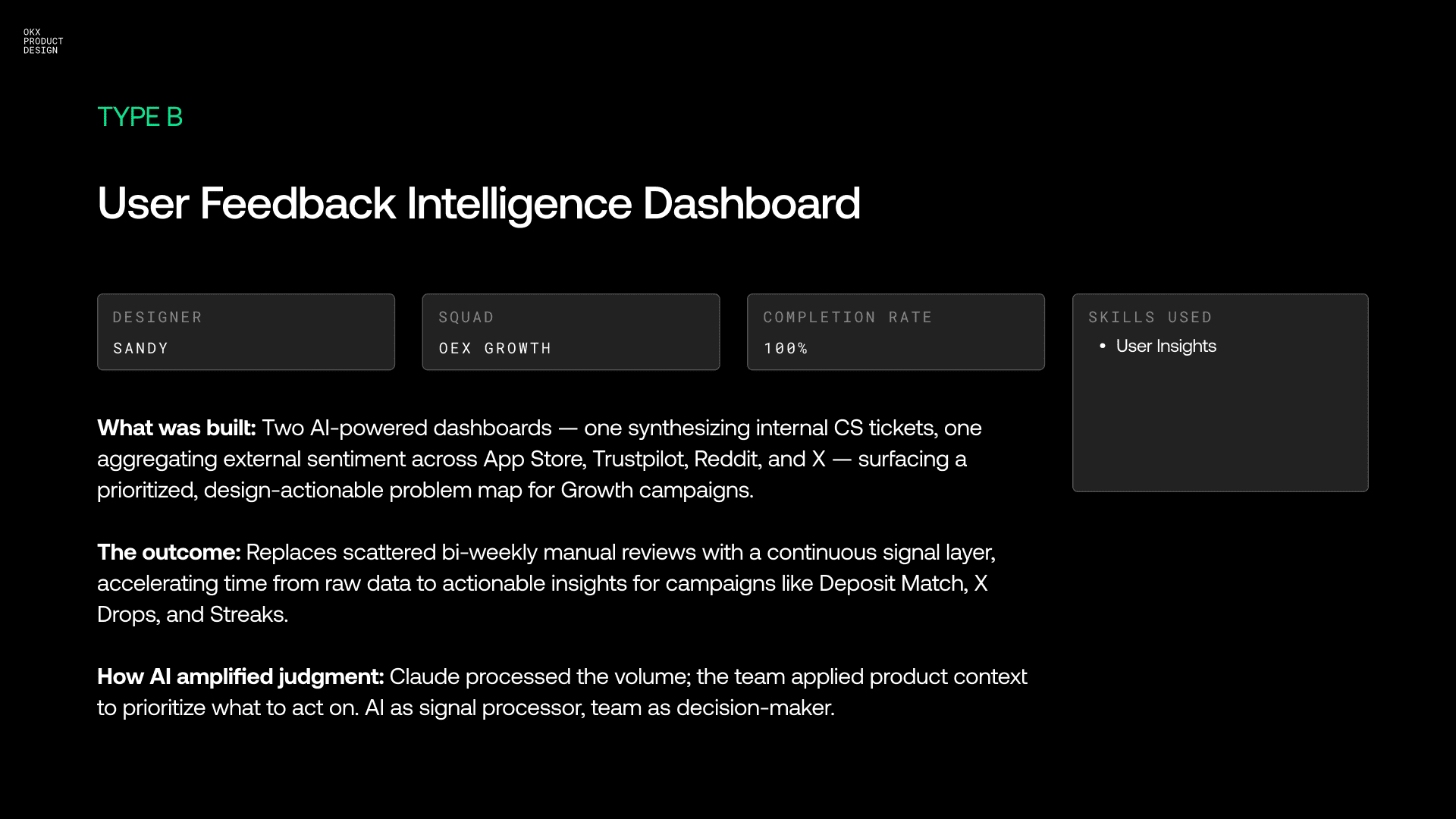
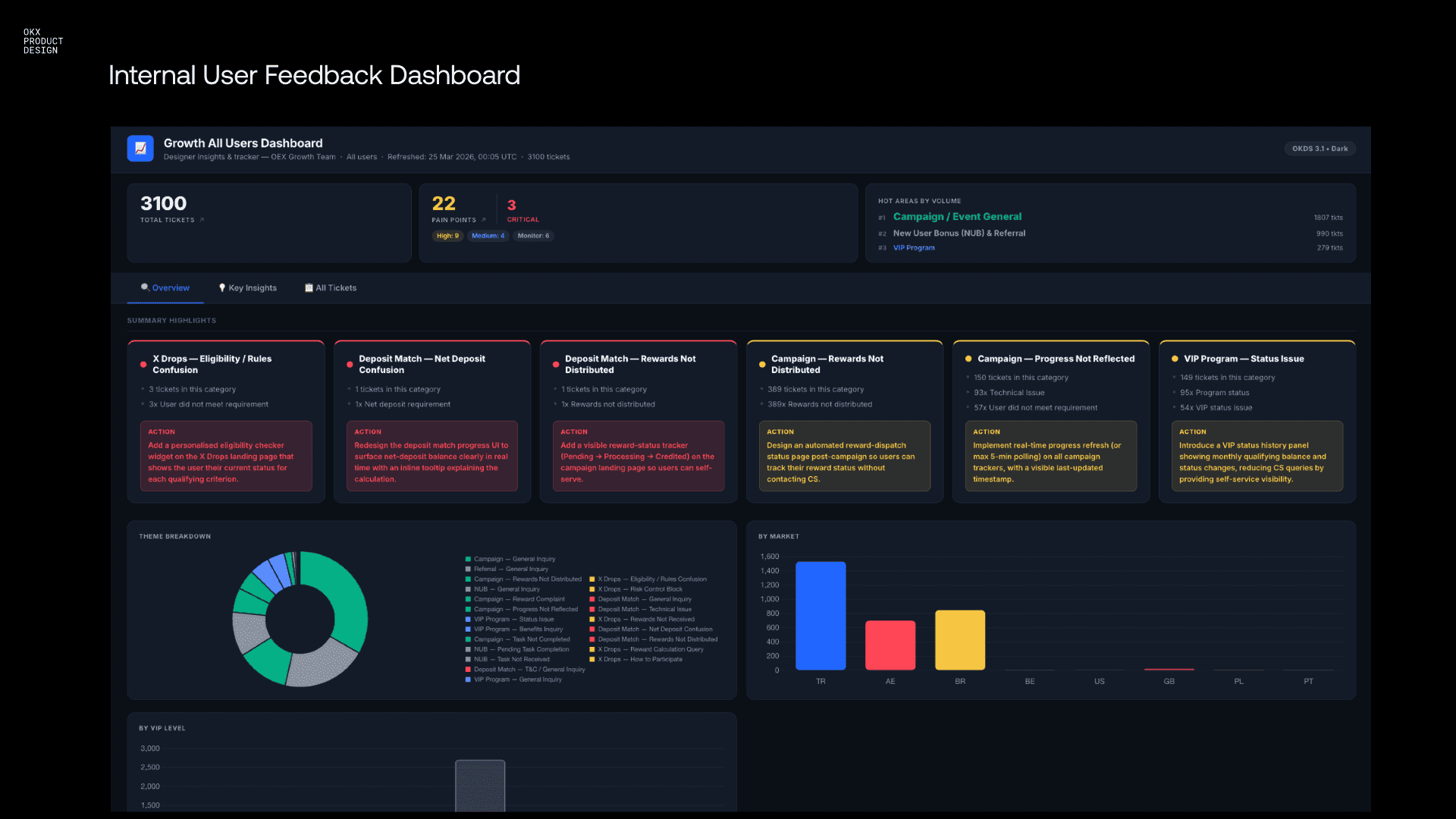
Using the User Feedback Intelligence Dashboard I shipped earlier in the year (see Chapter 7), I pulled 3,100 active tickets and surfaced 22 prioritized pain points.
6 intelligence pillars
22 pain points addressed in one coordinated release — not 22 squad-local fixes.
Projected −35% Exchange Mode tickets within 90 days post-launch.
"One tab, one job" adopted as the org-wide IA principle for OKX Pay, Earn, and Invest revamps.
PROJECT 7
Problem
Research revealed a critical bottleneck: 60-70% of retail users cited "lack of understanding" as their #1 blocker. While competitors added standalone chatbots, nobody was building a unified intelligence layer. The opportunity: a 200M+ digital finance user base.
6 intelligence pillars
Every AI feature has to map to one otherwise we build the same plumbing twice. "Adaptive Personalization · Proactive Guidance · Predictive Analytics · Progressive Automation · Portfolio Intelligence · Behavioral Learning."
Solution
A 3-layer reference model — now OKX's house pattern for every AI feature:
Data layer — exchange data + cross-chain wallet data across 70+ blockchains + third-party feeds. One schema.
Intelligence layer — six runtime engines on an intent / reasoning / memory / learning architecture.
Presentation layer — eight adaptive surfaces (Home, Earn, Invest, Borrow, Pay, Search, Settings, Onboarding).
Outcome
3-layer architecture adopted as OKX's reference model for every AI feature — AI investment compounds across squads instead of duplicating.
Repositioned OKX internally: from reactive trading platform to proactive financial intelligence engine.
The data substrate (exchange + 70+ chains of wallet data) is something competitors cannot replicate by writing better prompts.