OKX
OKX is one of the world’s largest crypto exchanges. But its most active traders still leave the platform to decide what to trade.
I joined as a day trader turned product designer, leading design across advanced trading in regulated markets, growth, and AI — with one goal: make OKX a better place to discover, analyze, and execute trades.
- My role
- Senior Product Designer (Advanced Trading)
- Timeline
- 2025 Q3 – Current
- Team
- VP, 3 Design Directors, 10+ PMs, 3 Senior Product Designers, 3 Content Designers, 6 Engineers
Key contributions
- $208M/year: Opportunity identified for Simple Perps
- 120K+ traders · $450M+ peak daily volume: European X-Perps launch
- 15× AUM · +32% CTR: USDG growth after redesigning deposit discovery
- 4 regulated markets: Scaled derivatives on a shared product architecture
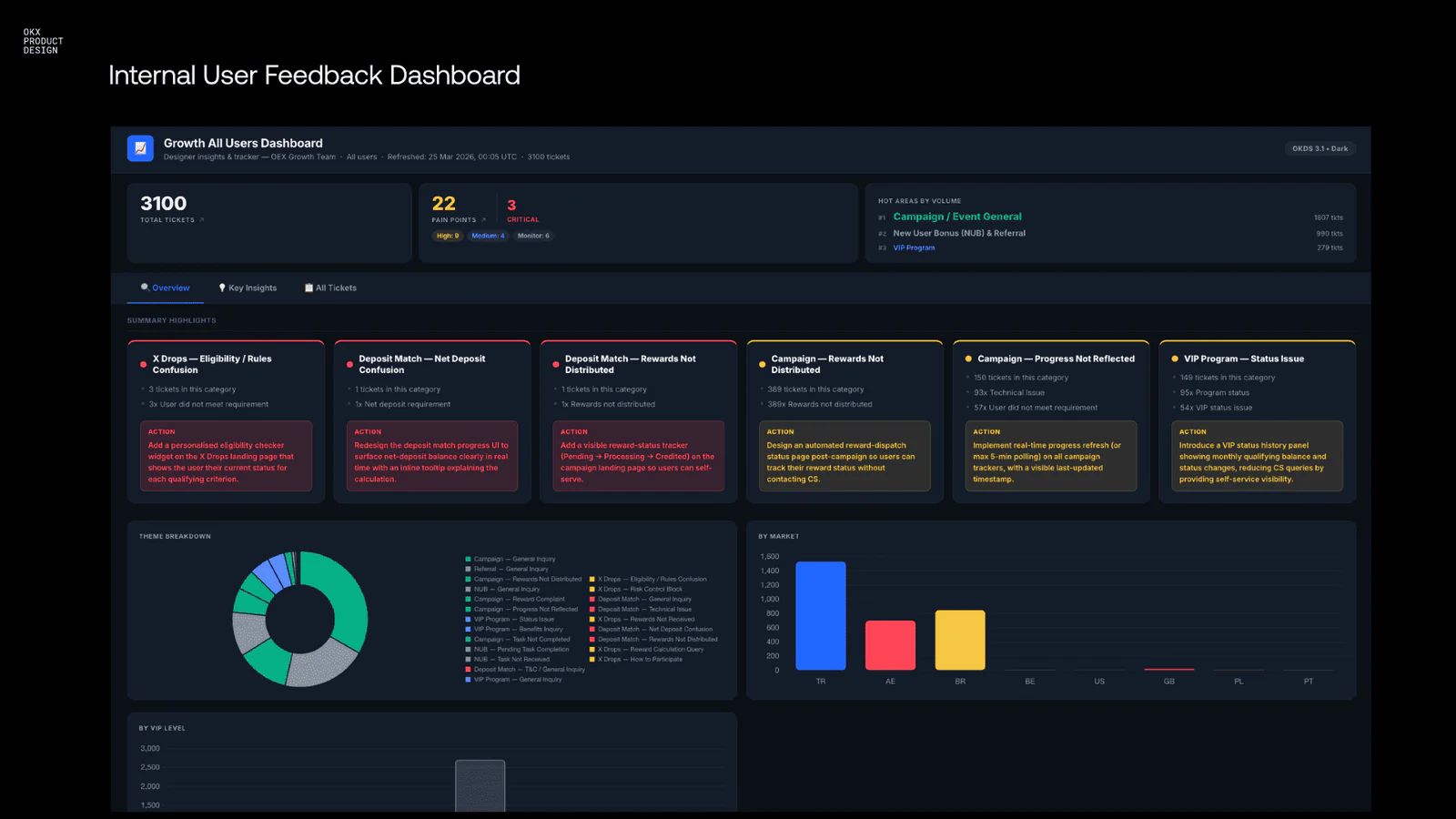
- 3,100 tickets → 22 priority problems: Turned fragmented feedback into one coordinated product revamp
- 6 intelligence pillars: Defined a shared framework for OKX’s AI product strategy
- 2 advanced trading masterclasses: Raised trading-domain expertise across Design, Research, and Product
Trade page revamp
Problem
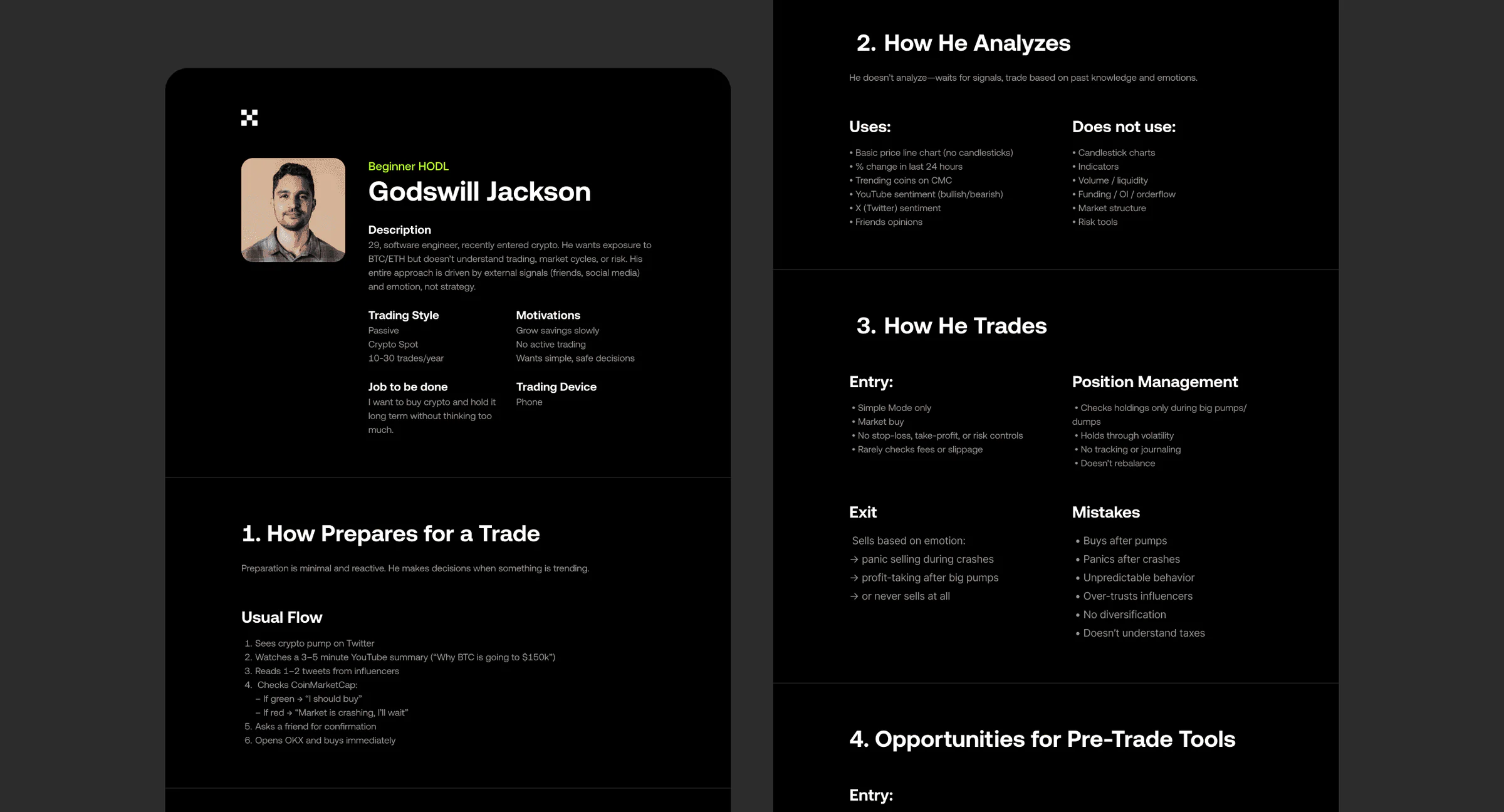
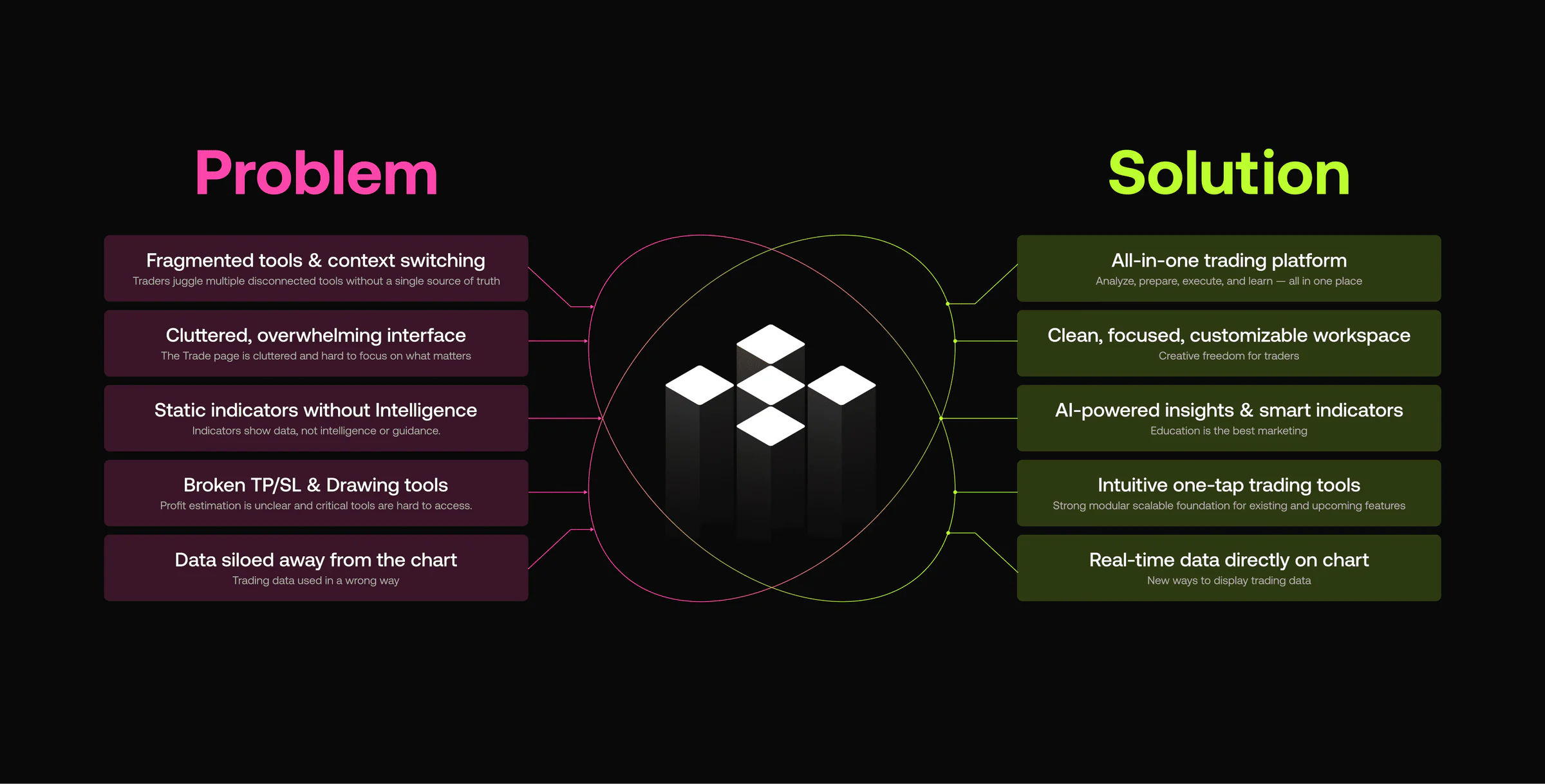
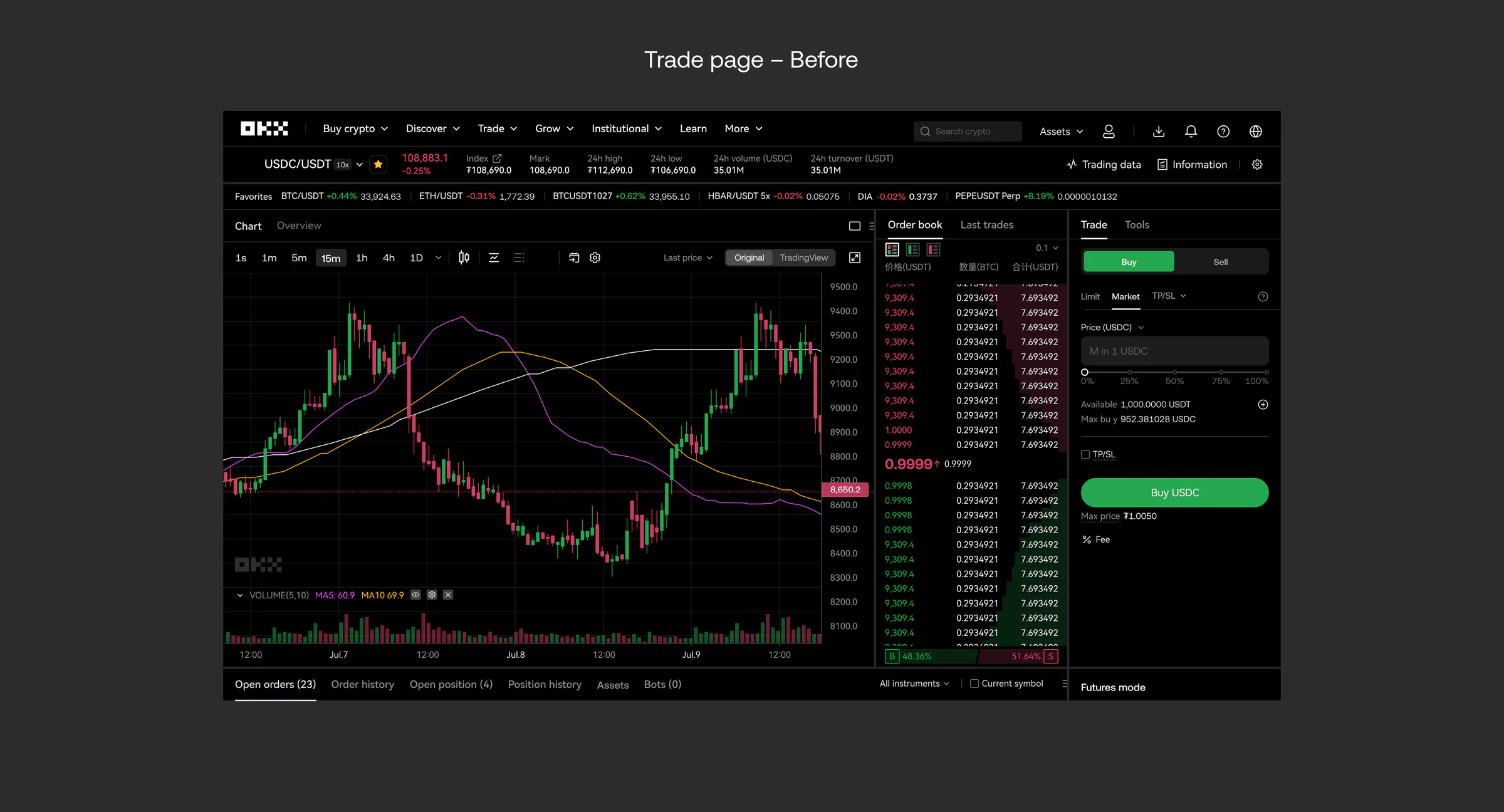
Trading has evolved faster than trading platforms. Our Trade page had fallen behind how modern traders work: dense, rigid, difficult to customize, with an interface that had accumulated complexity over time.
Different traders need different tools and workflows, but we were giving everyone essentially the same workspace.
What I did
After 34 interviews with European KOLs, 15 with VIP and high-frequency traders, and a competitive teardown across Binance, Bybit, Bitget, TradingLite, Coinglass and Bookmap, I identified the highest-impact gaps in our trading experience.
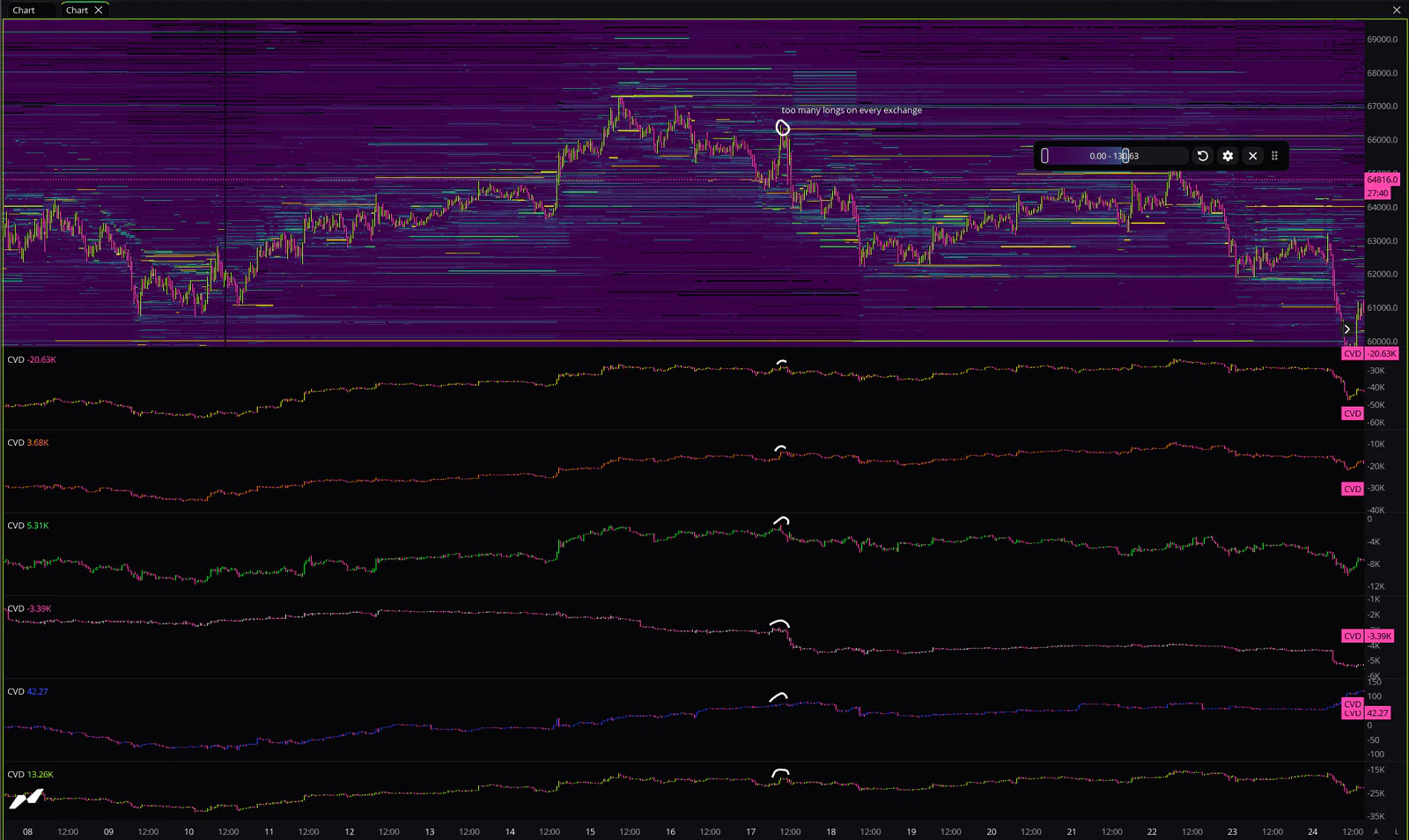
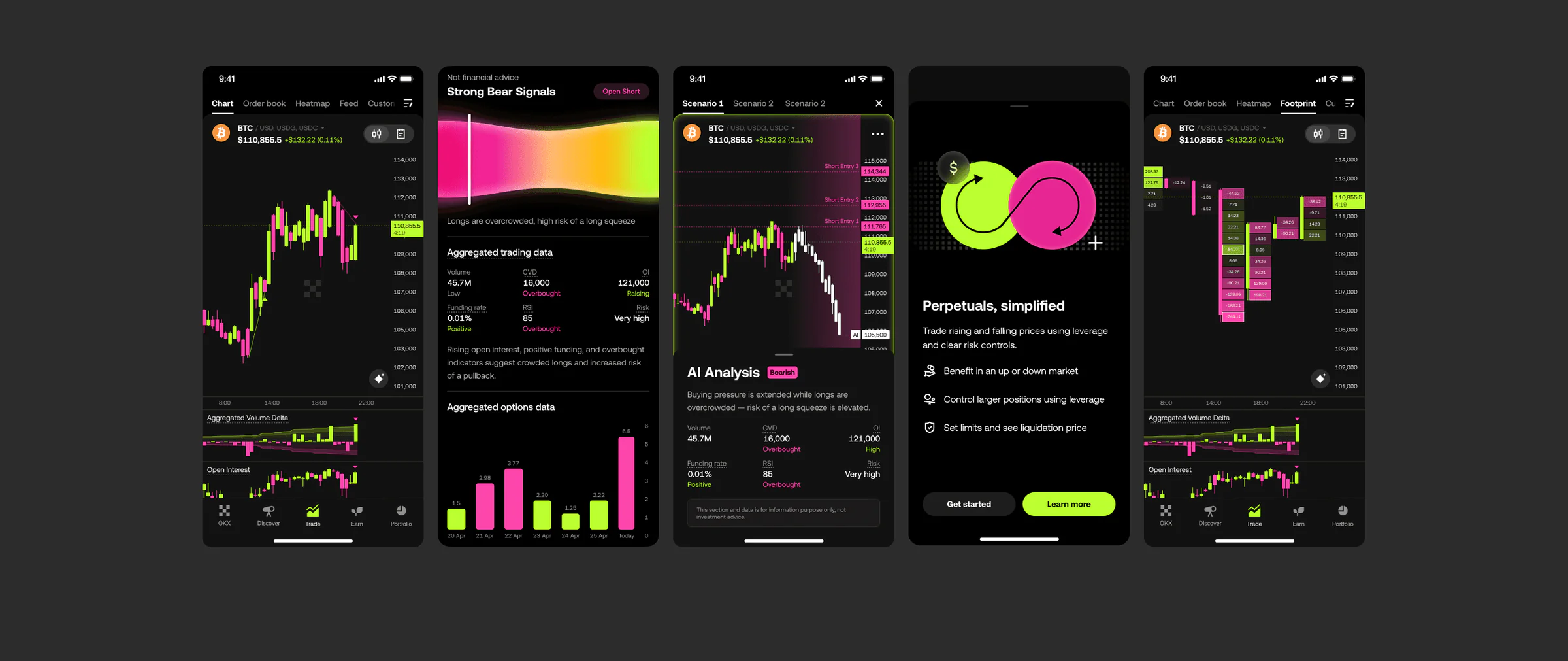
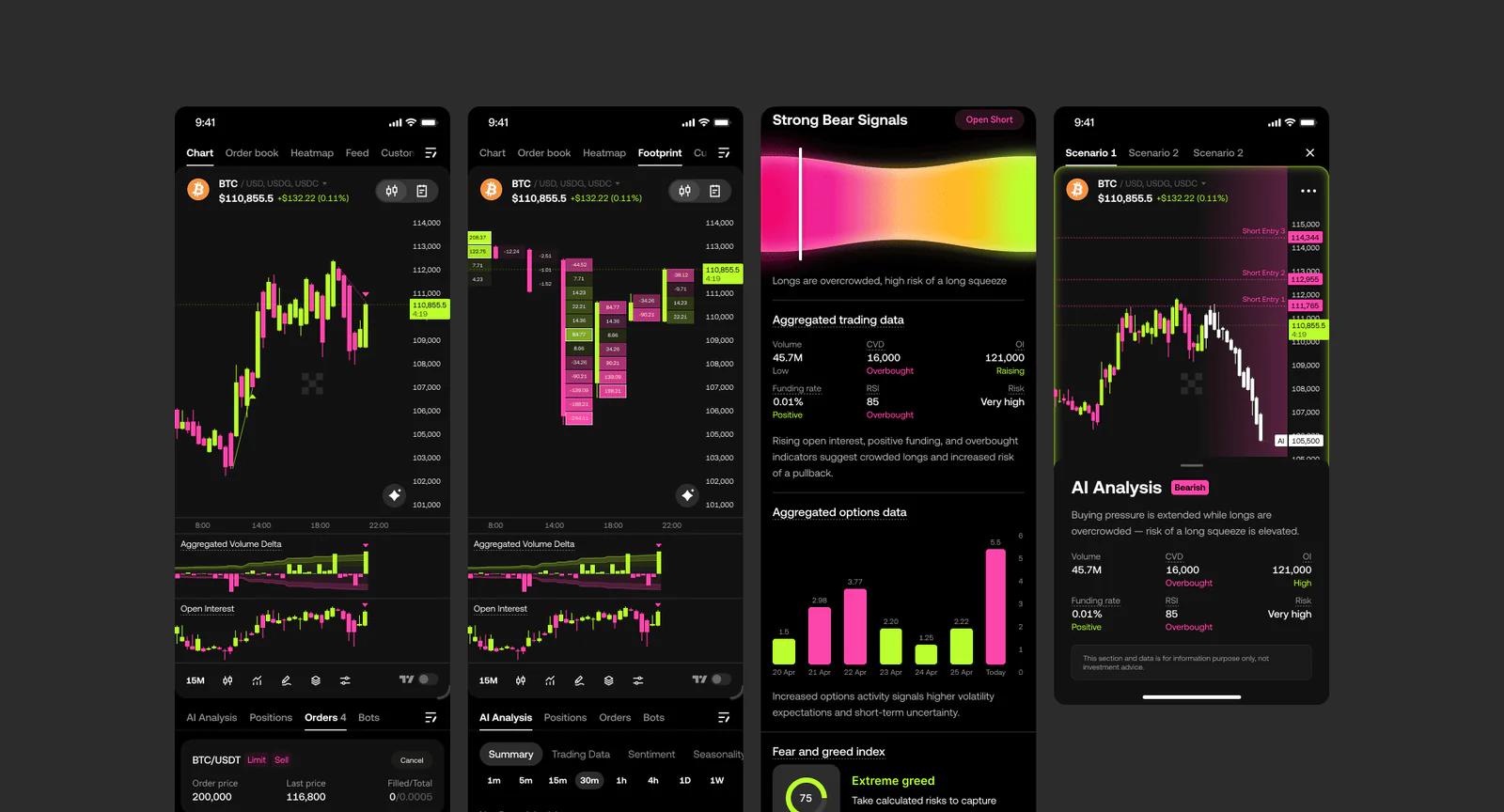
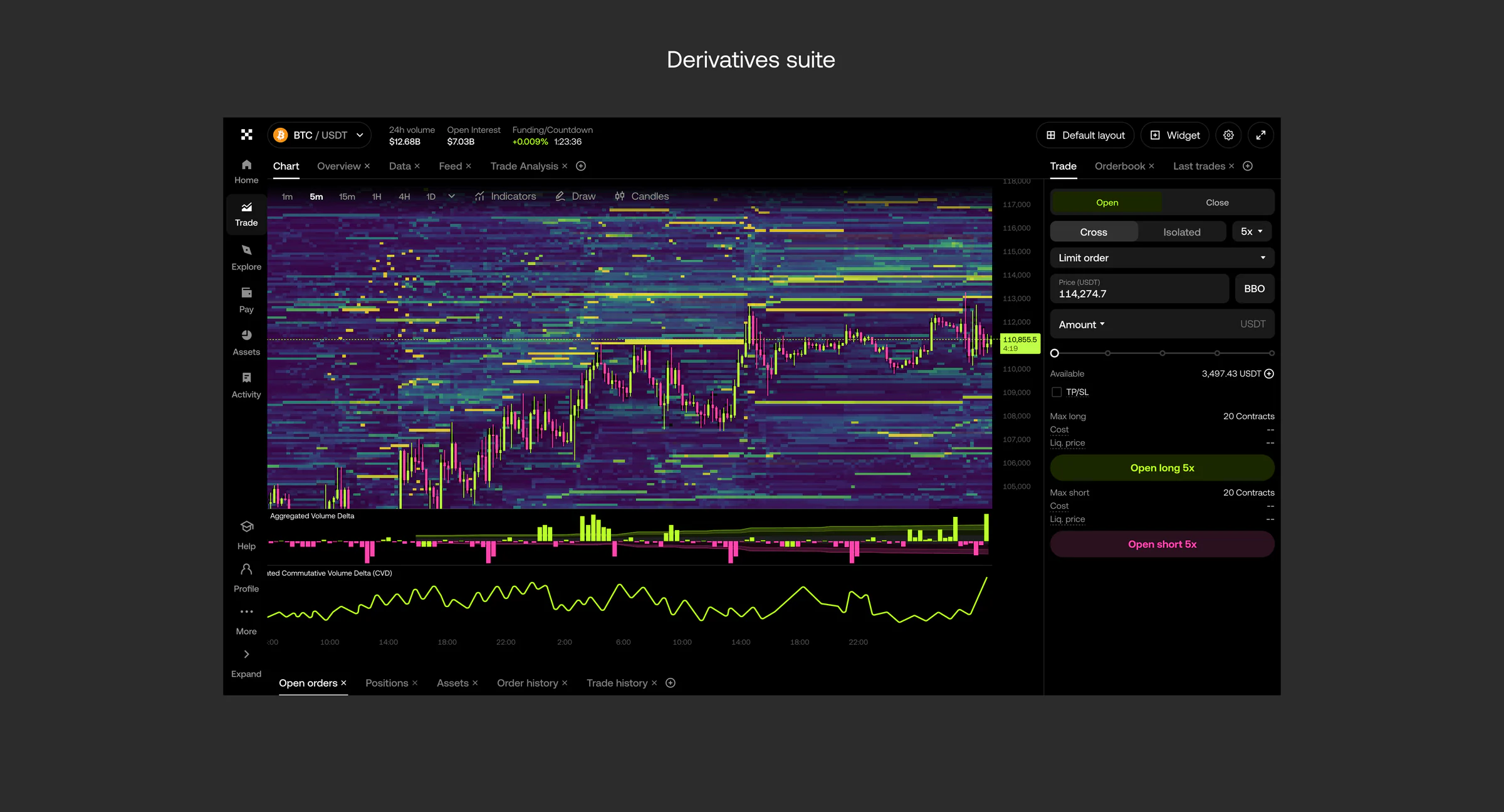
The vision brought the fragmented workflow into one place: AI Market Summary, Footprint Charts, Order Book Heatmaps, on-chart derivatives data, custom workspaces and an opportunity screener.
Work
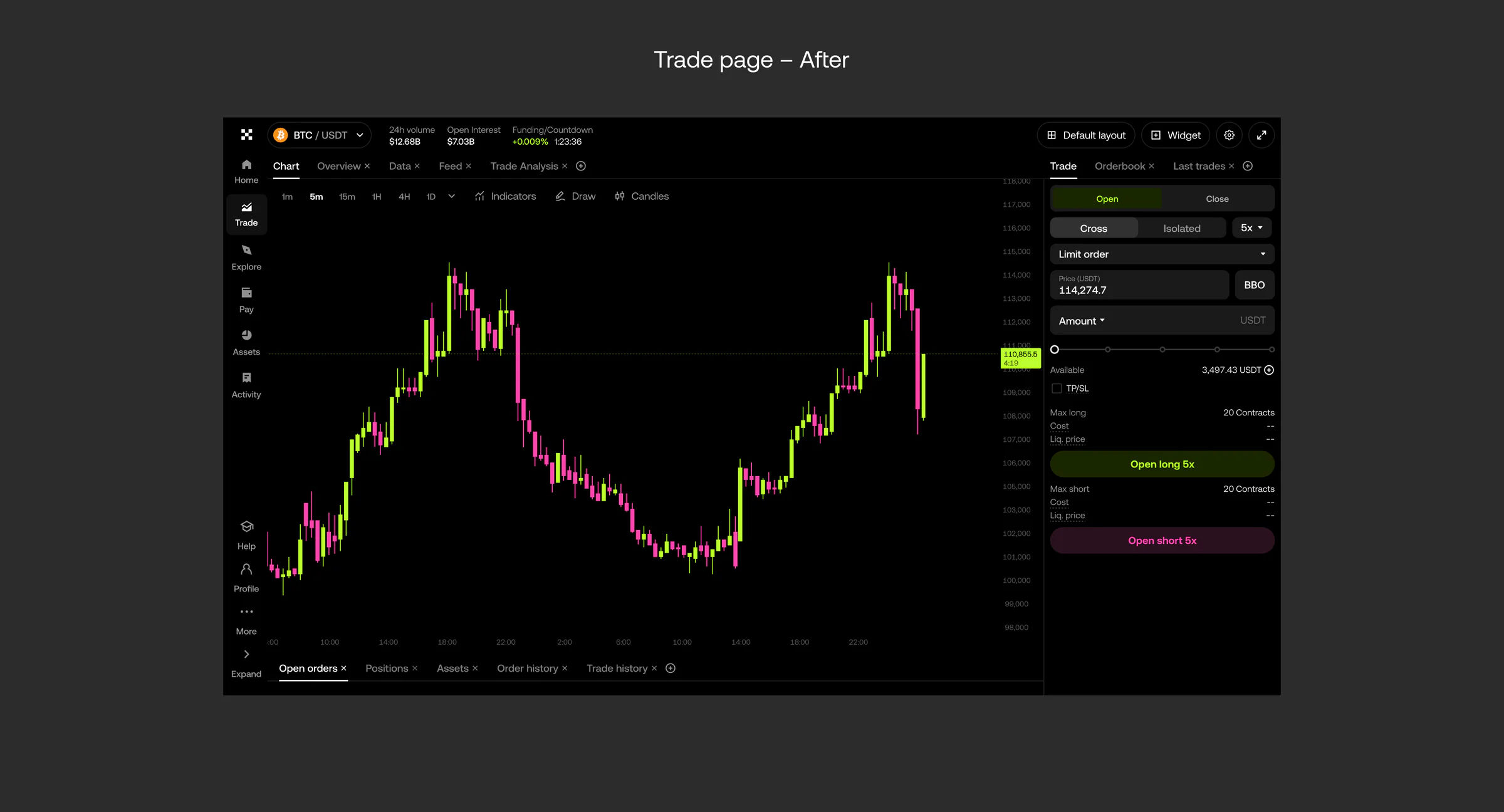
I led the vision for a modular trading experience where traders could add, resize, rearrange and save their workspace around how they trade.
At the same time we brought more of the analytical workflow into OKX — Footprint Charts, Order Book Heatmaps, CVD, Open Interest, advanced drawing tools and opportunity discovery. The goal wasn’t to add more information; it was to give traders control over the information they need.
The solution & outcome
The work established a new direction for OKX Trading and aligned Web, Mobile, Data and AI teams around a shared vision — from a fixed execution interface to a flexible workspace built around the trader.
- +15% 30-day retention
- +25% session duration
- +5% volume per user
- +12 NPS
European X-Perps
Problem
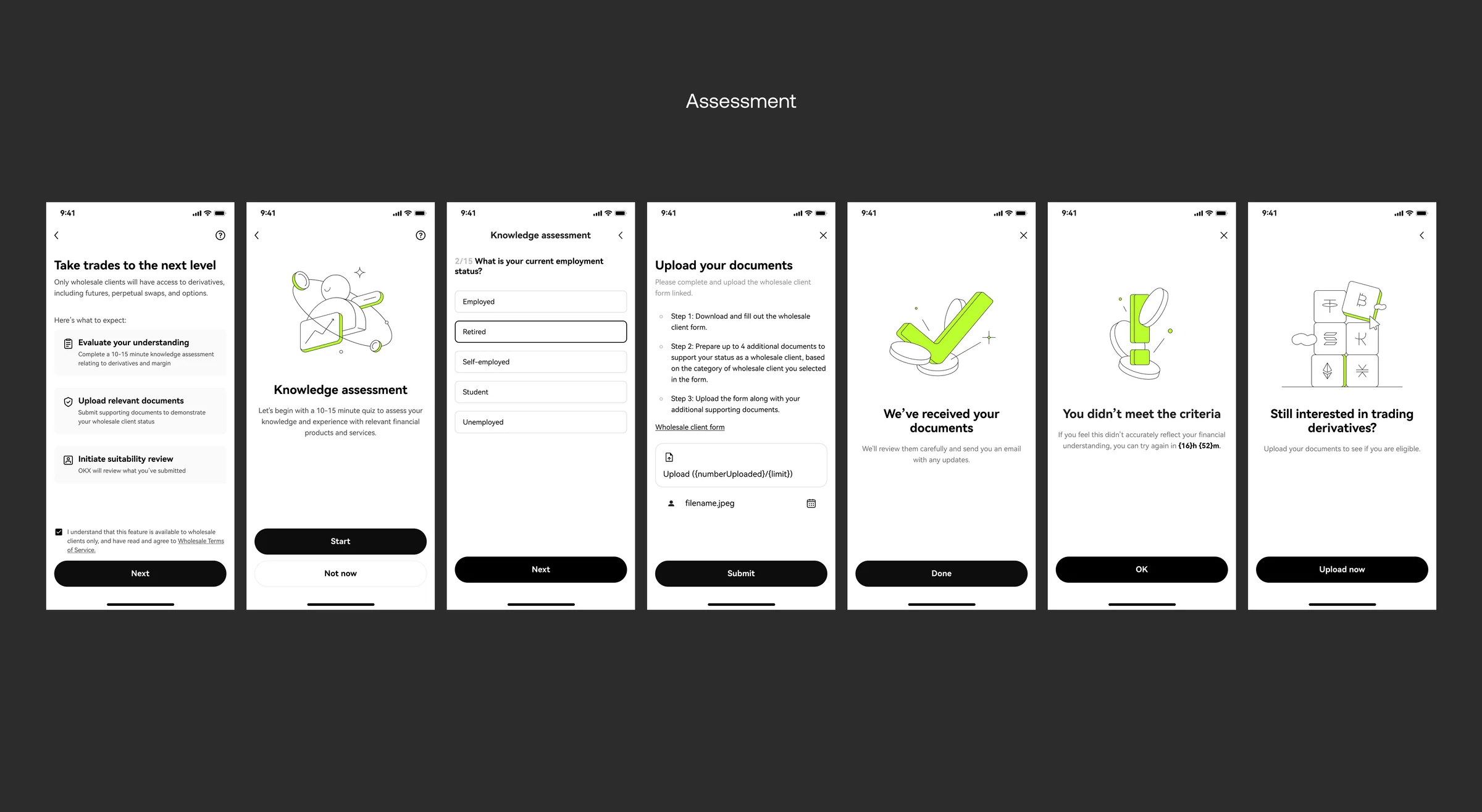
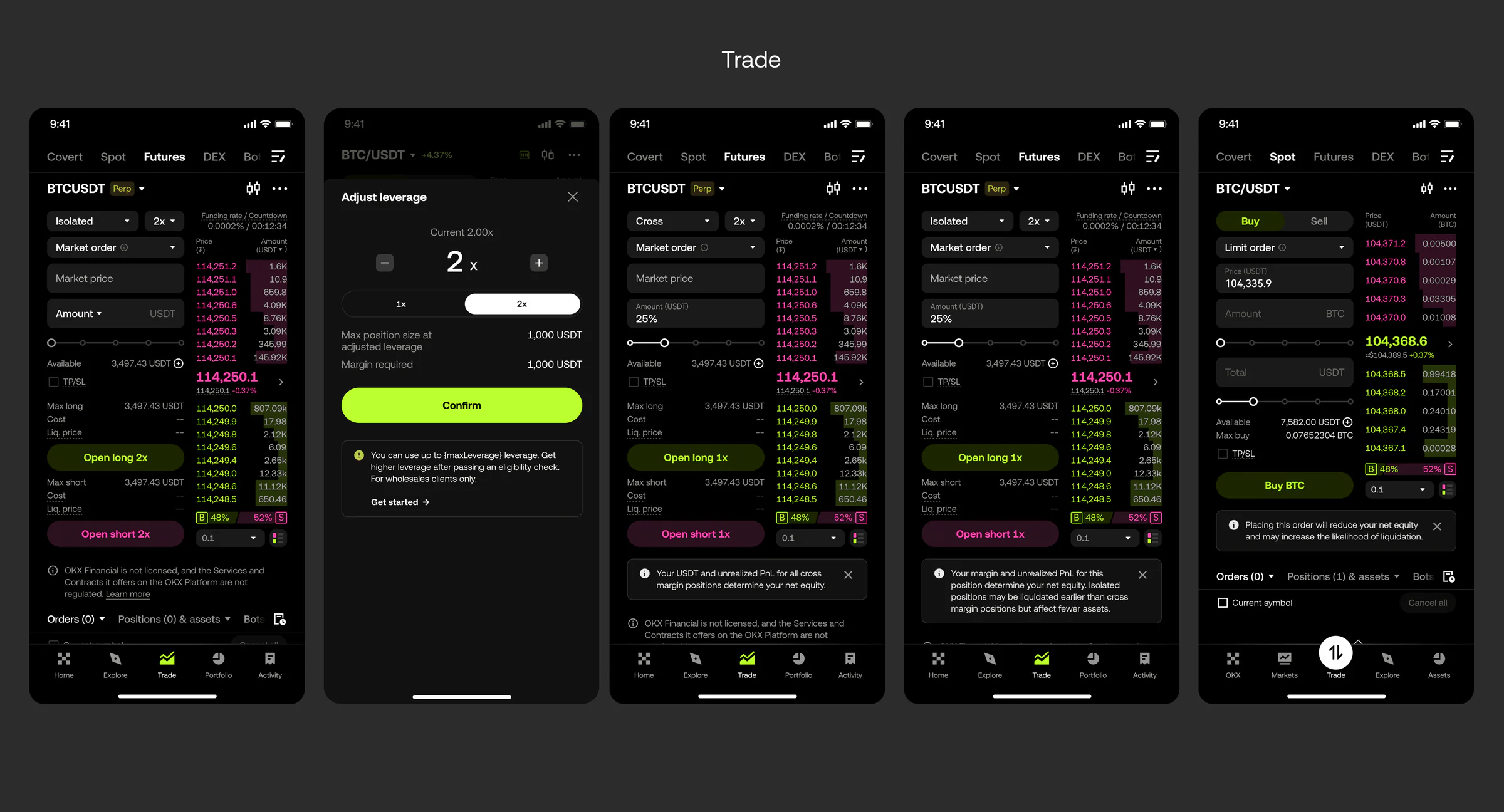
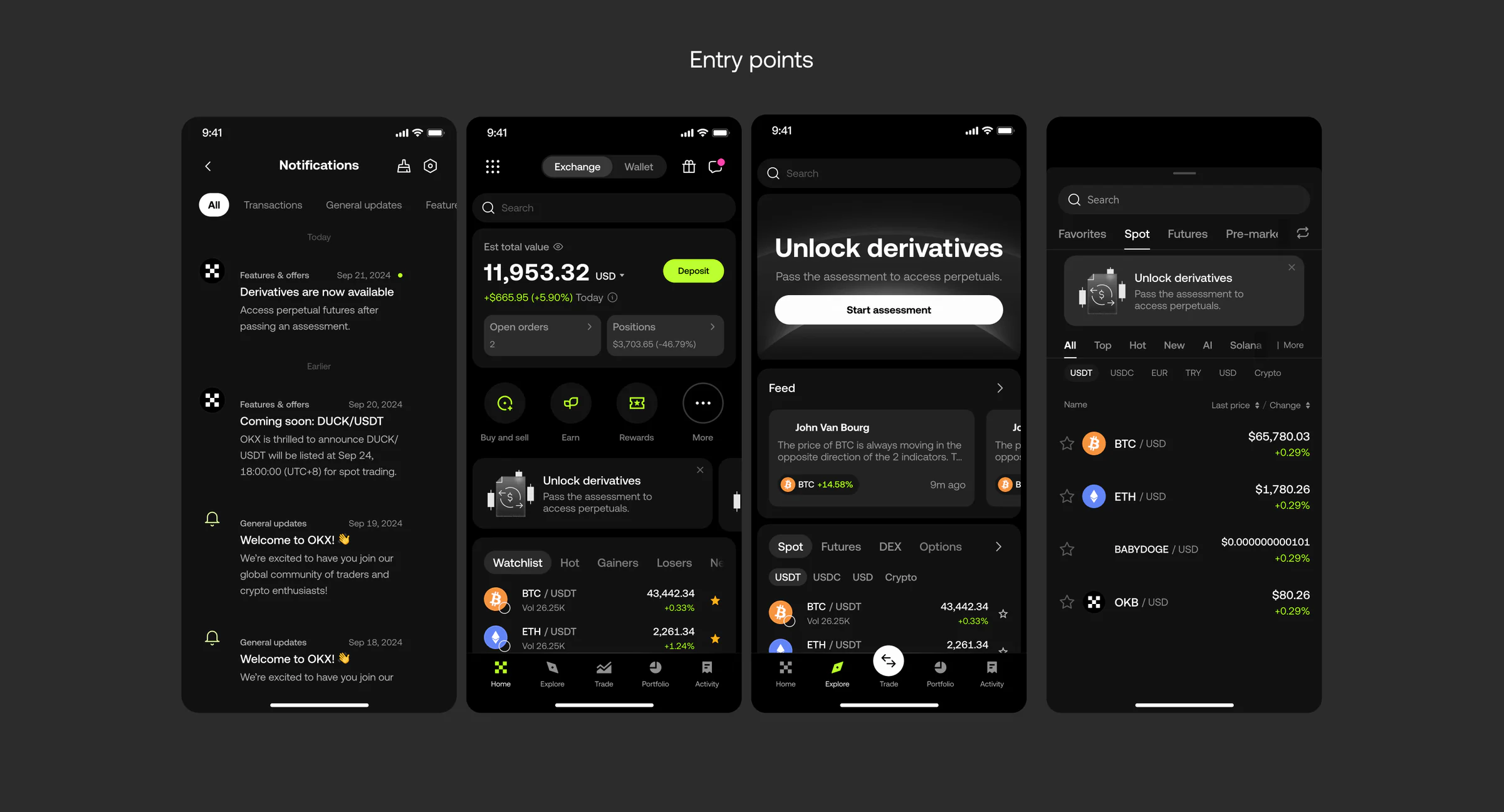
Bringing derivatives to Europe wasn’t simply a matter of enabling futures trading. Under the new regulatory framework, existing Spot users had to become eligible, understand a significantly more complex product, pass compliance checks, activate the right account configuration, fund it correctly — and only then reach their first trade.
Every additional step created another opportunity to lose a trader before they ever placed an order.
Research
At a major European crypto conference we interviewed 34 KOLs, professional traders and advanced retail traders about how they actually trade derivatives — from discovery and account setup to funding, execution and position management.
One particularly damaging failure state was the “zero available balance” problem: users could hold funds on OKX yet arrive on the trading surface unable to place an order. The problem wasn’t just the Trade page — it was the entire journey before the first trade.
My role
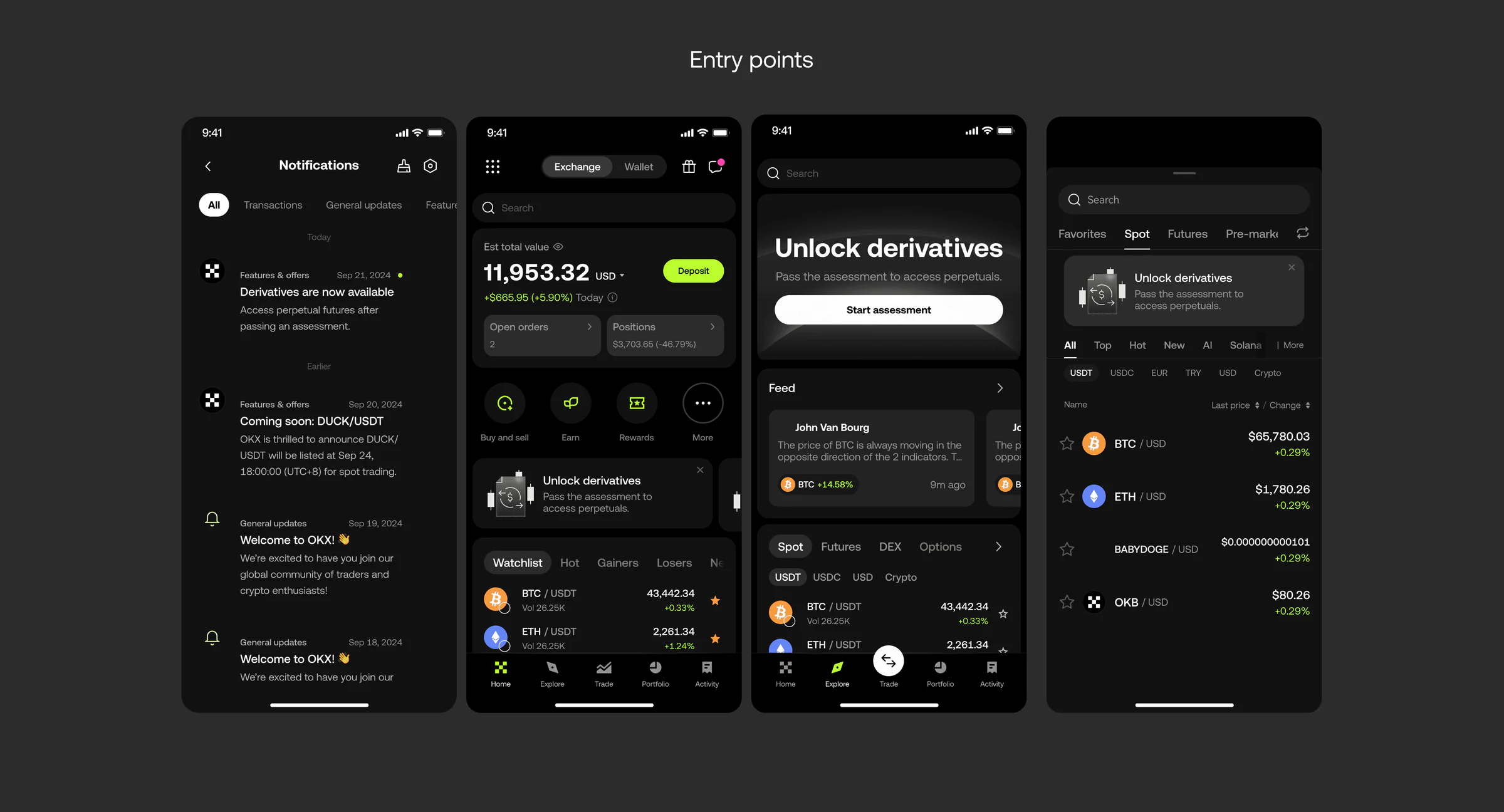
I led the end-to-end product design for X-Perps, from the first derivatives entry point to the first executed position: discovery and entry points, eligibility and appropriateness flows, Spot → Derivatives activation, funding states, a fix for the zero-available-balance failure, first-time onboarding, the Trade experience, order entry and position management.
Instead of treating regulation as a sequence of interruptions, I worked with Product, Compliance, Legal and Engineering to make it one progressive activation flow.
Outcome
X-Perps launched across 30 EEA markets. Adoption consistently exceeded our initial expectations, and internal dashboards repeatedly reached new highs as traders activated derivatives accounts.
- 120K+ activated traders
- $450M+ peak daily volume
- 6 weeks of consecutive trading-volume all-time highs
Rethinking web for advanced traders
Problem
Product data showed most OKX users were active on mobile, with only a small percentage on web. But after interviewing 34 advanced traders and KOLs across Europe, we uncovered a different story.
Traders weren’t choosing between mobile and web — they used them for different jobs. Mobile was for monitoring and managing positions; web was where they analyzed markets, made decisions and executed complex trades.
What I did
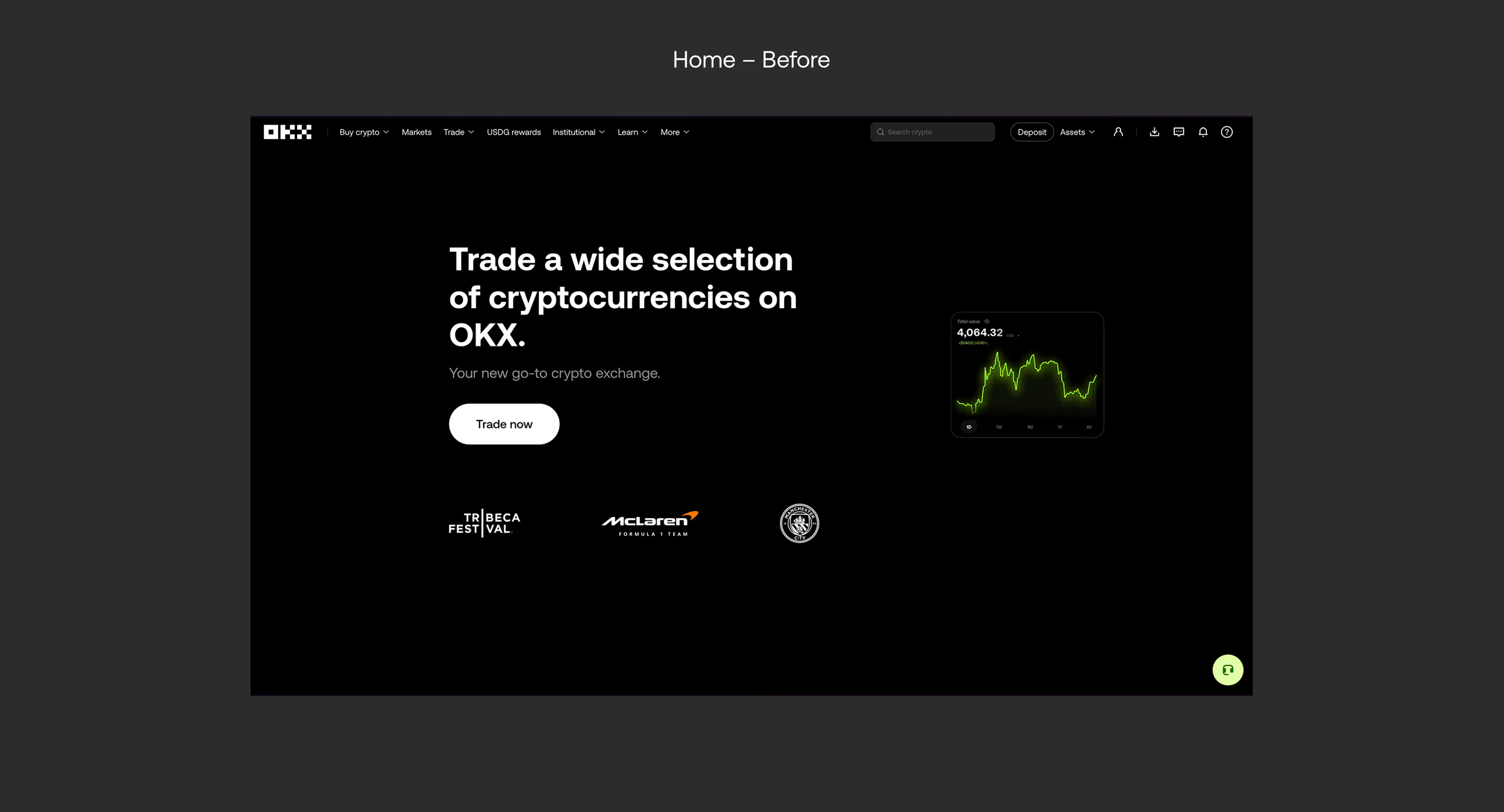
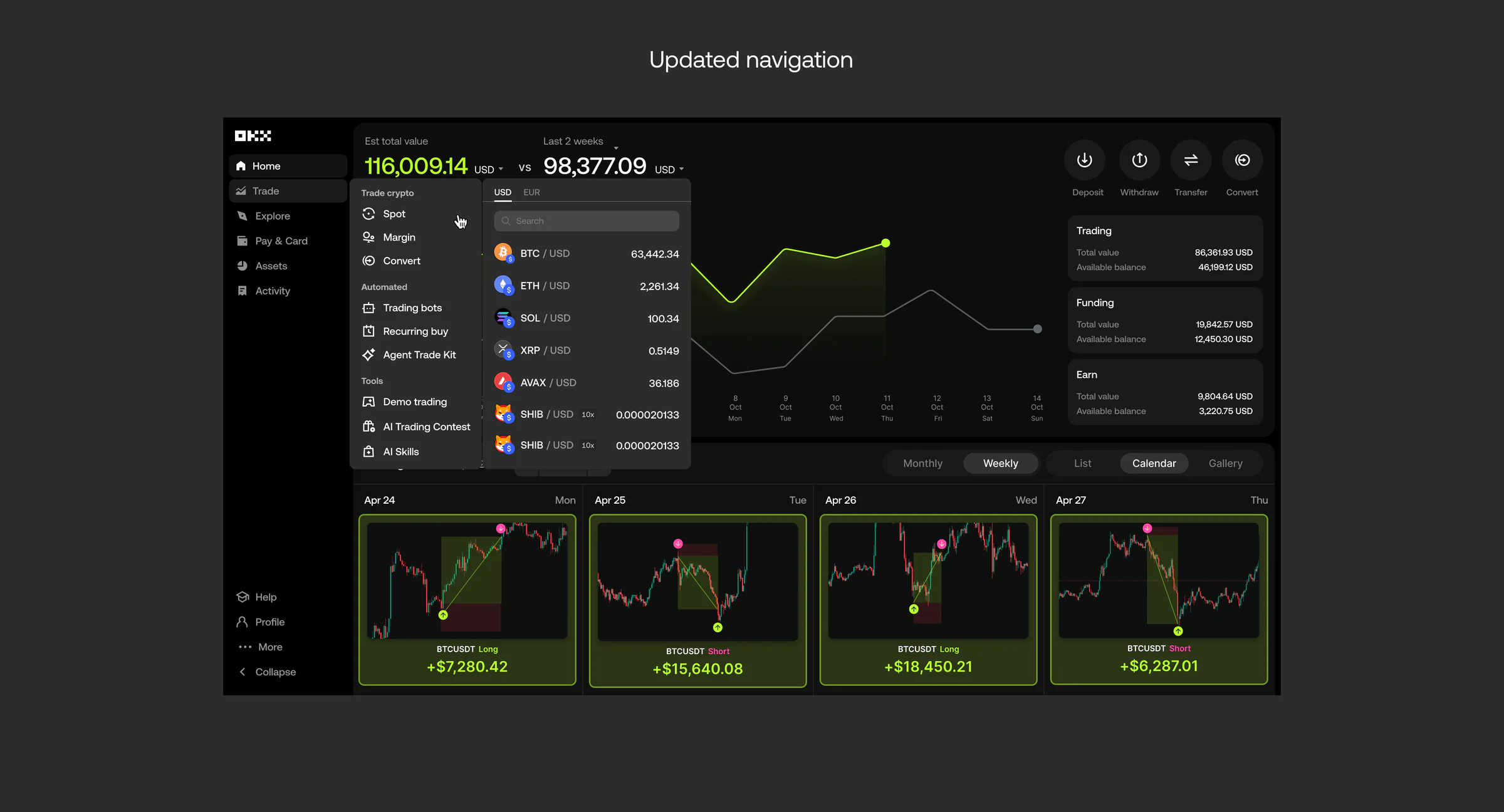
Our web experience had been underinvested in. Navigation was overloaded and poorly personalized, logged-in users landed on essentially the same marketing homepage as logged-out visitors, and many patterns had diverged from mobile.
We reframed the role of web around one goal: turn OKX from a place where traders execute into a place where they analyze, decide and execute.
Work
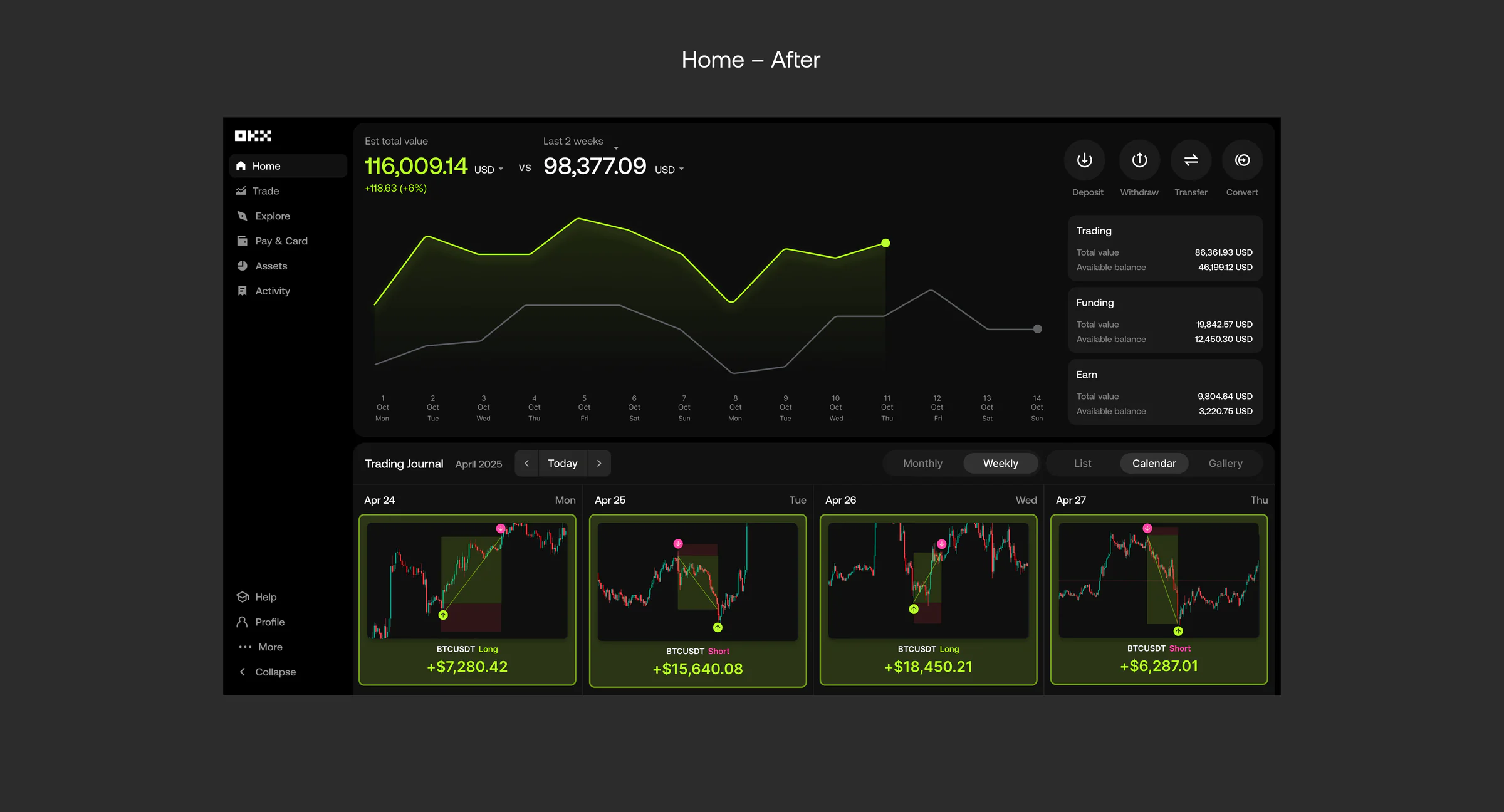
We redesigned around a modular system of widgets traders could add, remove, resize, rearrange and save, with predefined layouts or their own workspace across the homepage and Trade experience.
The logged-in homepage evolved from a marketing surface into a personalized trading dashboard — markets, assets, positions, watchlists and opportunities.
Outcome
The broader strategy is to give advanced traders fewer reasons to leave OKX, transforming web into a customizable daily workspace for the entire trading lifecycle.
- Execution platform → advanced trading workspace.
- Currently in development.
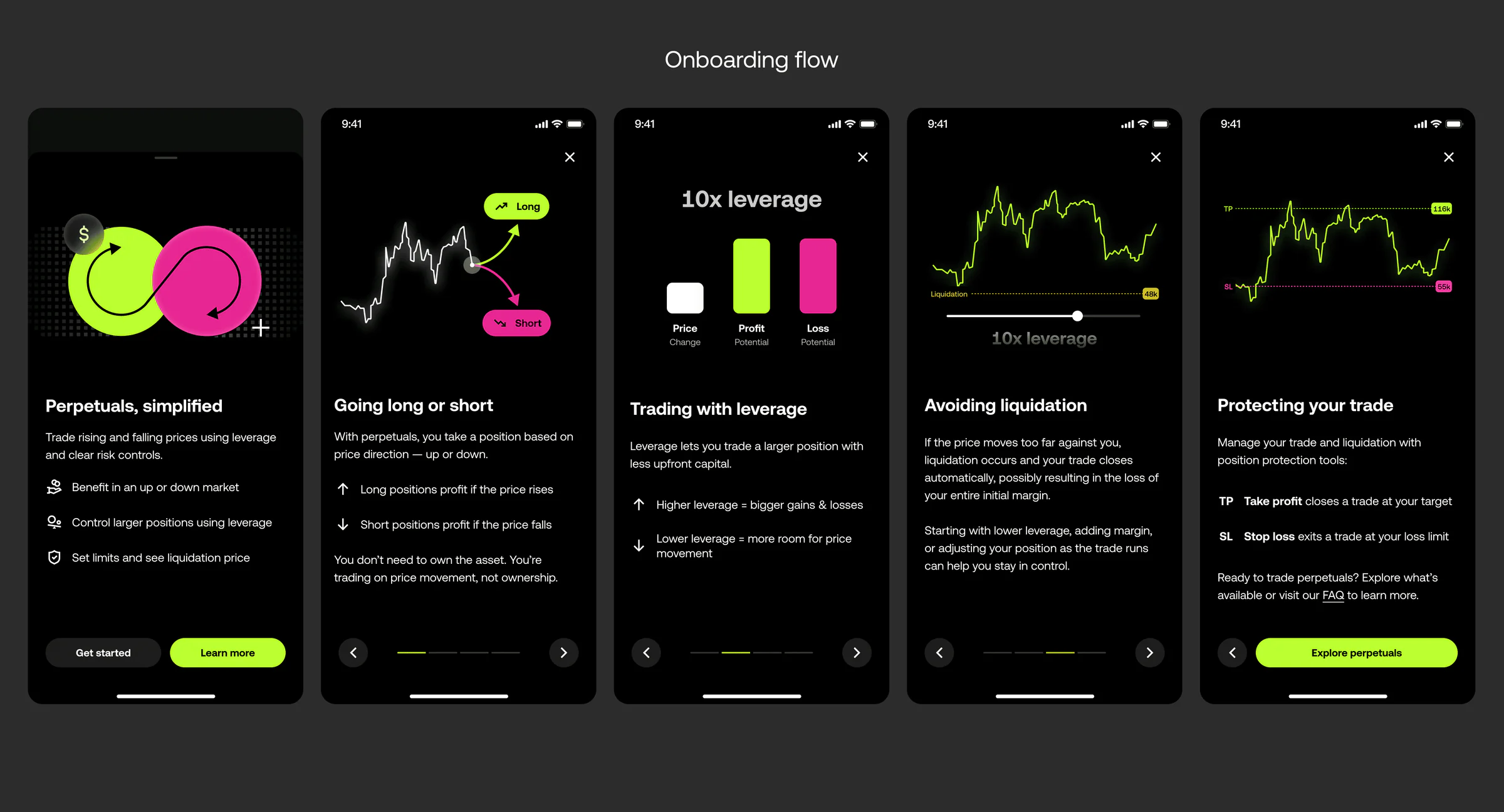
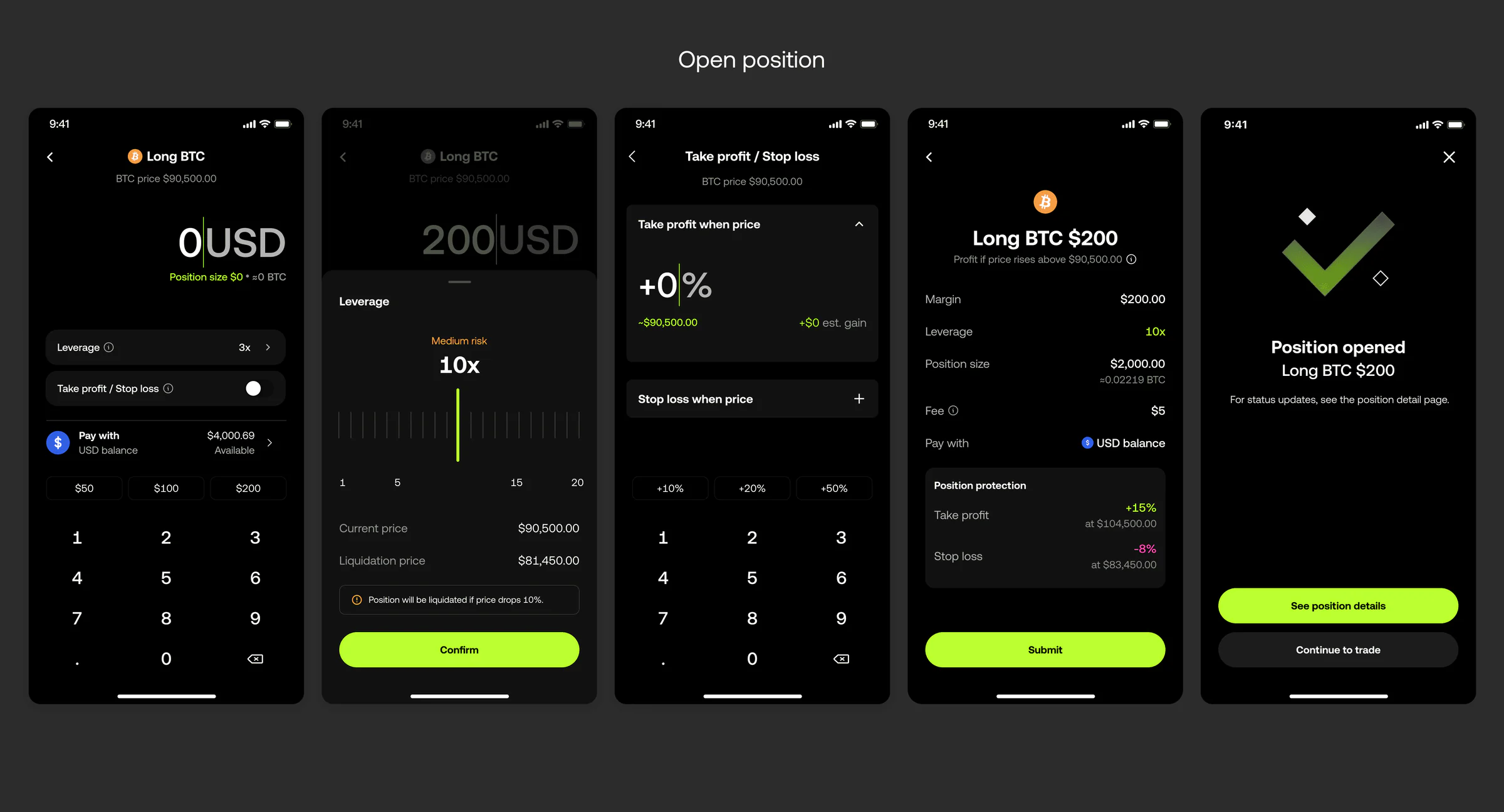
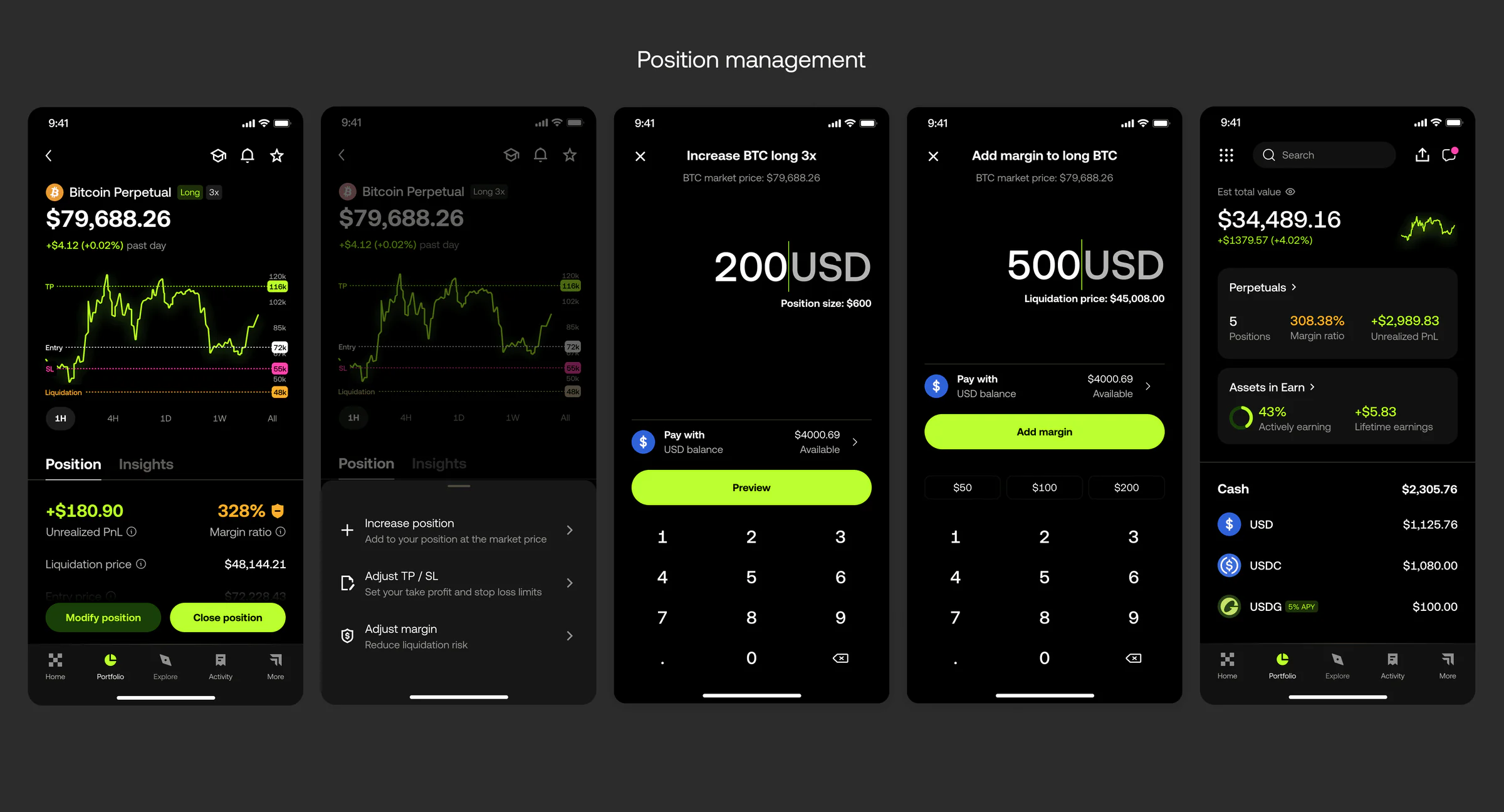
Simple Perps
Problem
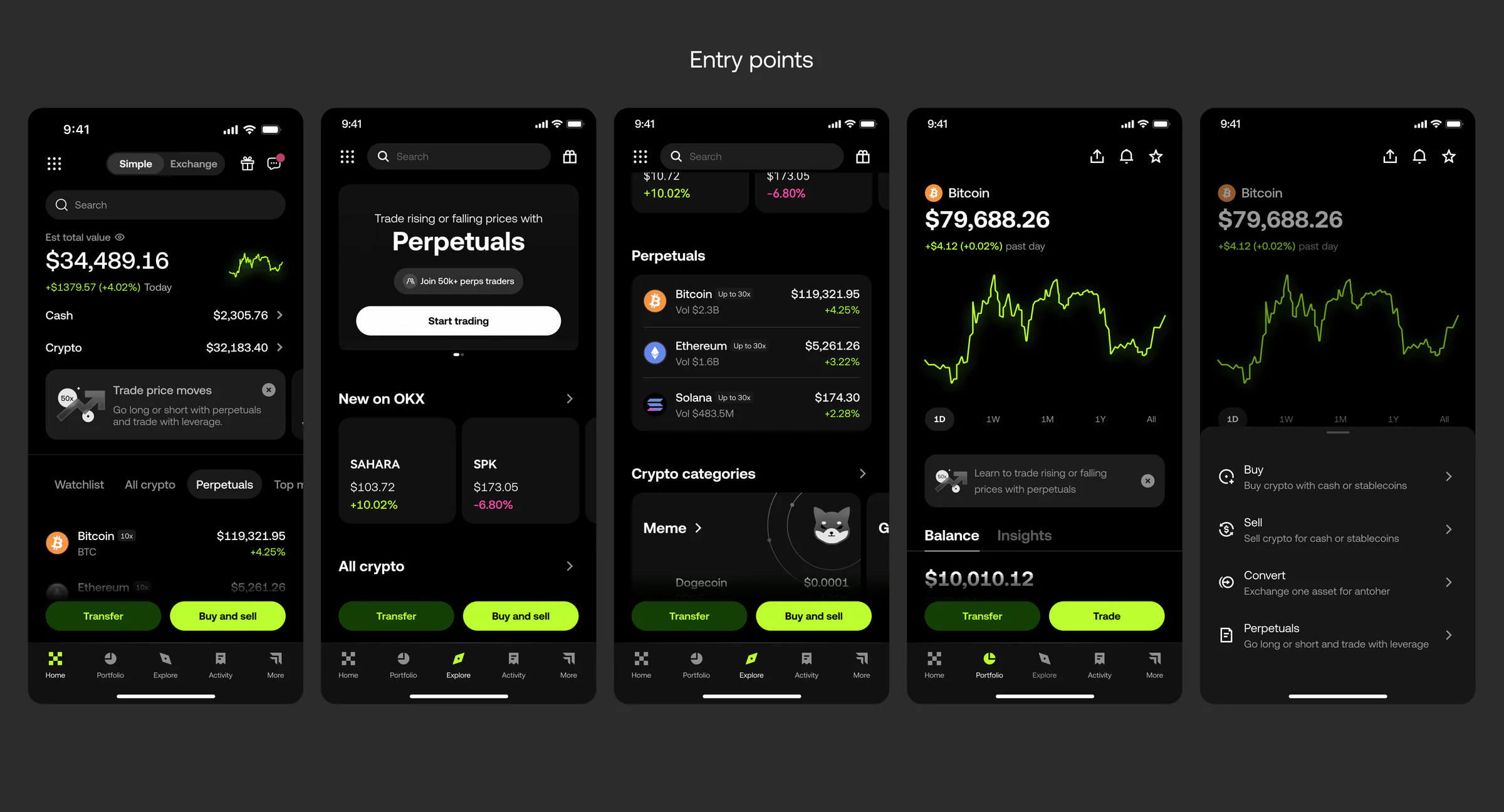
76.3% of OKX’s trading volume comes from perpetual contracts. But perps only exist inside Advanced mode — order books, isolated versus cross margin, manual funding transfers and position-mode toggles — which locks out the retail user base spot-side.
Users who deposit stablecoins, hold spot and have a directional view have no clean way to act on it. They convert opinions into Twitter posts, not positions. Meanwhile Kraken and Coinbase International were building simple-mode perps for exactly this user.
Business case
- Anchored on OKX’s own data. The internal EEA Simple/Advanced volume ratio as a proxy for retail perp adoption. In Feb–Apr 2026 it stabilised at 15.4%–16.7% — roughly one in six dollars of EEA derivatives volume already flows through the simpler surface, before we ship anything.
- Applied the ratio to competitor benchmarks. Kraken Total Perp TV from their public Futures API, Coinbase International from the perps dashboard.
- Multiplied by published taker fees for a defensible monthly revenue estimate per platform.
Personas
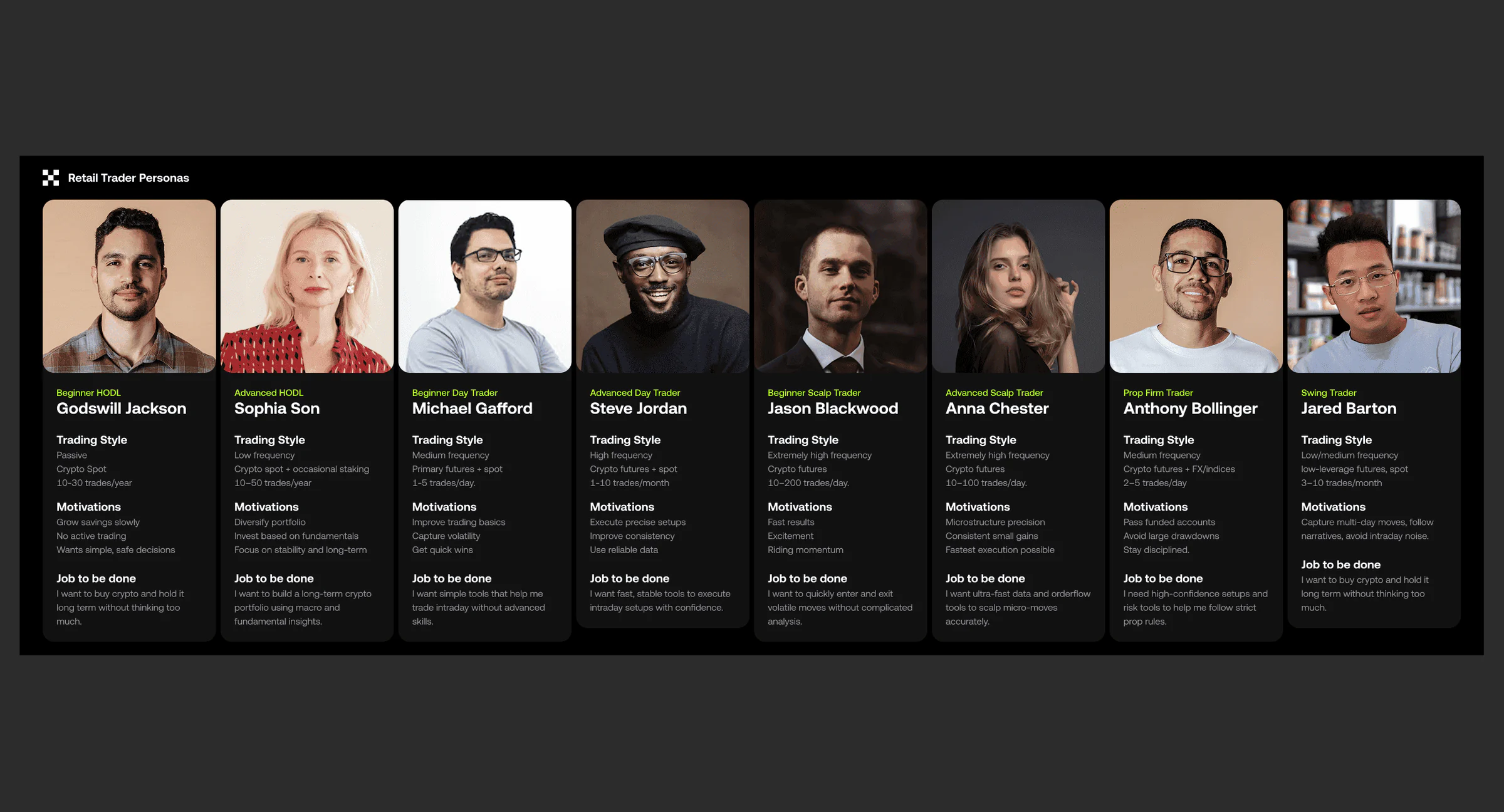
Directional Daniel. 25–40, UAE/SG/AU/EEA. Holds BTC/ETH/SOL spot. Opened Exchange mode once, got intimidated, closed it. “I want to express a directional view without losing money to UX confusion.”
Sideline Sofia. 27–42. Sits in $2K–$50K USDT. Won’t move funds into a separate futures account. Fears “a trade turning red while I’m not watching.”
Outcome
- $208M/year opportunity unlocked in roadmap reviews.
- 4-market MVP scope aligned in one quarter — historically six.
- Mandatory SL, 3× default, auto-transfer codified as OKX’s house pattern for all regulated retail derivatives.
- Ships Q3 2026.
Australian retail derivatives
Problem
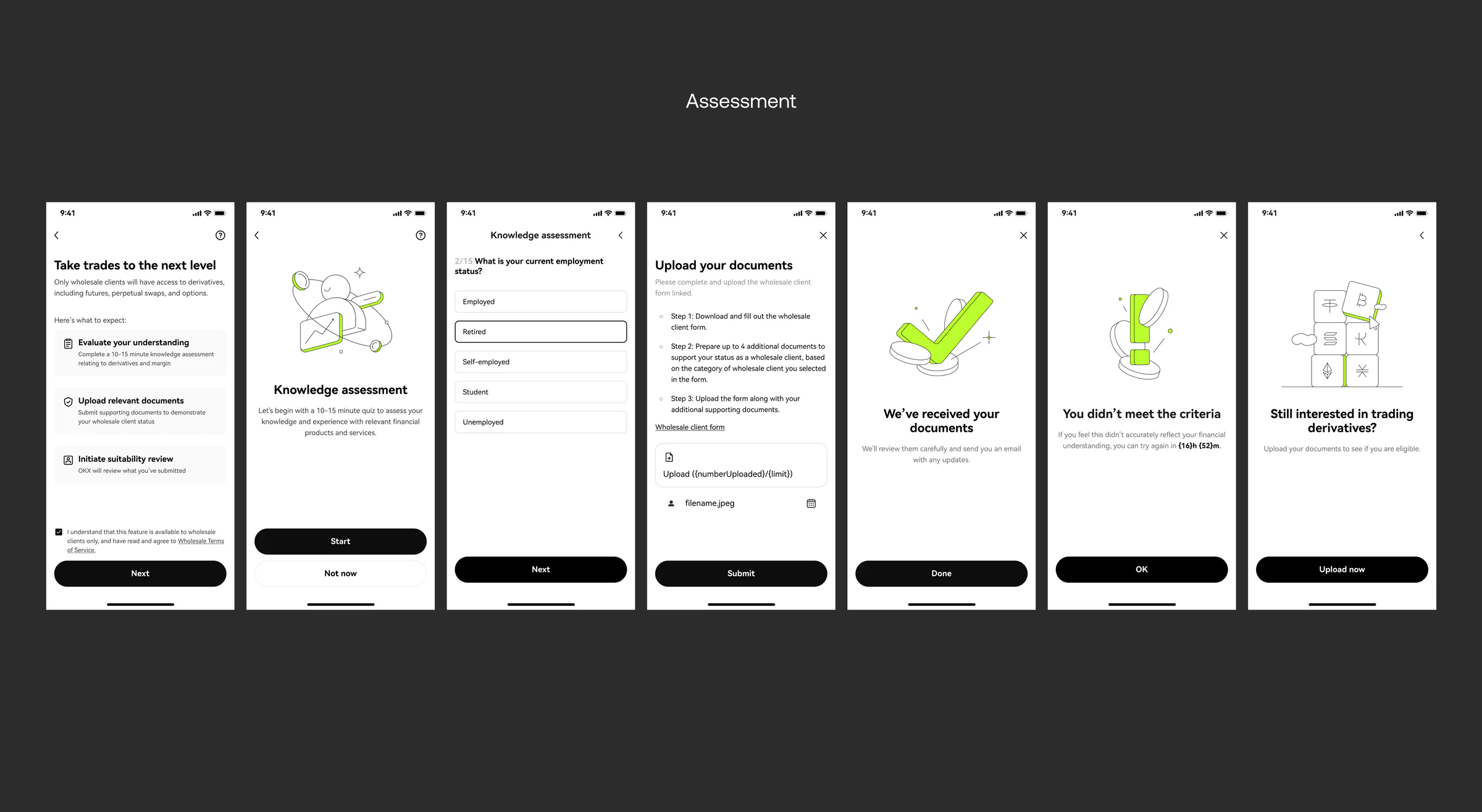
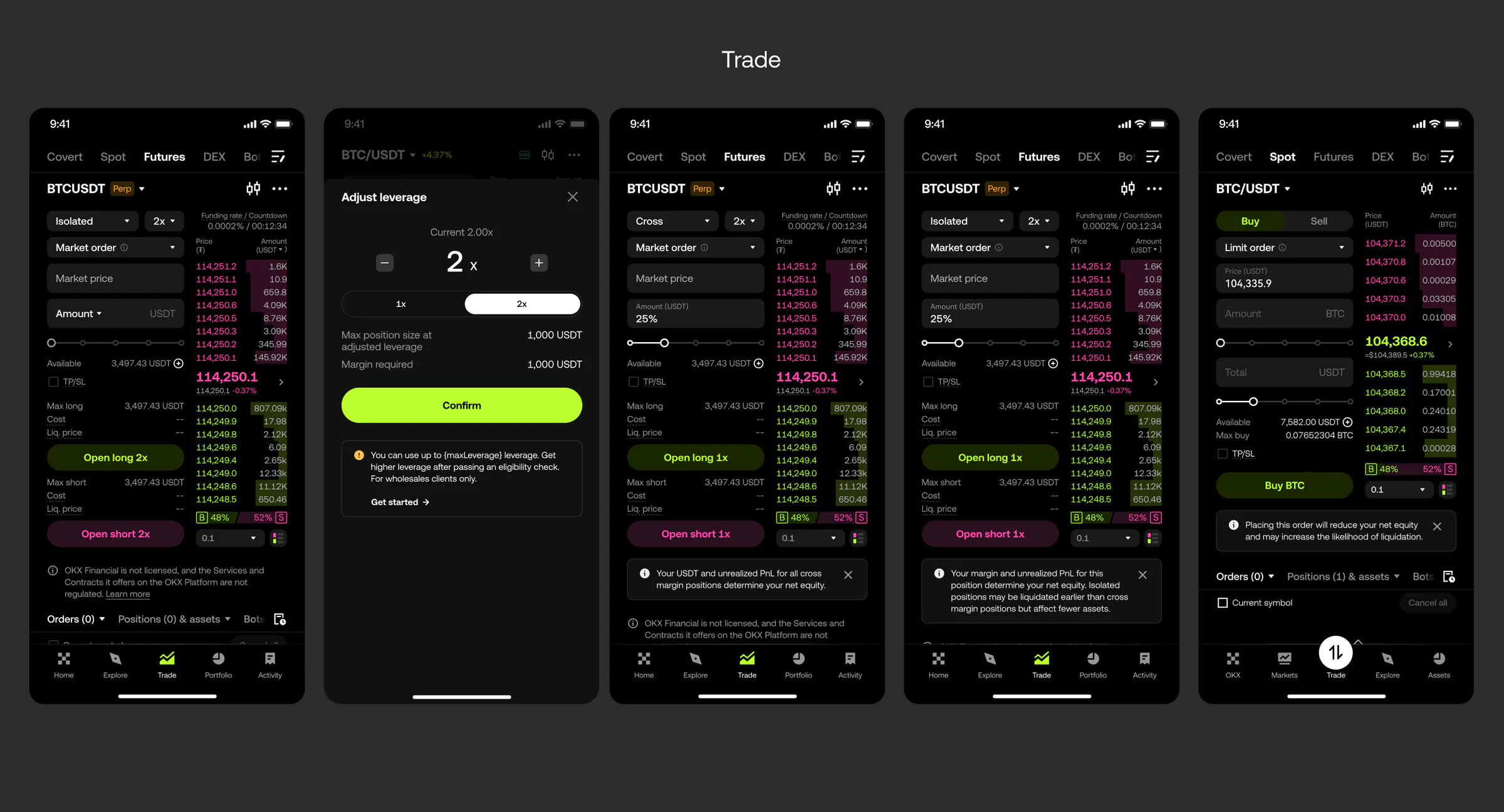
Australia is a high-value, highly regulated crypto market. The goal: become the first ASIC-licensed exchange to offer regulated retail derivatives, without fracturing our global UI architecture.
ASIC guidelines mandated a strict 2× leverage cap and eligibility checks. Internal modeling showed Perpetual Contracts would drive 95% of retail volume, dictating a phased rollout.
The solution
I led the end-to-end design of a two-phase rollout. Instead of treating compliance as a legal roadblock, I designed an eligibility onboarding flow that felt like a premium feature unlock.
Australia isn’t where we win on volume. It’s where we prove the architecture that lets us win on volume everywhere else.
Outcome
- First-mover in regulated retail crypto derivatives in AU. Kraken can’t ship it without an ASIC retail licence, Coinbase can’t ship it globally, Binance can’t ship it in the market at all.
- Architecture validated inside a regulator’s constraints — in the first 30 days Open Interest grew from zero to $23K+ and position holders 1 → 8, every one a fully KYC-cleared, ASIC-supervised retail trader. Small by design; the signal is that the surface works under regulation.
- Single-codebase Simple Perps surface ships in four regions off the AU foundation.
USDG US adoption
Problem
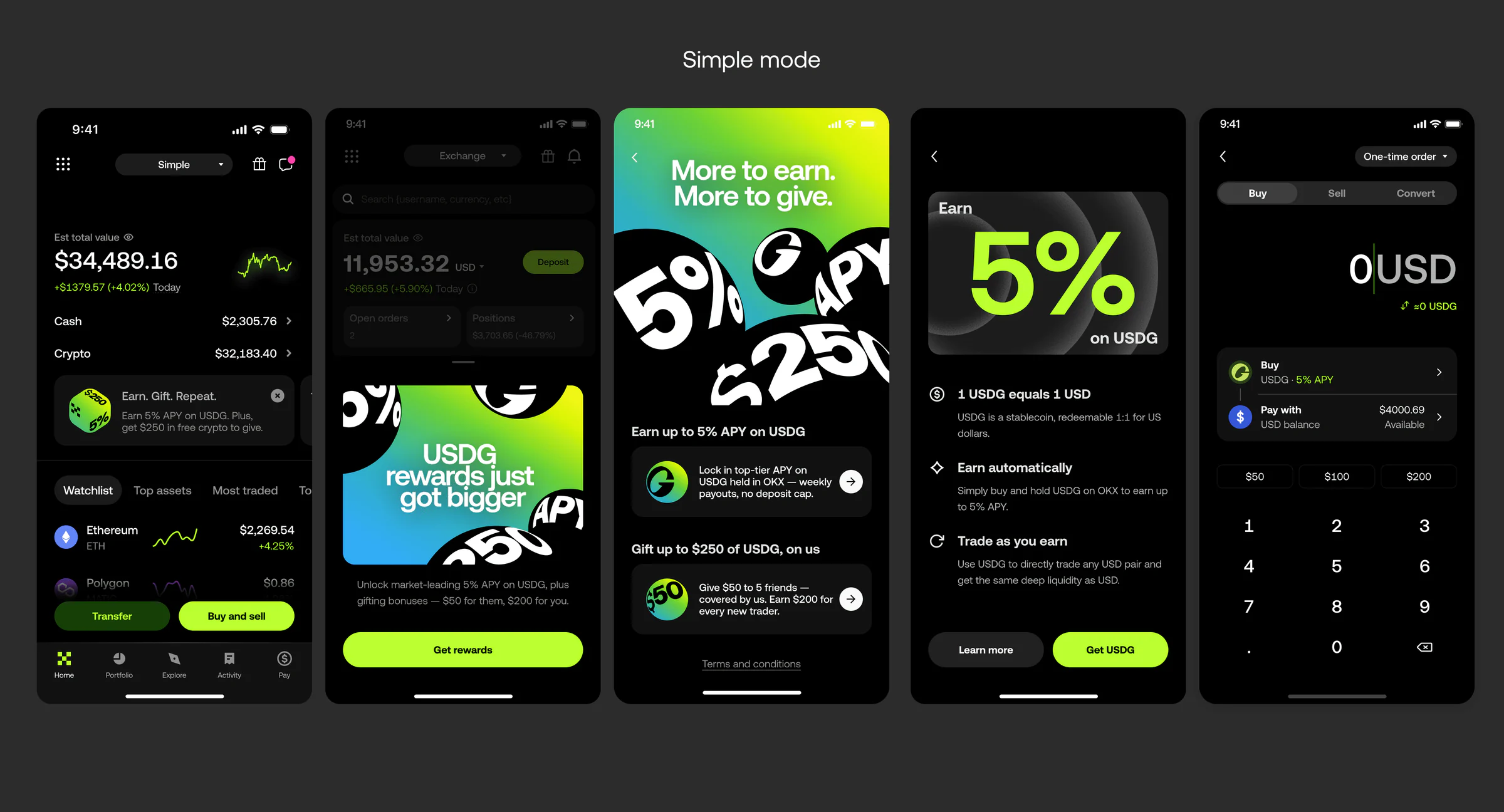
Despite offering a 4.1% APY (boosted to 5%), USDG adoption was stalling. The root cause: users didn’t know the yield existed until they actively sought out the Earn product. Yield was invisible at the point of deposit.
What I did
The objective: increase USDG holdings (target 10× AUM) and OKX’s revenue share from the underlying Earn product (target +15% CTR).
I brought the Earn value proposition into the core deposit flow and led the UX/UI for a cross-platform integration.
Outcome
The deposit-flow integration drove a 15× increase in USDG AUM and increased the baseline CTR on USDG placements by 32%, directly increasing OKX’s Earn revenue.
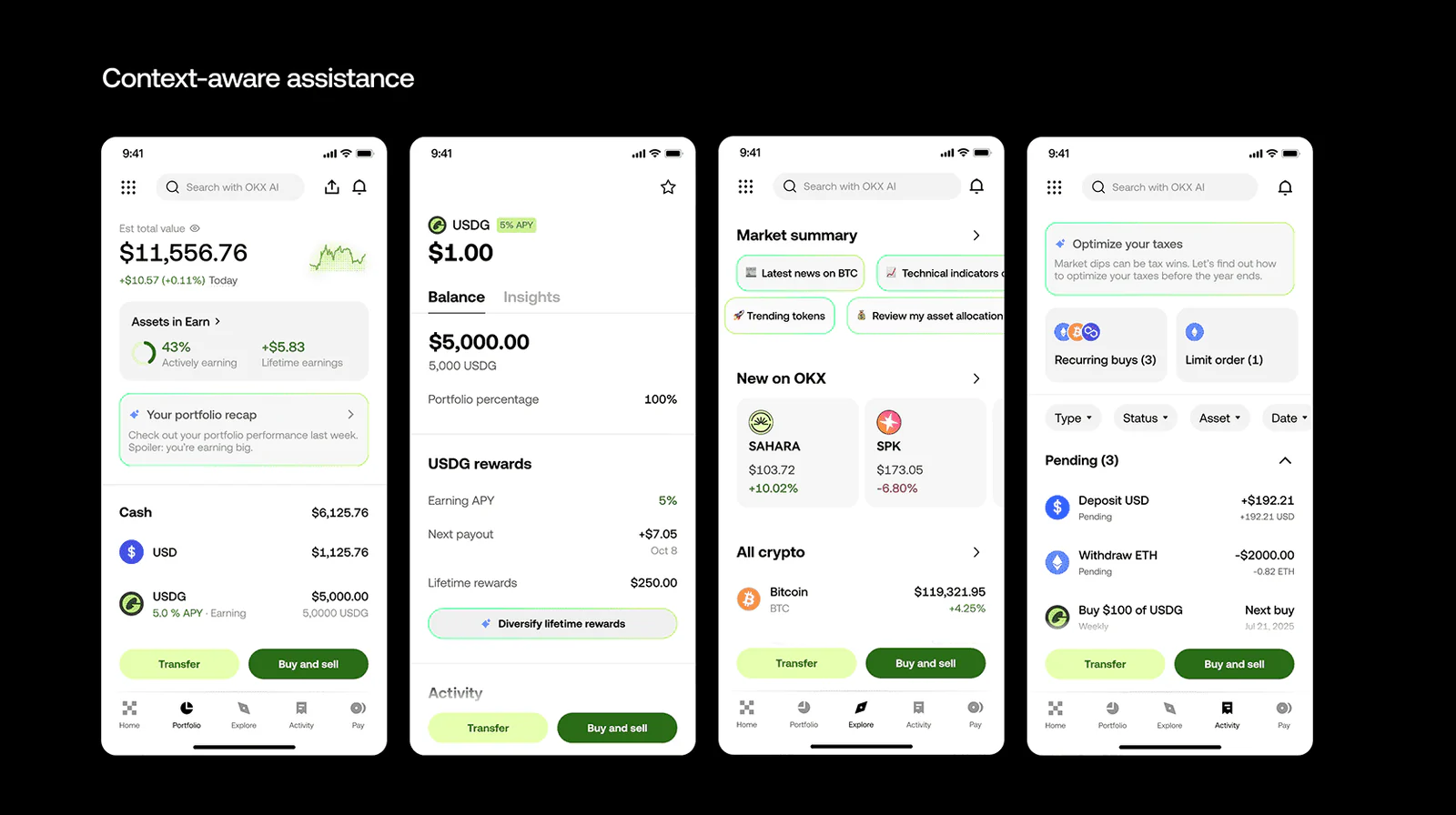
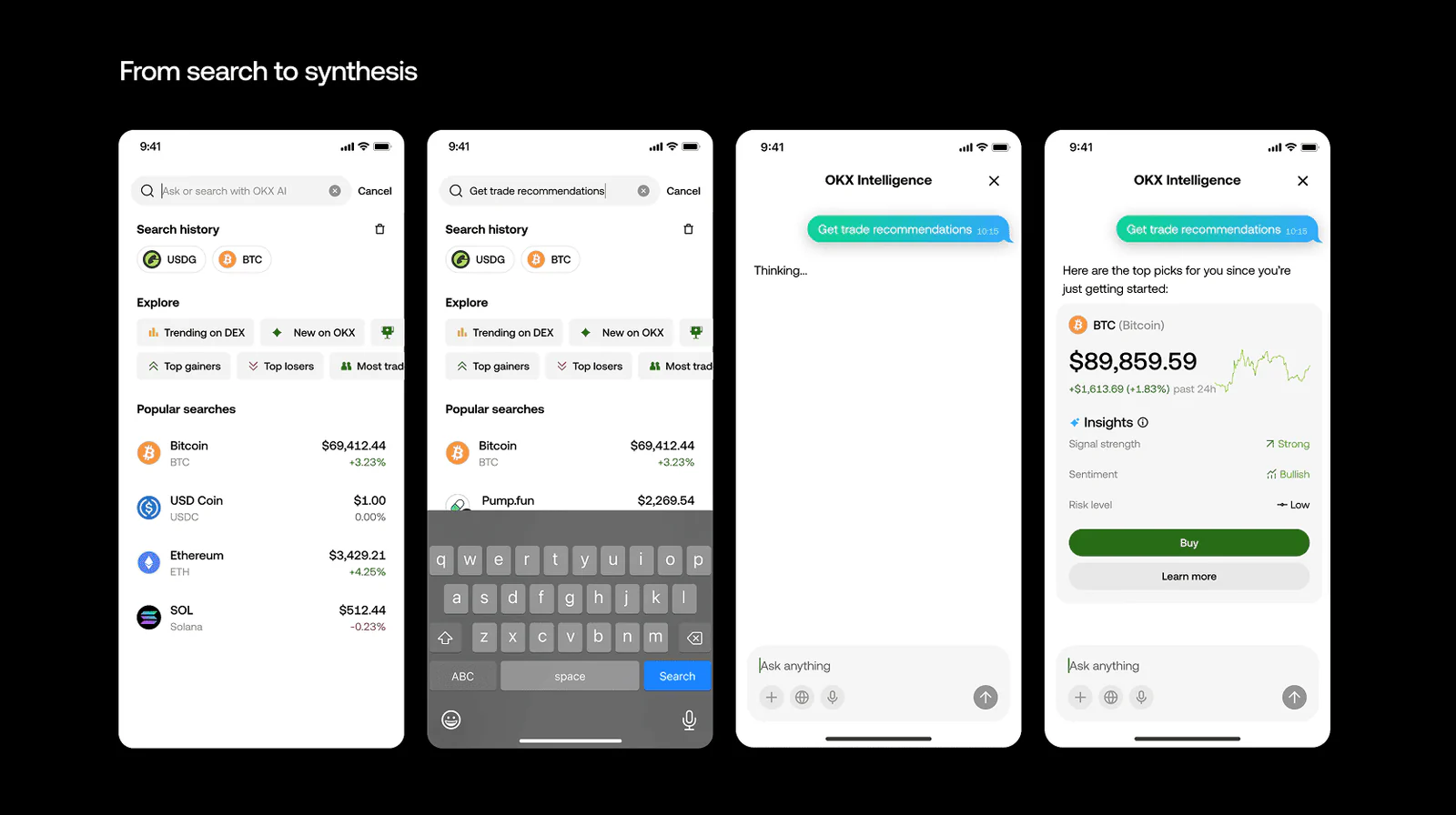
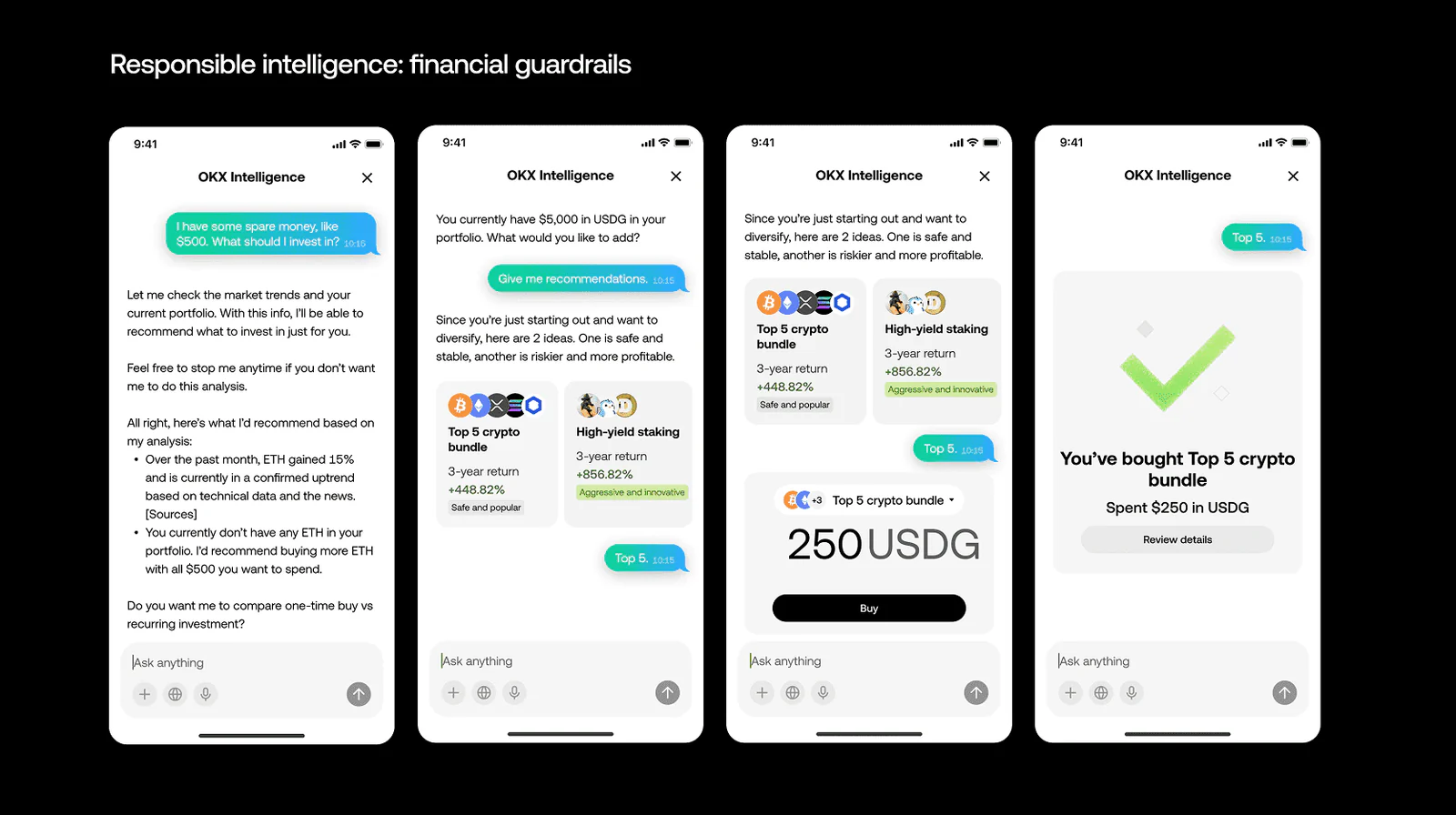
OKX Intelligence
Problem
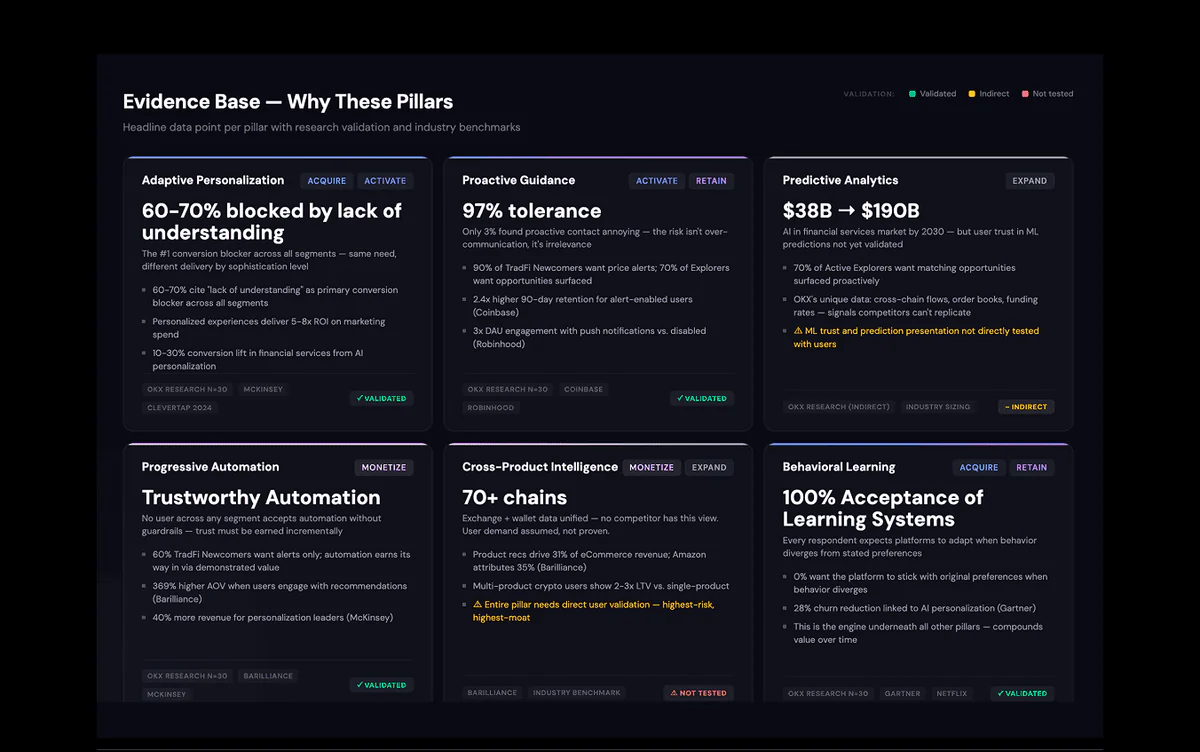
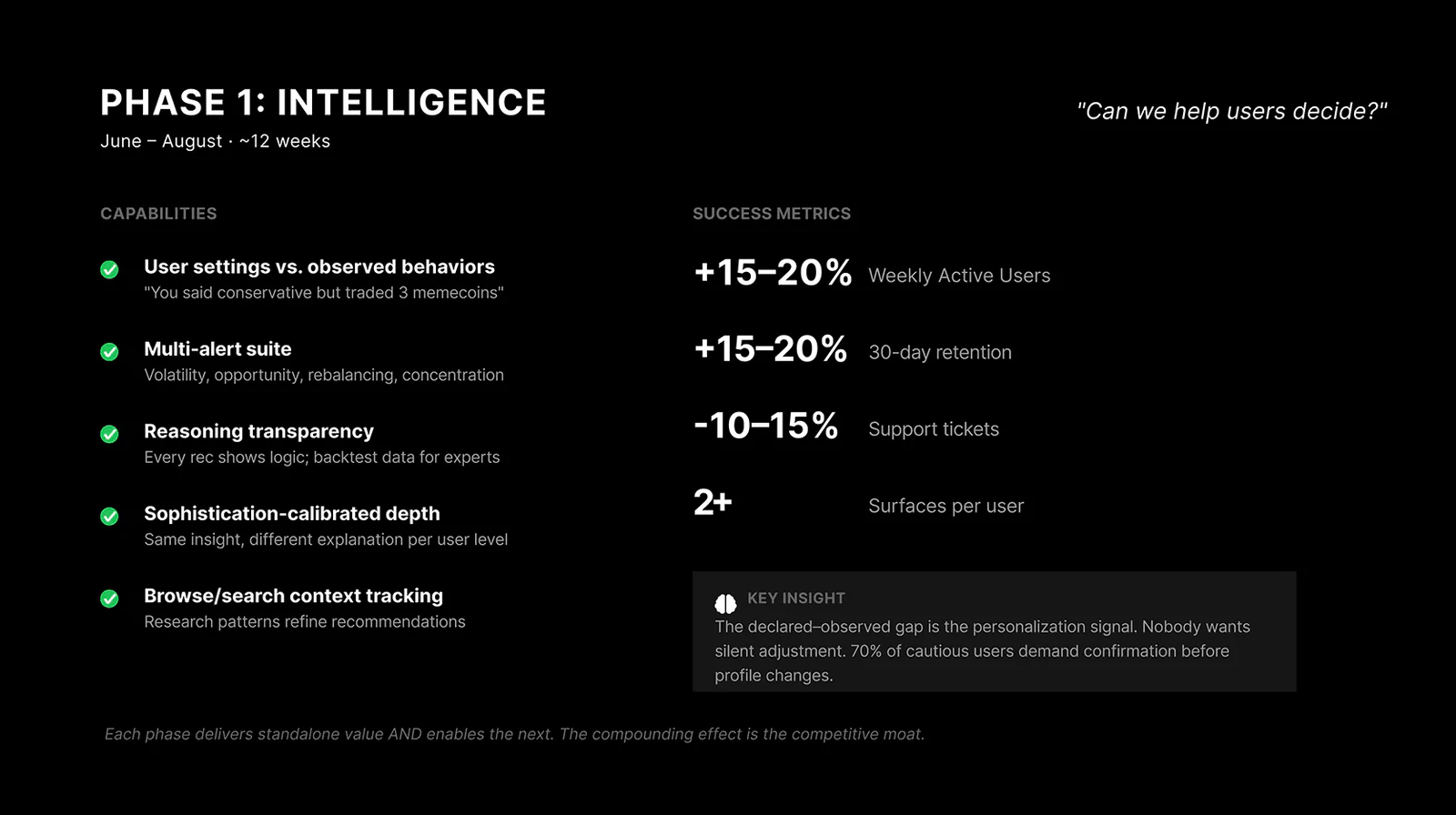
Research revealed a critical bottleneck: 60–70% of retail users cited “lack of understanding” as their #1 blocker. While competitors added standalone chatbots, nobody was building a unified intelligence layer — against a 200M+ digital finance user base.
Six pillars
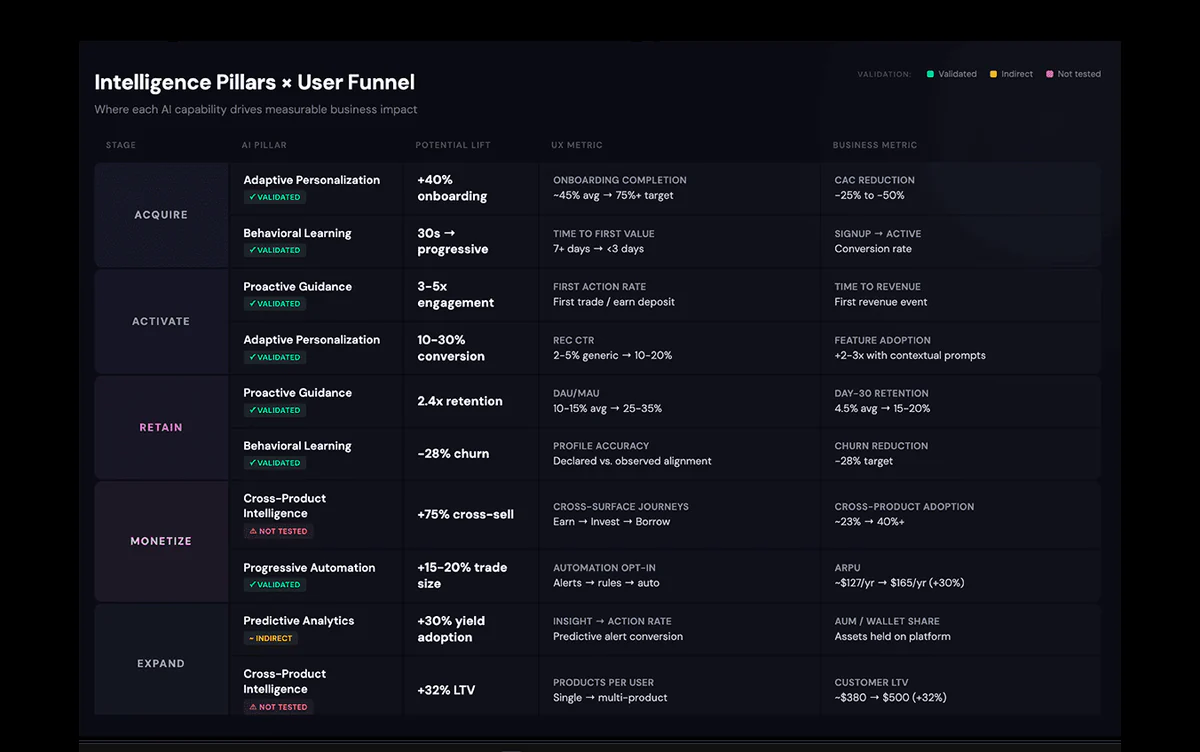
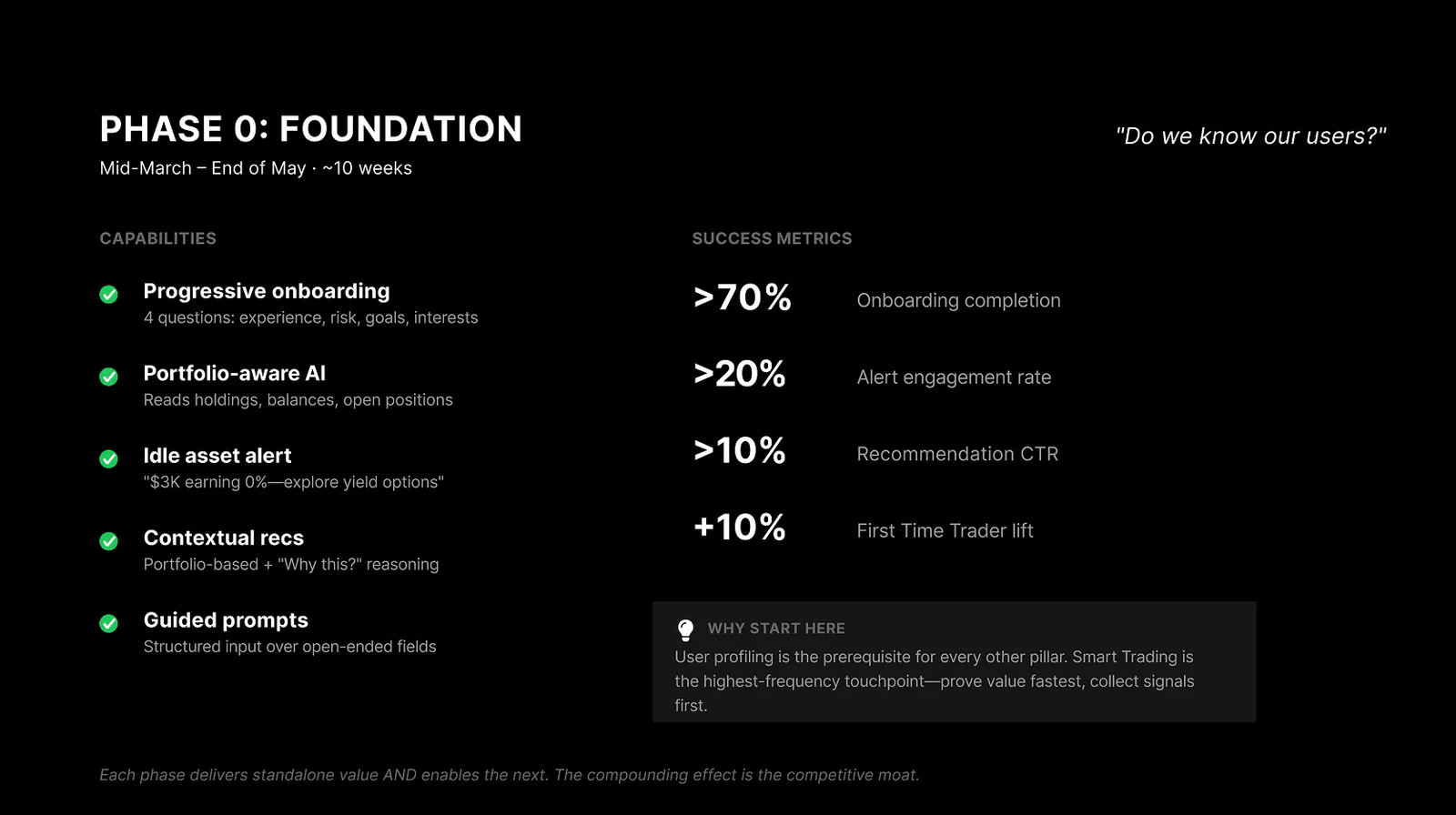
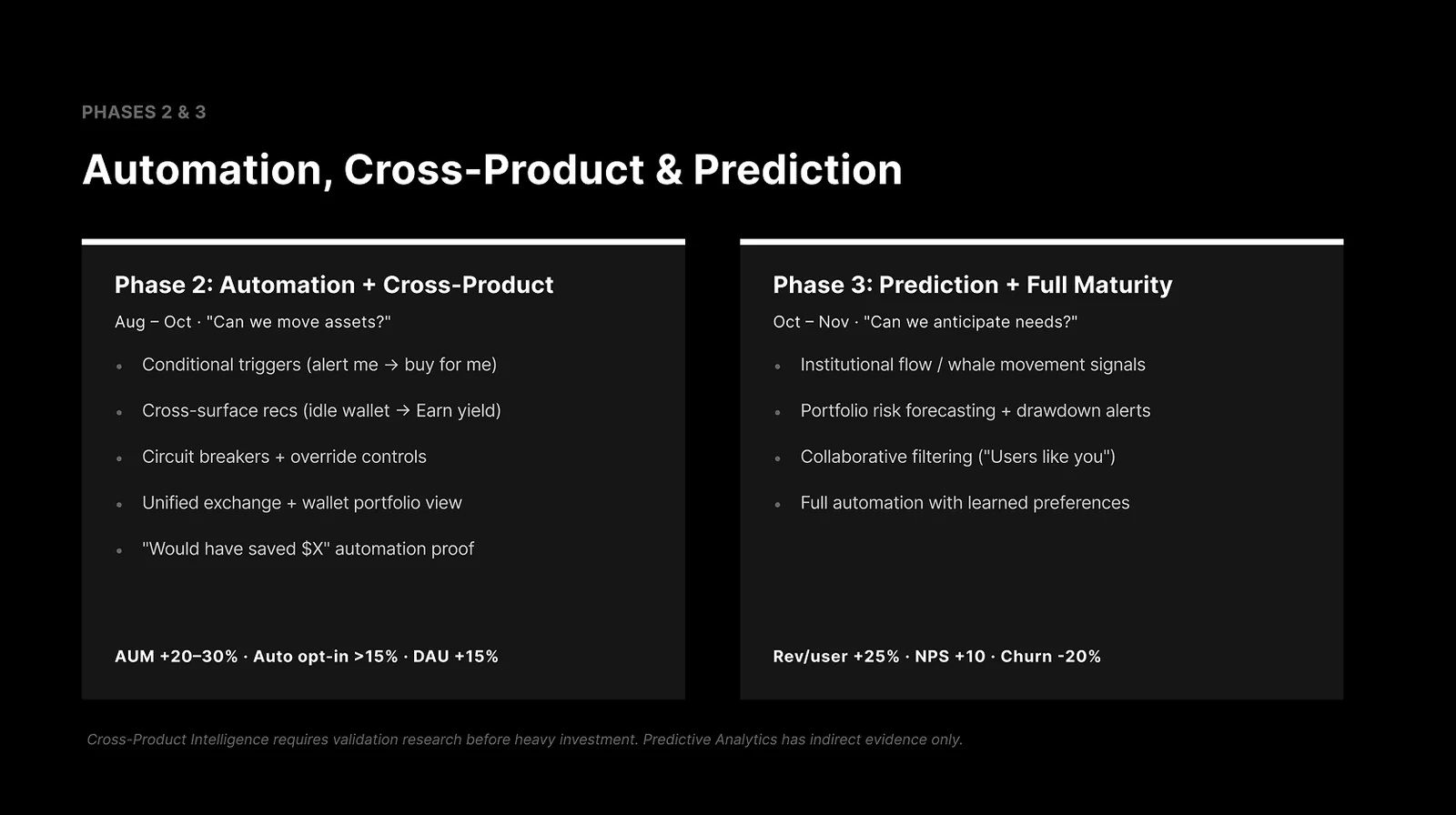
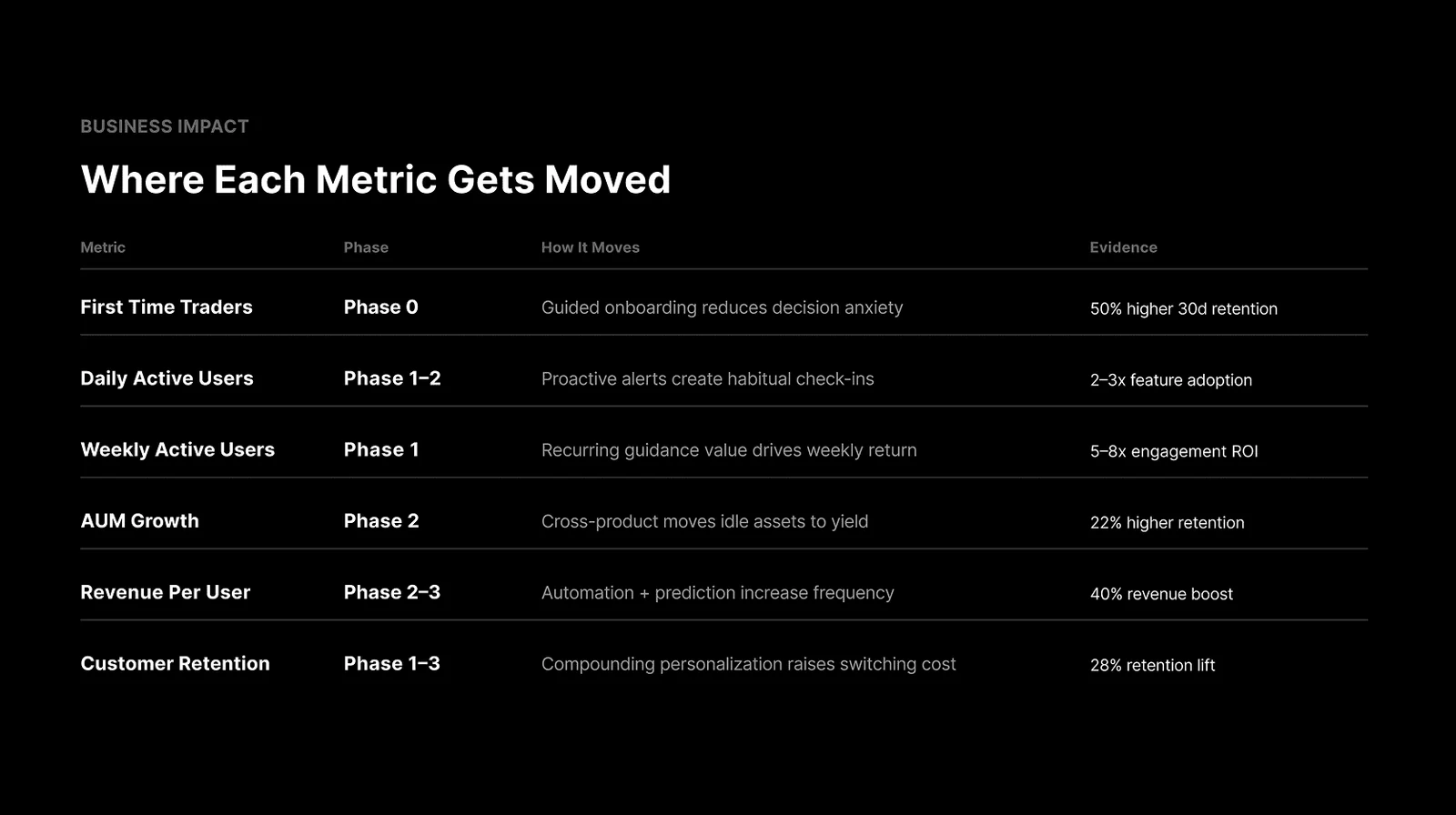
Every AI feature has to map to one of six intelligence pillars — Adaptive Personalization, Proactive Guidance, Predictive Analytics, Progressive Automation, Portfolio Intelligence, Behavioral Learning — otherwise we build the same plumbing twice.
Solution
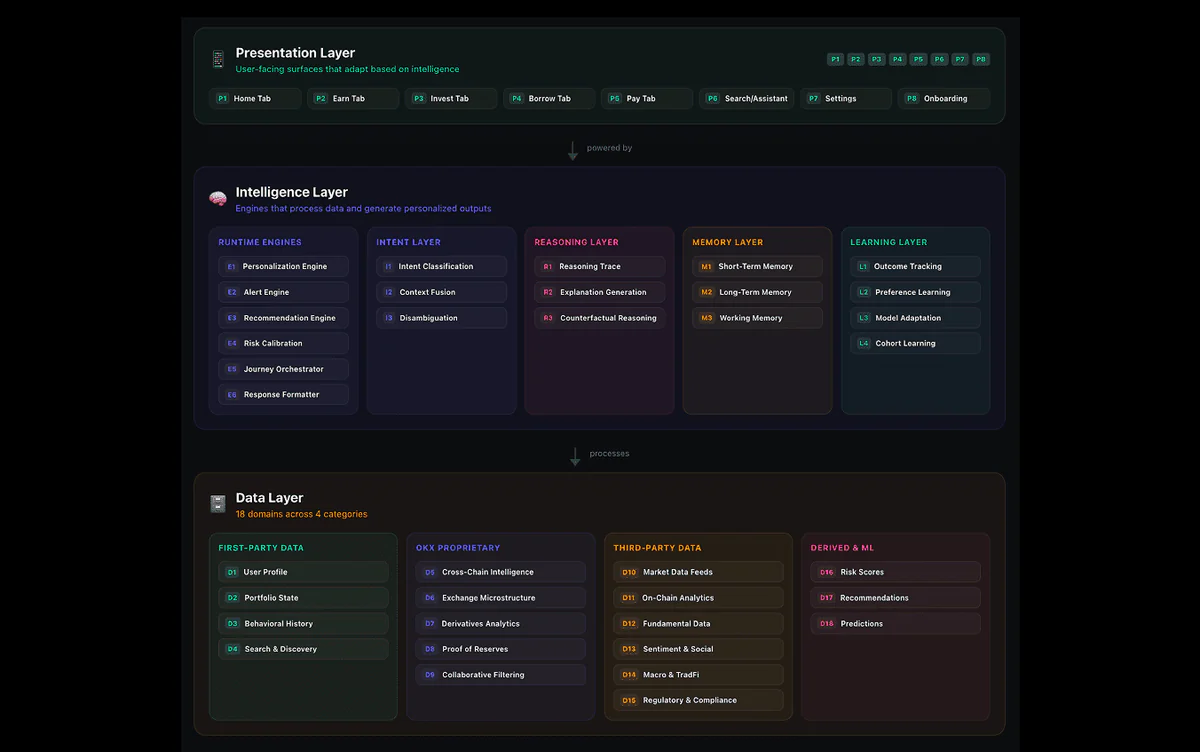
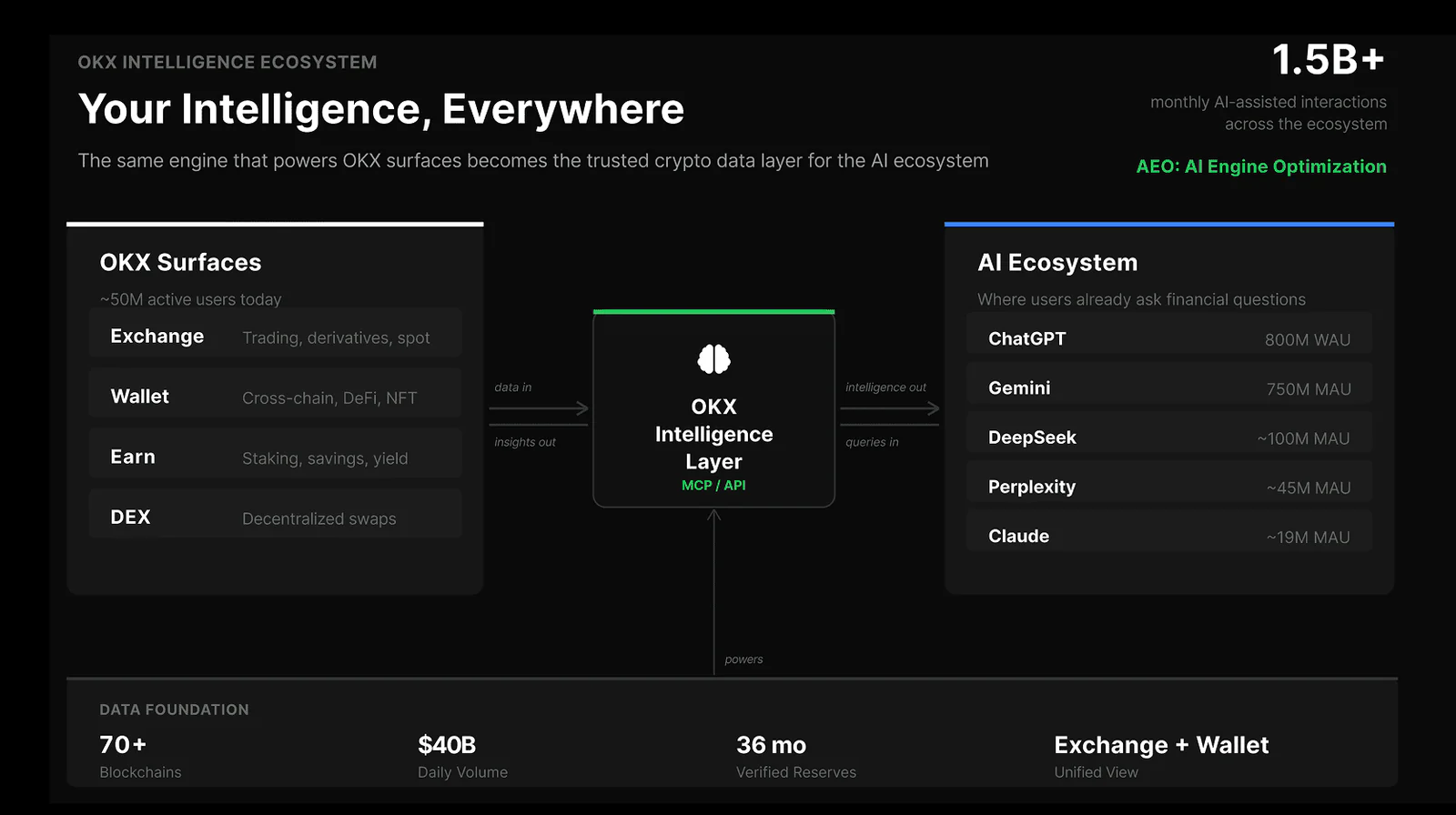
- Data layer — exchange data plus cross-chain wallet data across 70+ blockchains and third-party feeds. One schema.
- Intelligence layer — six runtime engines on an intent / reasoning / memory / learning architecture.
- Presentation layer — eight adaptive surfaces: Home, Earn, Invest, Borrow, Pay, Search, Settings, Onboarding.
Outcome
- 3-layer architecture adopted as OKX’s reference model for every AI feature — AI investment compounds across squads instead of duplicating.
- Repositioned OKX internally: from reactive trading platform to proactive financial intelligence engine.
- The data substrate — exchange data plus 70+ chains of wallet data — is something competitors cannot replicate by writing better prompts.
Exchange mode revamp
Problem
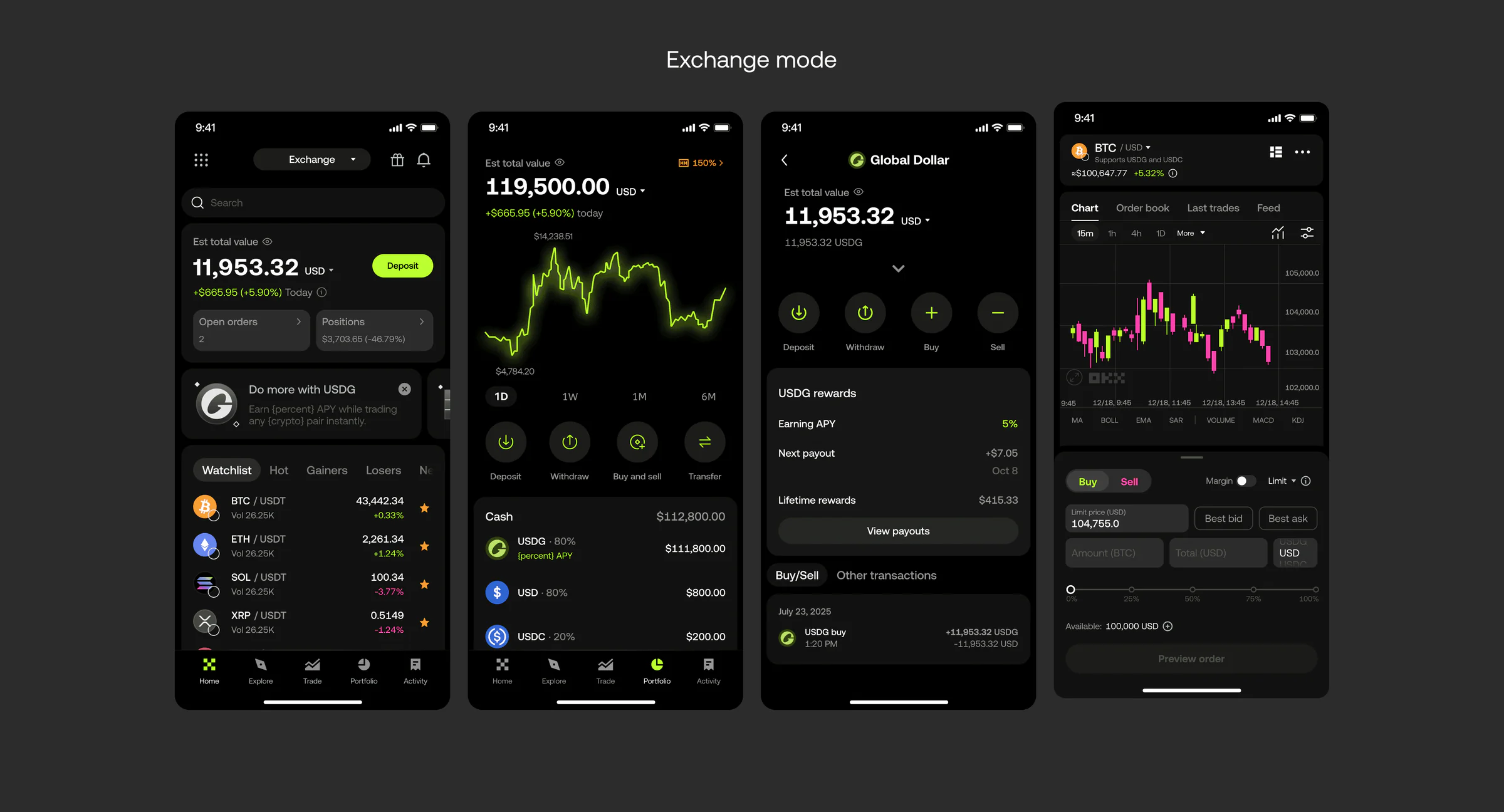
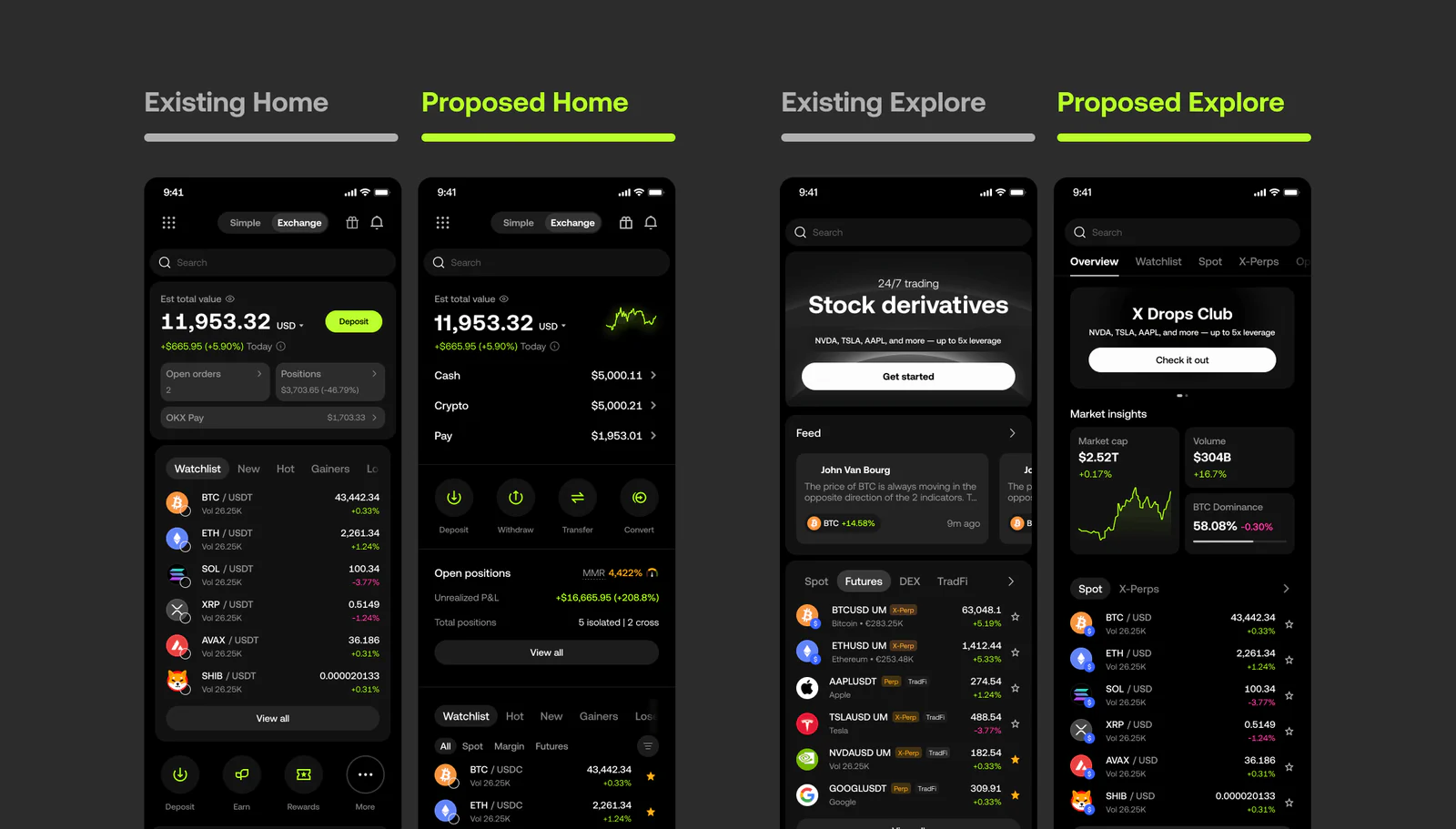
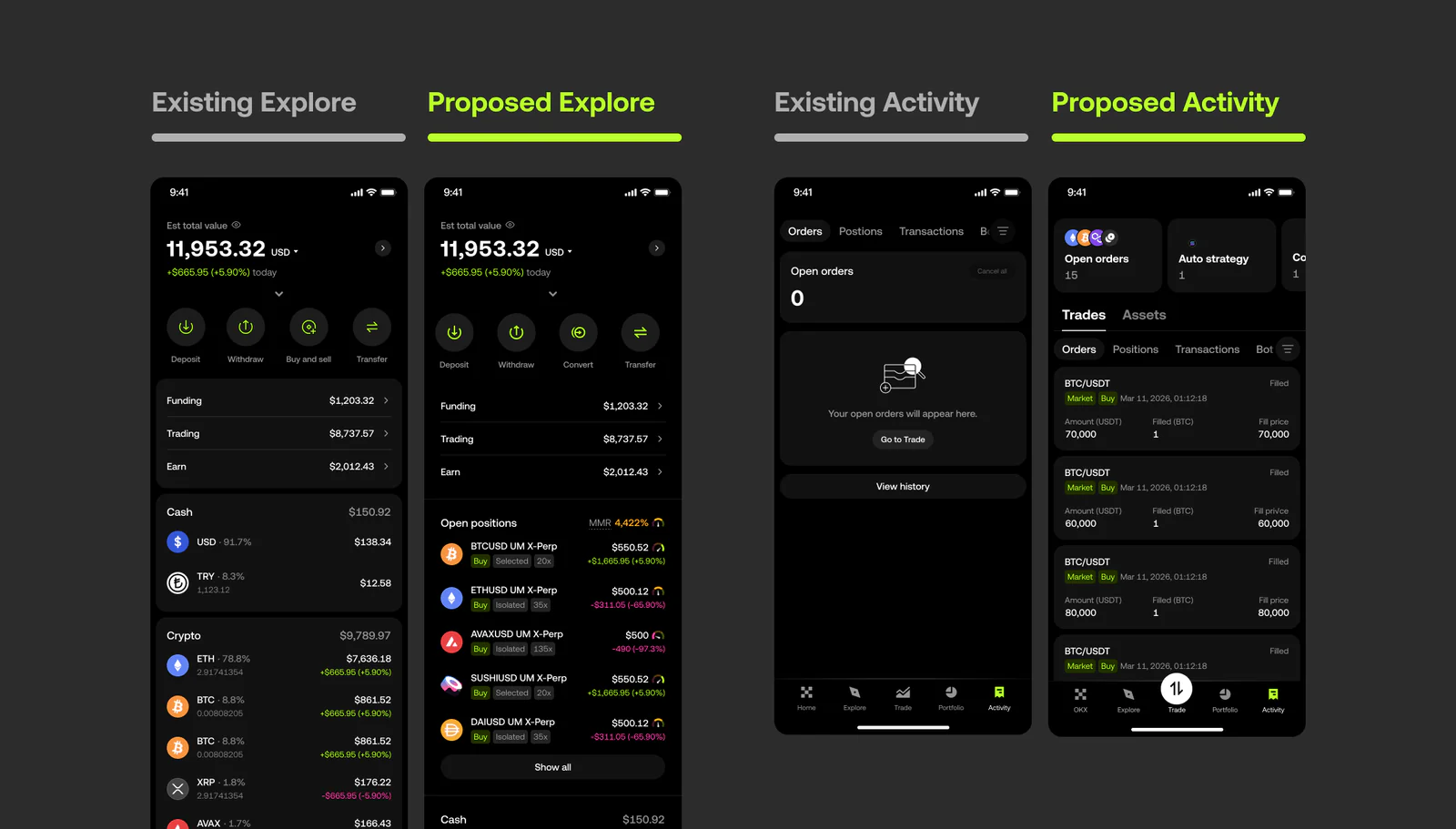
Exchange Mode is the surface 70%+ of mobile users open daily. The five tabs drifted — Home became a campaign dump, Explore lost its job, Trade and Portfolio fell out of sync, Activity flattened into a log.
What I did
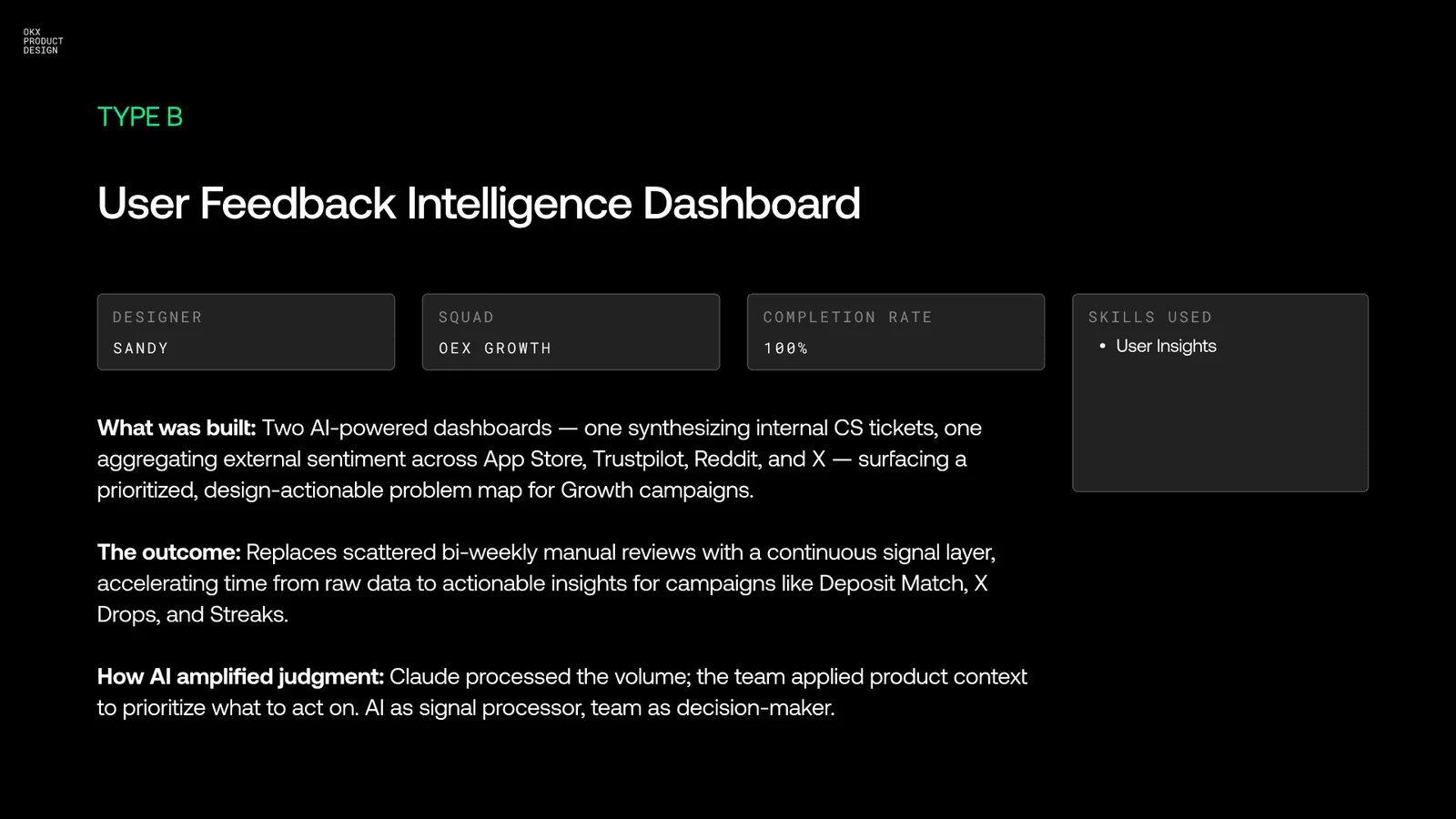
Using the User Feedback Intelligence Dashboard I shipped earlier in the year, I pulled 3,100 active tickets and surfaced 22 prioritized pain points — addressed in one coordinated release, not 22 squad-local fixes.
Outcome
- Projected −35% Exchange Mode tickets within 90 days post-launch.
- “One tab, one job” adopted as the org-wide IA principle for OKX Pay, Earn and Invest revamps.
Design tooling
What I did
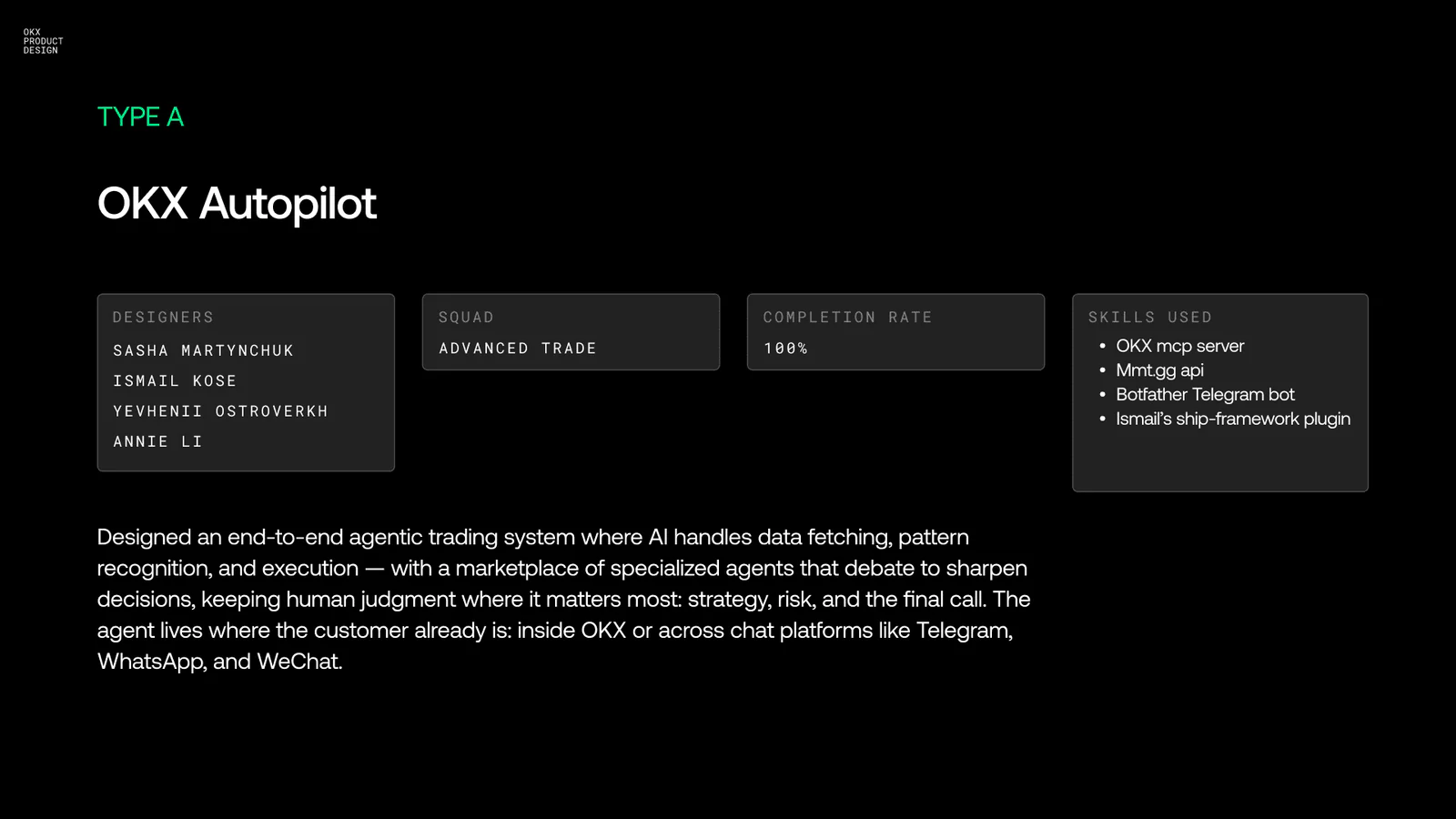
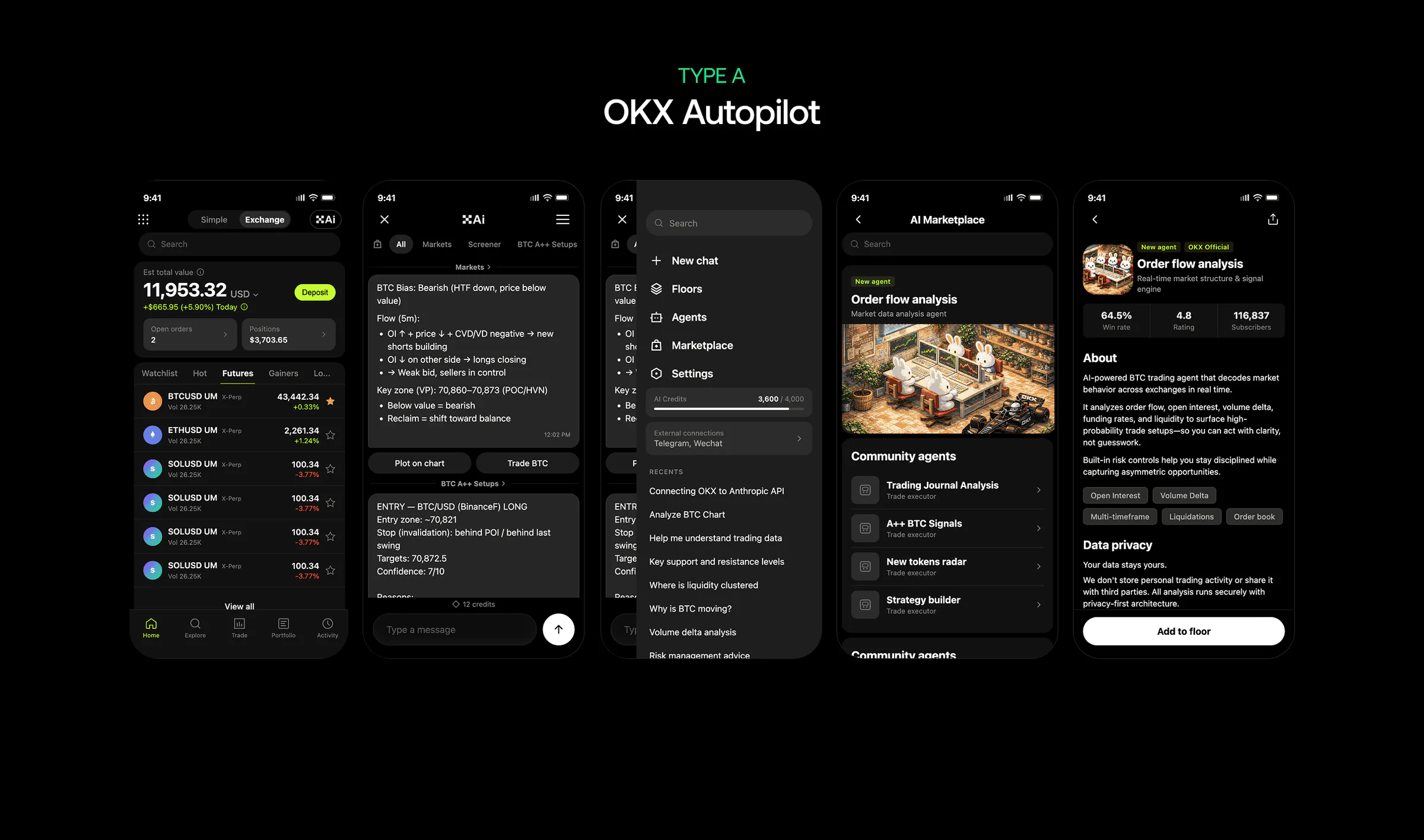
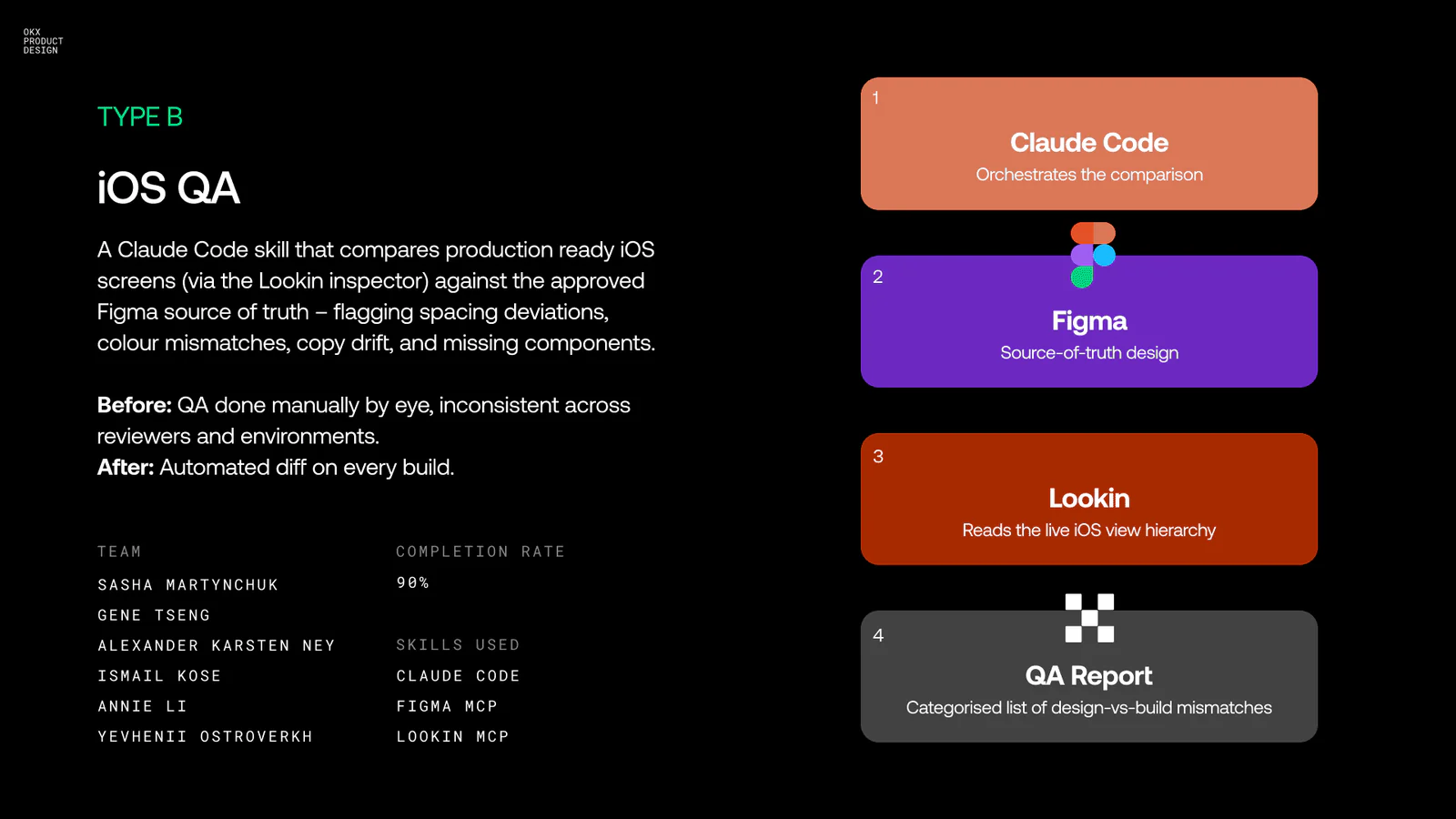
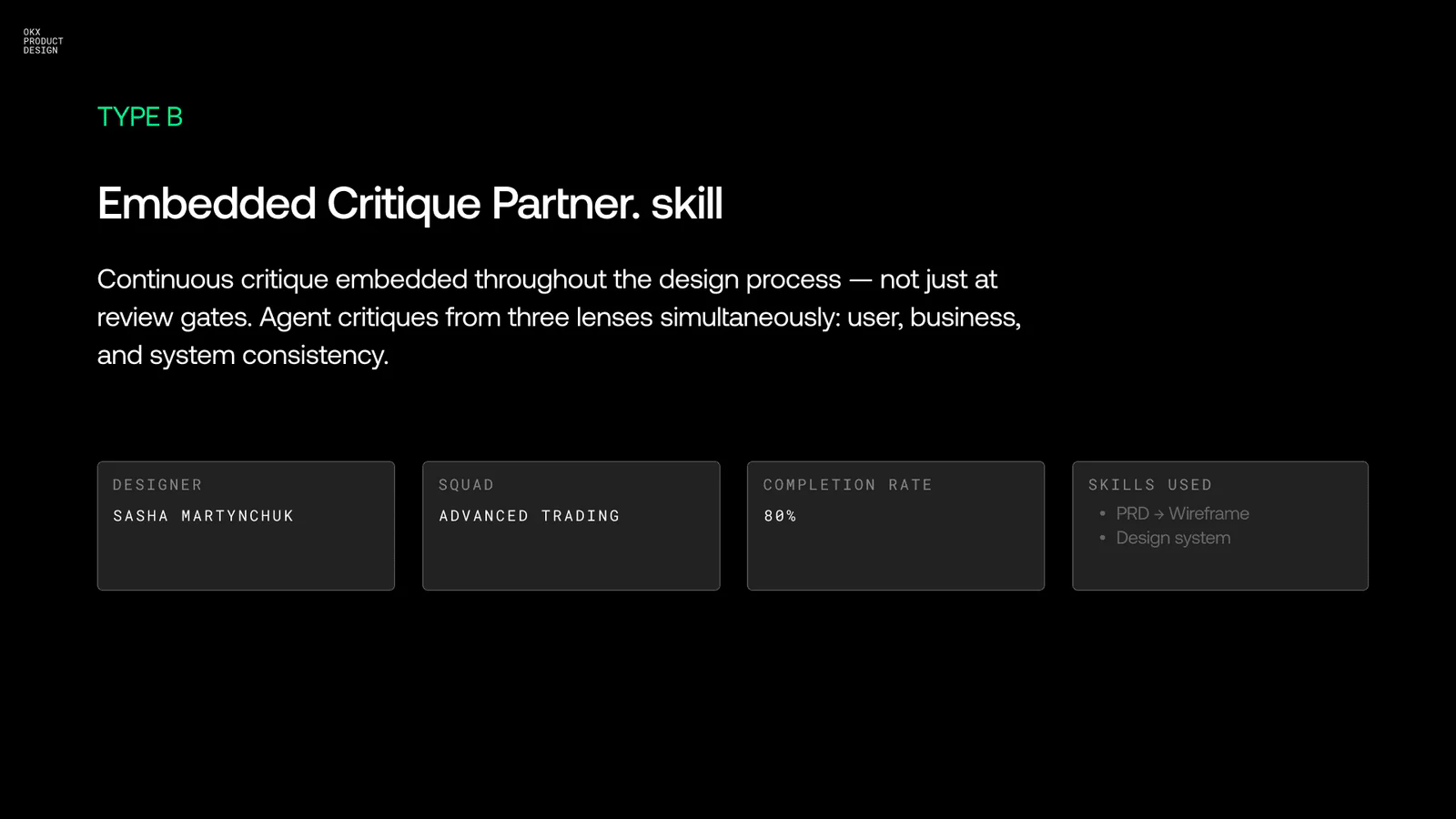
Internal tools built alongside the product work — an agentic trading system, an automated iOS design-QA skill, and an embedded critique partner that reviews from the user, business and system-consistency lenses at once.
Teaching the team how traders think
Problem
Understanding advanced traders from research is one thing. Trading like one is different.
What I did
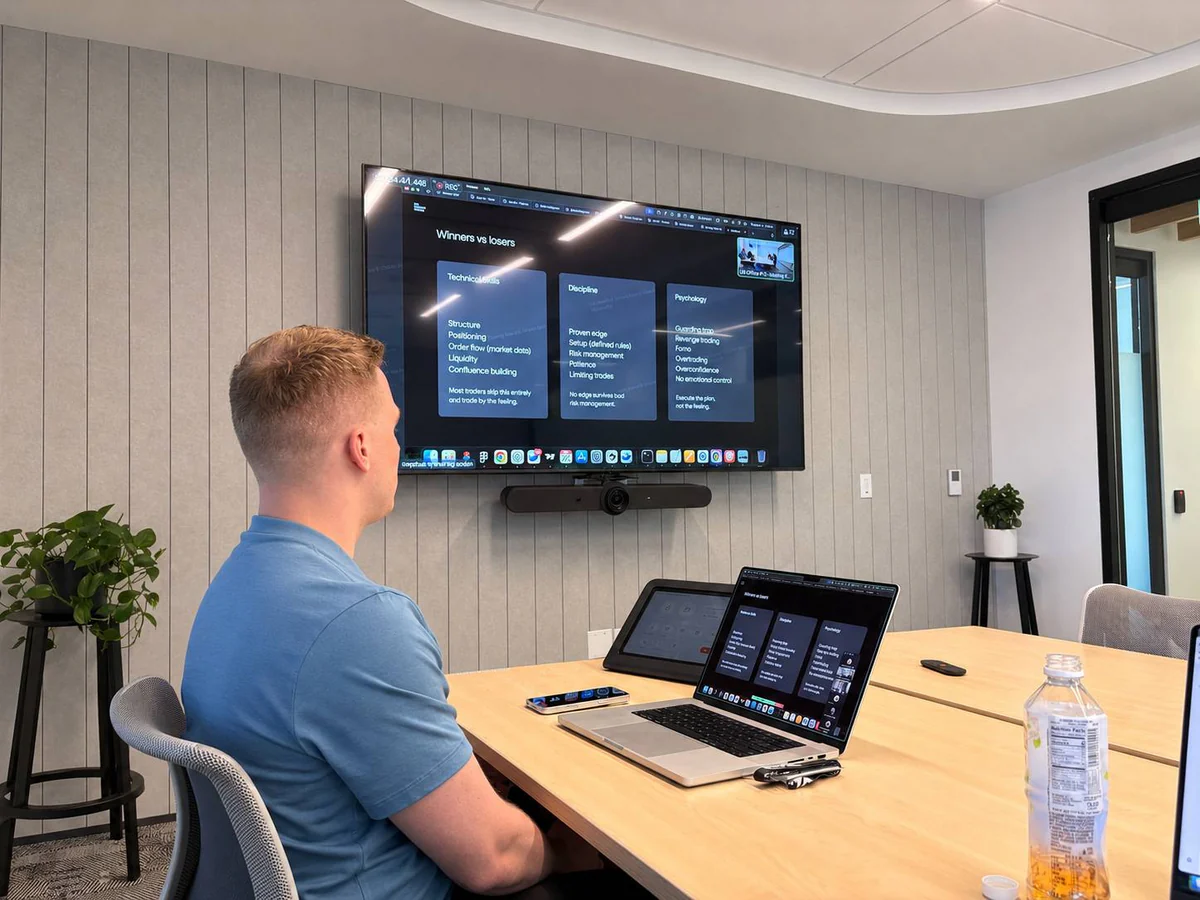
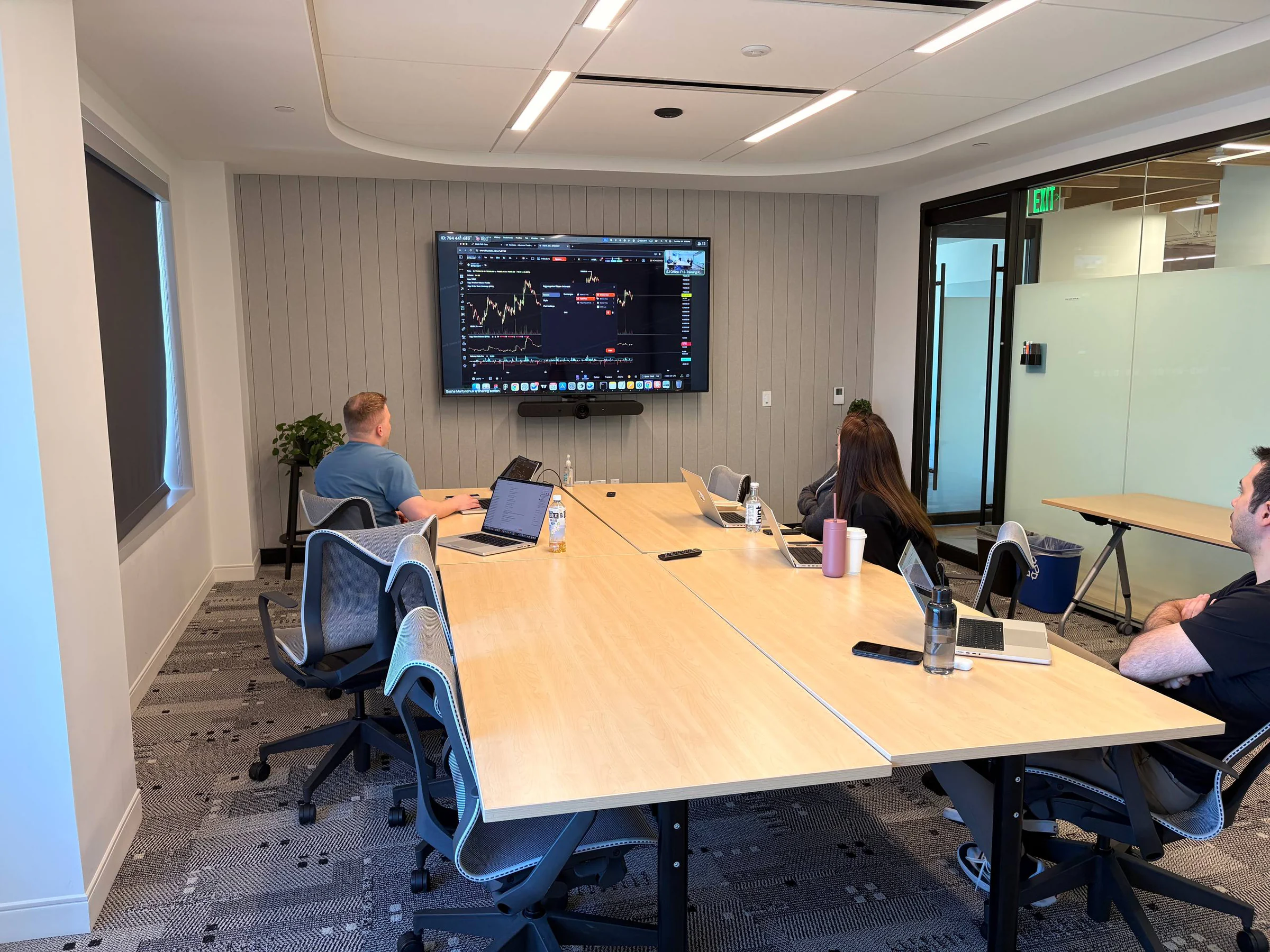
I hosted two hands-on trading masterclasses for our Design, Research and Product teams, to bring them closer to the people we were designing for.
We started with the fundamentals — who moves the market, market structure, price action and liquidity — then went much deeper into how professional traders actually read the market.
Work
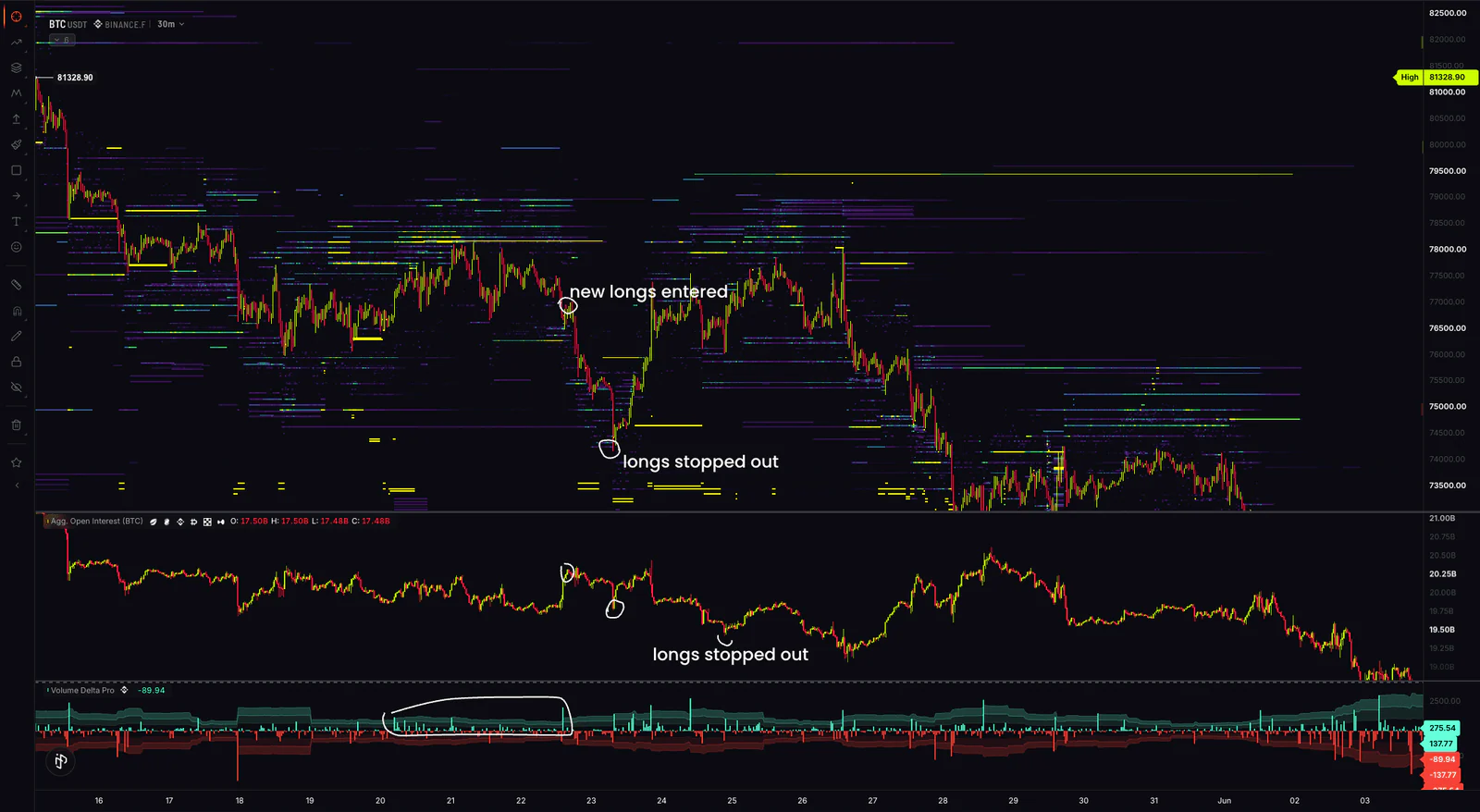
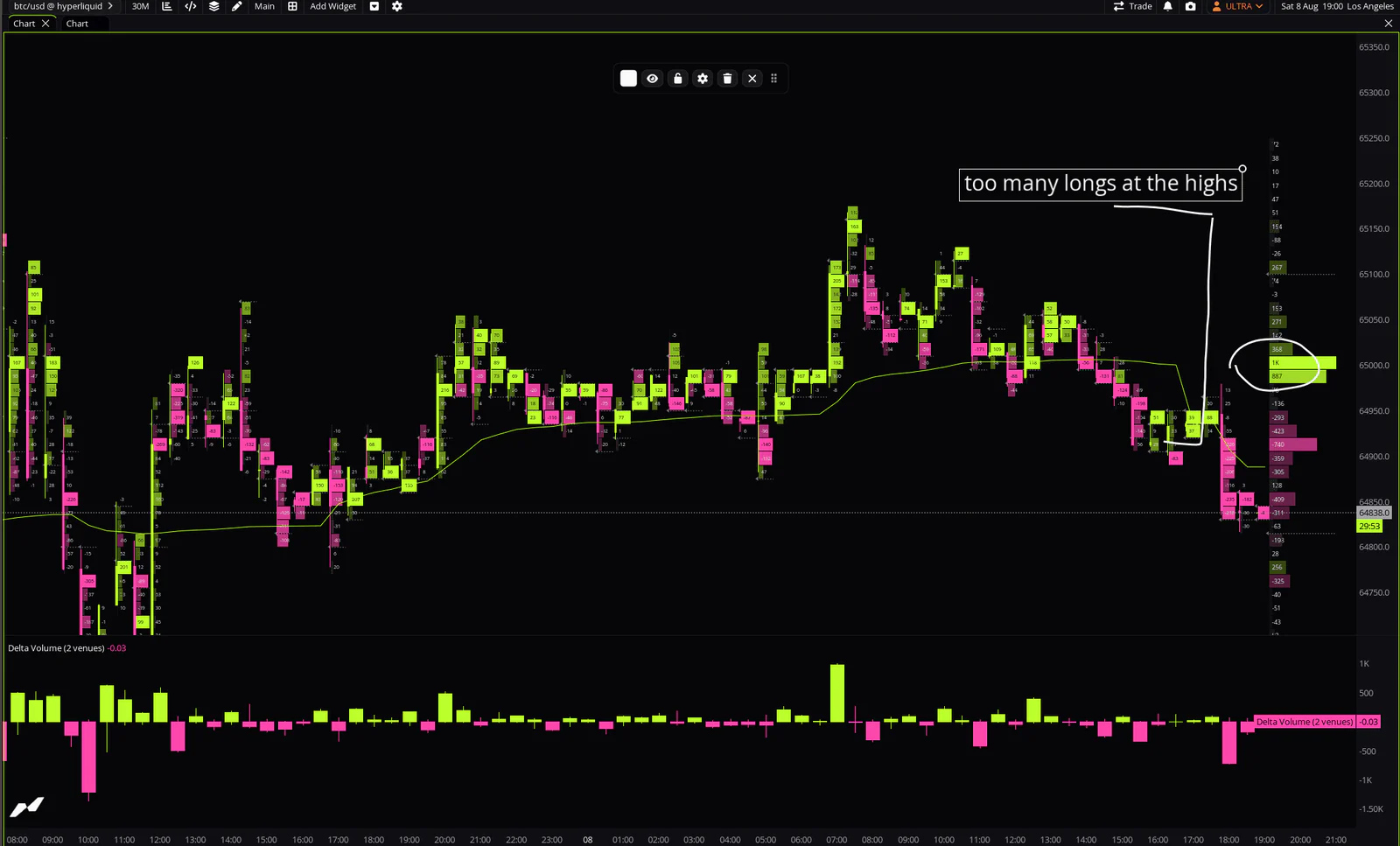
Together we worked with Volume, Open Interest, Footprint Charts, DOM, Order Book Heatmaps, CVD across exchanges and Fibonacci levels, connecting the signals to understand where traders are positioned, where they’re trapped, and where larger players may be entering.
No slides full of personas. We opened the charts and traded together.
Outcome
We ran two sessions, in-person and remote, and the response was amazing. People kept asking questions, experimenting with the tools, and a few teammates even started actively trading afterward — with some surprisingly good results.
For me it became another way to bring the team closer to our users: don’t just study how traders work — experience it.